
Disaster and climate risk insurance: parametric cover in India
Why in news: A June 2026 CETEx policy brief urged India to scale up parametric insurance, after early-stage talks on a nationwide scheme were reported in October 2025.
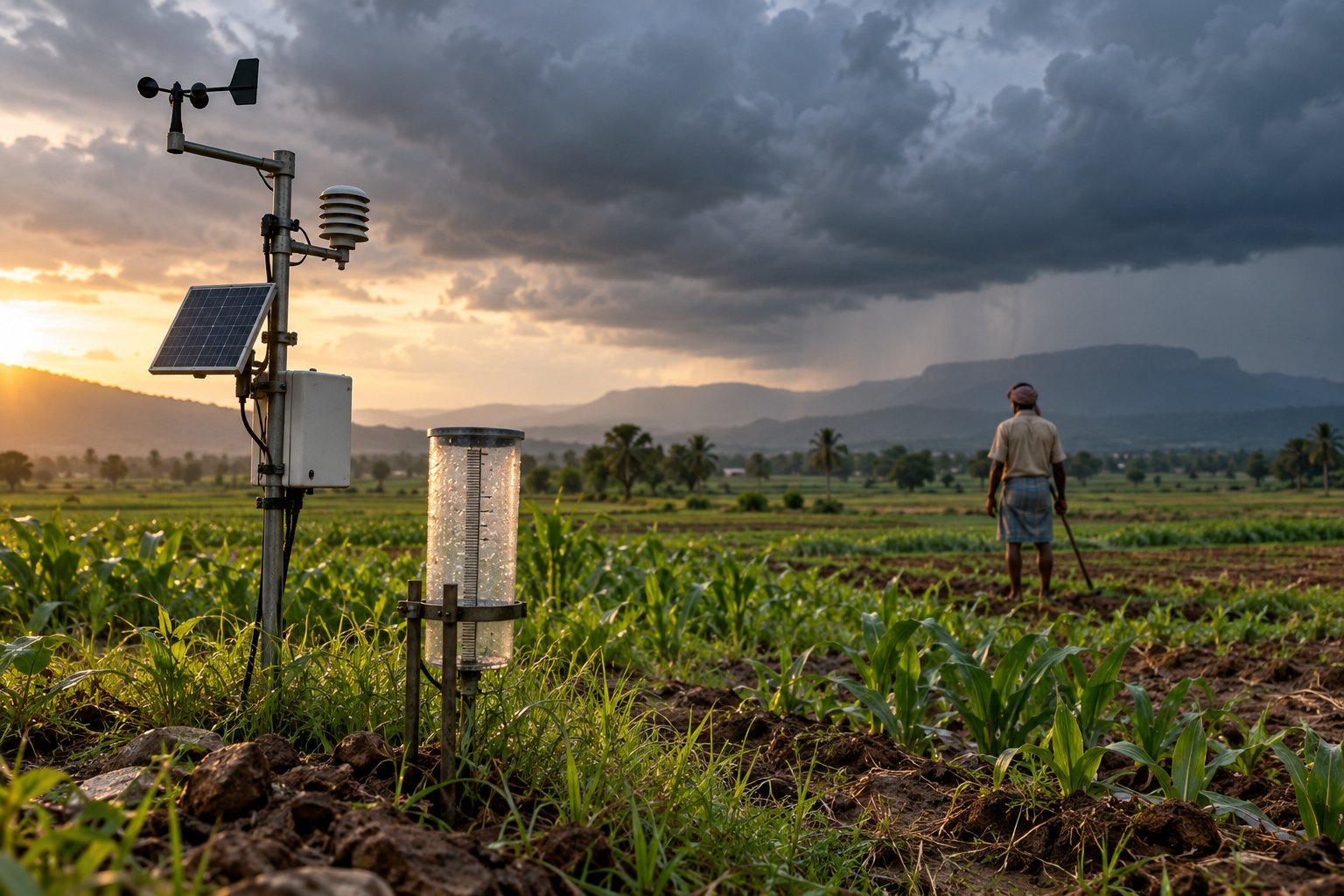
Parametric insurance pays a pre-agreed sum once a measured index, such as rainfall or temperature, crosses a set trigger, without surveying each loss. India applies it in weather-index crop cover and Nagaland's State-wide rainfall policy, and the XV Finance Commission proposed wider risk pools. A June 2026 policy brief urged scaling it up nationally.
Syllabus: GS3 · Agriculture & Irrigation; Prelims · Environment & Ecology; GS3 · Disaster Management
Why this matters for UPSC
GS III disaster management and agriculture: Prelims can ask how parametric insurance and basis risk work, what the 2020 RWBCIS revamp changed and which body runs CCRIF or ARC; Mains, how insurance can supplement SDRF and NDRF.
In short
Disaster and climate risk insurance shifts the cost of natural hazards from households and governments to insurers; parametric cover pays automatically once a measured index crosses a pre-set trigger.
Parametric cover makes relief faster and budgets steadier; local data, affordable premiums and national pooling must keep basis risk from eroding trust.
Why it matters
When a flood or heatwave strikes, a small farmer or a daily-wage worker needs cash in days, not after a year of surveys. Government relief is often slow and small, and most disaster losses in India carry no insurance at all, so families sell assets or borrow from moneylenders to recover. A policy that pays automatically on a rainfall or temperature reading can keep food on the table and let a State rebuild roads without raiding other budgets. The catch is fairness: if the trigger is set badly, the hardest-hit village may get nothing. As climate change makes extreme weather more frequent, how India shares this risk between citizens, States, the Union and global markets becomes a central question of public finance.
Prelims pointers
- The 2020 revamp of PMFBY and RWBCIS capped central premium subsidy at premium rates of 30% for unirrigated and 25% for irrigated areas.
- States may add optional covers to these crop schemes: prevented sowing, localised calamity, mid-season adversity and post-harvest losses (2020 Cabinet decision).
- A Finance Commission is constituted under Article 280(1) every fifth year or earlier; the XV Finance Commission's award ran six years, to 31 March 2026.
- The XV Finance Commission left hazards recurring every five to ten years to SDRF and NDRF, and ten-to-hundred-year hazards to insurance or catastrophe bonds.
- The Sendai Framework for Disaster Risk Reduction 2015-2030, adopted on 18 March 2015, sets seven global targets and four priorities; it succeeded the Hyogo Framework.
- CCRIF SPC, operating since 2007 and registered in the Cayman Islands, calls itself the world's first multi-country, multi-peril parametric risk pool.
- The African Risk Capacity is a specialised agency of the African Union, founded in 2012; SEADRIF is a regional platform for ASEAN members.
- The second point of the Prime Minister's Ten Point Agenda on Disaster Risk Reduction (2016) seeks risk coverage for all, from poor households to nation states.
Practise a UPSC-style question
With reference to parametric insurance, consider the following statements:
1. Negative basis risk arises when the insured suffers a real loss but the index stays below the payout trigger.
2. A payout is released once an objective measure such as rainfall crosses a pre-set threshold, without assessing each claimant's loss.
Which of the statements given above is/are correct?
- (a) 1 only
- (b) 2 only
- (c) Both 1 and 2
- (d) Neither 1 nor 2
Show the answer
Answer: (c) Both 1 and 2
Answer: (c) Both 1 and 2. Both describe how an index-based policy pays and where it fails.
Statement 1: correct. Basis risk is the gap between index and actual loss; the negative kind leaves a real loss unpaid because the trigger was not met.
Statement 2: correct. Parametric cover pays a pre-agreed sum when a measured index crosses its threshold; no loss survey is needed.
Eliminate: Judge statement 2 first: paying on an index without loss assessment is the defining feature, so statement 2 is correct. Out: (a), (d).
Eliminate: Statement 1 is the standard meaning of negative basis risk, so it is correct. Out: (b).
Trap: Reversed direction. A student who confuses parametric and indemnity cover may think payouts follow a loss assessment and reject statement 2.
Remember: Parametric pays on the index, not the loss; basis risk is the gap between the two.
More Explainers
- State Legislative Councils: Articles 168-172 and the graduates' and teachers' seats Polity
- Whales and dolphins in Indian waters: legal protection, IUCN status and strandings Environment
- The Aligarh Movement, AMU and the Article 30 minority test Polity
- Environmental clearance by States: SEIAA, SEAC and the EIA Notification, 2006 Environment
- Software vulnerabilities: CVE, CVSS, coordinated disclosure and CERT-In's role Sci-Tech
- Drug trafficking law in India: NDPS Act, PIT-NDPS, NCB and NCORD National
- Choosing the UN Secretary-General: Article 97, UNSC veto and straw polls World & IR
- UN Convention against Torture, and why India has not ratified it Polity
- NavIC: why India's navigation constellation cannot give a standalone position Sci-Tech
- International Energy Agency: membership, 90-day oil stocks and India's status World & IR
- PM Surya Ghar: Muft Bijli Yojana and the rooftop solar subsidy Economy
- HFSS foods: FSSAI's draft limits and front-of-pack warning labels National