
Defence self-reliance: DAC, DAP 2020, indigenisation lists and corridors
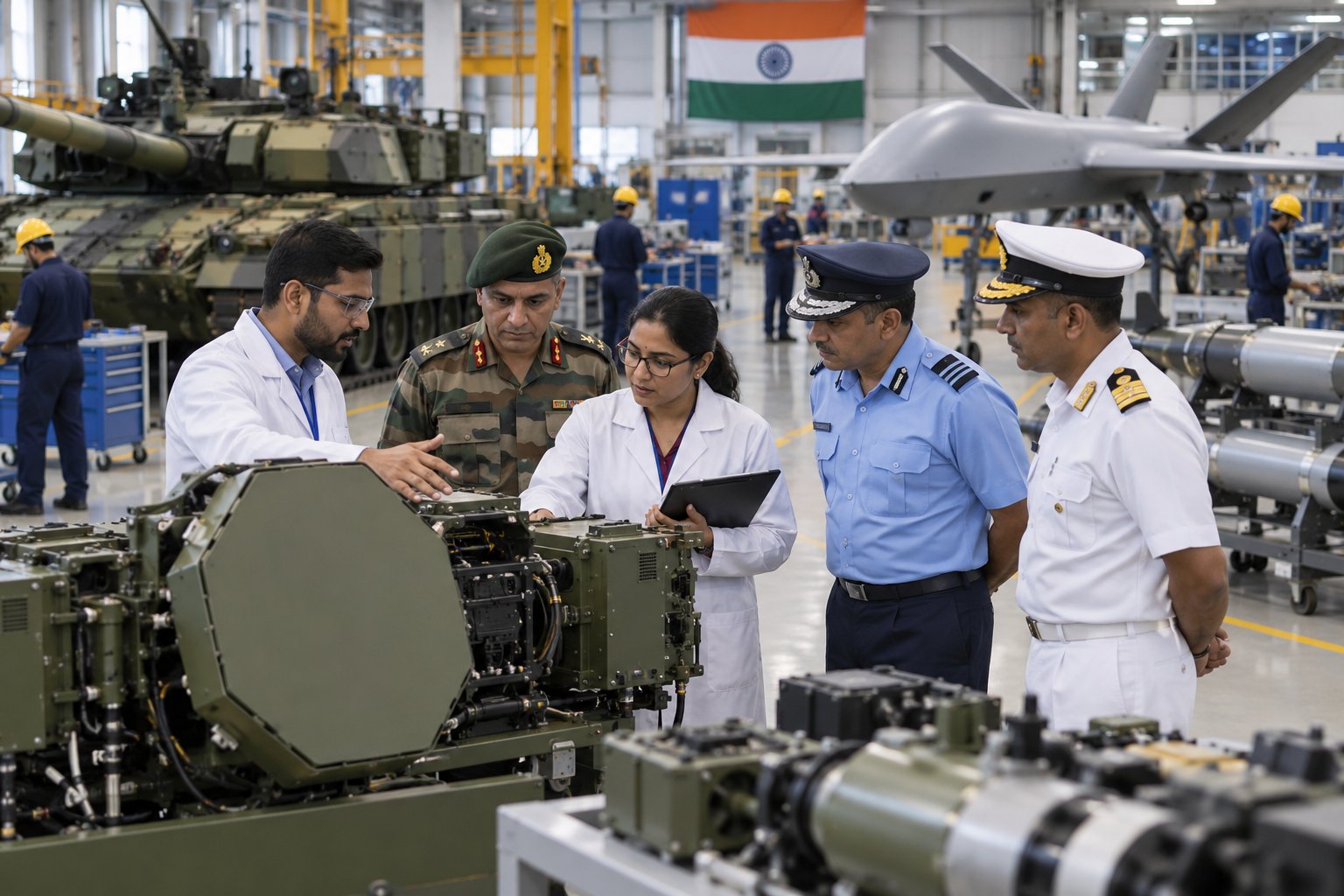
India's drive for defence self-reliance rests on buying Indian first: the Defence Acquisition Procedure 2020 ranks indigenously designed equipment highest, positive indigenisation lists end imports of notified items after set dates, and iDEX and the Technology Development Fund back new technology. Defence production reached a record ₹1.78 lakh crore in 2025-26, the Government said on 14 August 2026.
Syllabus: Prelims · Current Affairs & IR; GS3 · Liberalisation & Industry; GS3 · Indian Achievements in S&T
In short
Defence self-reliance under Atmanirbhar Bharat means making the forces' weapons and spares at home so wartime supply never hinges on foreign vendors; cost and quality are the risks.
Buying Indian should stay the rule, but competition and independent testing must keep it honest, or the forces risk late, costly systems.
Why it matters
For a soldier on the border, self-reliance means shells and spares that keep coming from Indian factories even if a foreign supplier halts deliveries in a crisis; the Government says the Army now makes 159 of its 175 ammunition types at home. For a small engineering firm in Coimbatore or Kanpur, the positive lists and iDEX grants create an assured buyer for parts that were once imported. The larger issue is strategic autonomy: a country that imports its main weapons can be pressed by its suppliers. The risk is cost and quality, because a protected market can yield costlier, slower systems unless competition and testing stay strict.
Prelims pointers
- Defence Acquisition Council: chaired by the Defence Minister; set up in 2001 after the Group of Ministers' report on reforming the national security system; grants Acceptance of Necessity.
- DAP 2020: in force from 1 October 2020; Buy (Indian-IDDM) is the top category, needing at least 50% indigenous content; it added leasing as a mode of acquisition.
- Positive indigenisation lists: notified by the Ministry of Defence's Department of Military Affairs and Department of Defence Production; listed items are bought only from Indian sources after set timelines.
- iDEX (Innovations for Defence Excellence): run by the Defence Innovation Organisation, a Section 8 not-for-profit company of HAL and BEL; ADITI extends it to deep tech.
- Technology Development Fund: run by DRDO; grants up to ₹50 crore to Indian industry, including MSMEs and start-ups, to develop defence technology.
- Defence Industrial Corridors: Uttar Pradesh nodes Agra, Aligarh, Chitrakoot, Jhansi, Kanpur, Lucknow; Tamil Nadu nodes Chennai, Coimbatore, Hosur, Salem, Tiruchirappalli.
- FDI in defence: up to 74% through the automatic route since 2020; up to 100% through the government route.
- Commissioned together at Mumbai on 15 January 2025: INS Surat (last Project 15B destroyer), INS Nilgiri (first Project 17A frigate), INS Vaghsheer (sixth and last Project 75 Scorpene submarine).
Practise a UPSC-style question
With reference to the Defence Acquisition Council, consider the following statements:
1. It is chaired by the Chief of Defence Staff.
2. It grants Acceptance of Necessity, the first step in a capital acquisition.
3. It was set up on the recommendations of the Group of Ministers that reviewed the national security system after Kargil.
Which of the statements given above is/are correct?
- (a) 1 and 2 only
- (b) 2 and 3 only
- (c) 1 and 3 only
- (d) 1, 2 and 3
Show the answer
Answer: (b) 2 and 3 only
1 is incorrect: the Defence Acquisition Council is chaired by the Defence Minister; the Chief of Defence Staff is a member. 2 is correct: Acceptance of Necessity, the first formal step of a capital acquisition, is granted by the DAC for major purchases, with smaller cases delegated to lower boards. 3 is correct: the DAC was set up in 2001 following the Group of Ministers' report on reforming the national security system after the Kargil conflict.
In the news
More Explainers
- State Legislative Councils: Articles 168-172 and the graduates' and teachers' seats Polity
- Whales and dolphins in Indian waters: legal protection, IUCN status and strandings Environment
- The Aligarh Movement, AMU and the Article 30 minority test Polity
- Environmental clearance by States: SEIAA, SEAC and the EIA Notification, 2006 Environment
- Software vulnerabilities: CVE, CVSS, coordinated disclosure and CERT-In's role Sci-Tech
- Drug trafficking law in India: NDPS Act, PIT-NDPS, NCB and NCORD National
- Choosing the UN Secretary-General: Article 97, UNSC veto and straw polls World & IR
- UN Convention against Torture, and why India has not ratified it Polity
- NavIC: why India's navigation constellation cannot give a standalone position Sci-Tech
- International Energy Agency: membership, 90-day oil stocks and India's status World & IR
- PM Surya Ghar: Muft Bijli Yojana and the rooftop solar subsidy Economy
- HFSS foods: FSSAI's draft limits and front-of-pack warning labels National