
Counter-drone air defence: MoD signs BEL contract for LLLR-I low-level radars
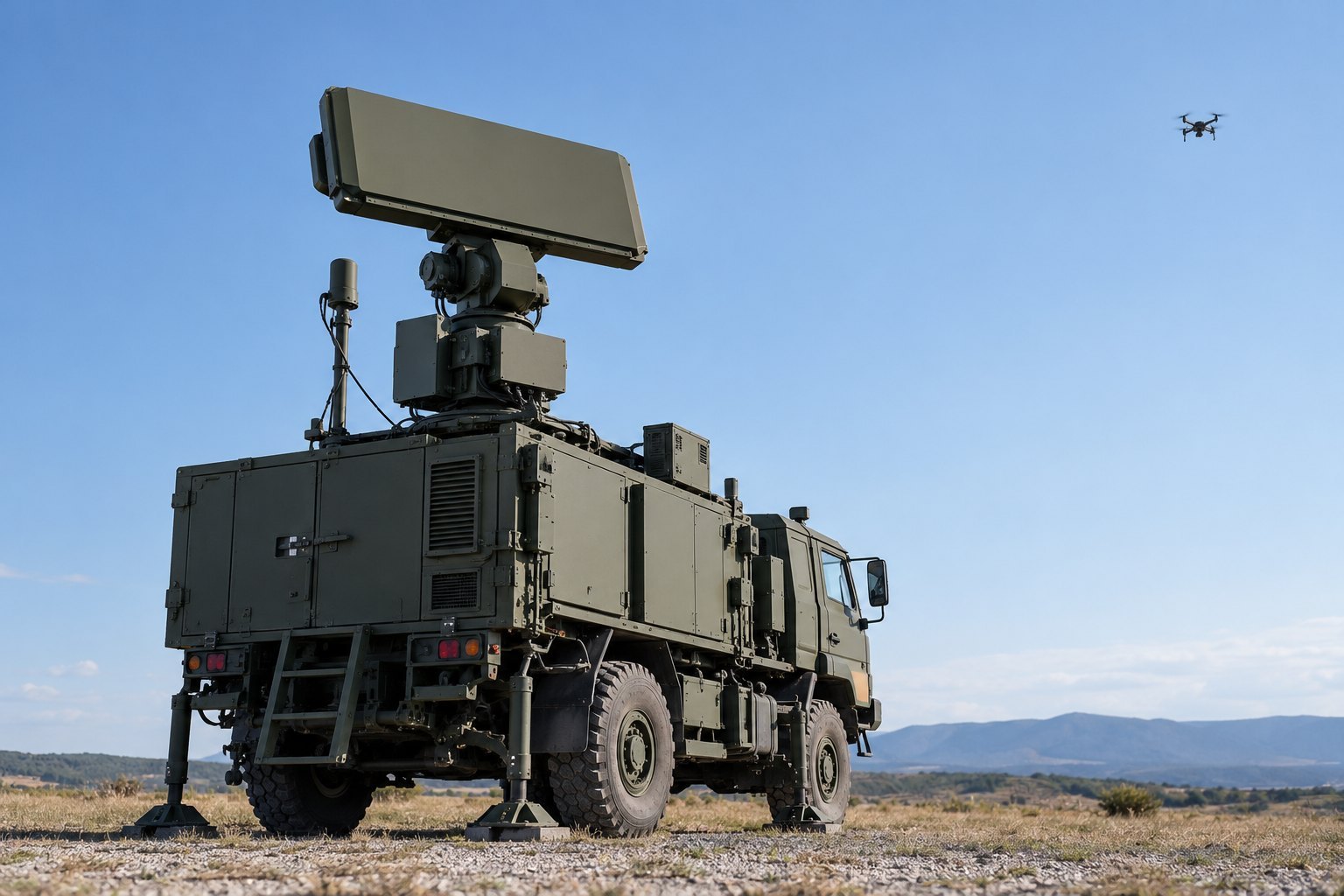
The Ministry of Defence on 21 October 2026 signed a contract worth about Rs 770 crore with Bharat Electronics Limited (BEL) for Improved Low Level Light Weight Radars (LLLR-I) for the Army. The Ministry says the radar detects and tracks fighter-size targets and mini and micro drones and prioritises aerial threats, to counter unmanned aerial systems.
Syllabus: Prelims · Science & Technology; GS3 · Science & Technology; GS3 · Indian Achievements in S&T
Why this matters for UPSC
GS3 security and science and technology: counter-drone air defence. Prelims can ask how AESA and pulse-Doppler radars work, what radar cross-section means and what Akashteer is; Mains, how India should meet the drone threat and build defence electronics at home.
Why it matters
For a soldier at a forward post, a small drone, or a swarm of drones, carrying a camera or explosives is a growing threat: it is cheap, flies low and has a tiny radar cross-section, reflecting almost no radar energy, so radars built to watch for jets can miss it. A radar that picks it up early gives the guns and jammers the seconds they need to stop it before it reaches a post, a depot or a camp. The order also keeps defence electronics work in India, including for small suppliers. The larger question is whether India can design and make the sensors its air defence depends on, down to the chips inside them, rather than buy them abroad.
Prelims pointers
- 3D radar: measures a target's range, azimuth (bearing) and elevation, so it fixes height too; BEL's drone-detection radar uses them to cue electro-optical and laser systems.
- Akashteer: supplied by BEL under a Rs 1,982 crore Ministry of Defence contract of March 2023; it links with the IAF's IACCS and the Navy's Trigun.
- Ashwini (LLTR): the IAF's low-level transportable AESA radar, designed by DRDO's Electronics & Radar Development Establishment (LRDE) and produced by BEL.
- Naval Anti-Drone System (NADS): first indigenously developed anti-drone system for the armed forces, contracted by the Navy in 2021; DRDO-developed, BEL-made; jams drones or kills them by laser.
- Drone Rules, 2021 (Ministry of Civil Aviation) classify drones by all-up weight: nano to 250 g, micro to 2 kg, small to 25 kg, medium to 150 kg, large above.
- DAP 2020 order of priority: Buy (Indian-IDDM) first, then Buy (Indian); Buy (Indian) needs 60% indigenous content, or 50% with an indigenous design.
- Third Positive Indigenisation List (April 2022): hand-held, hard-kill and soft-kill counter-drone systems are among items to be bought only from Indian sources.
- GaN components for defence were almost all imported as of December 2023, their export restricted by many countries, per the Ministry of Defence.
Practise a UPSC-style question
With reference to radar technology, consider the following statements:
1. An active electronically scanned array radar steers its beam electronically, so its antenna need not rotate.
2. A pulse-Doppler radar uses the frequency shift of echoes to separate moving targets from stationary ground clutter.
3. A three-dimensional surveillance radar gives a target's elevation as well as its range and azimuth.
Which of the statements given above is/are correct?
- (a) 1 and 2 only
- (b) 2 and 3 only
- (c) 1 and 3 only
- (d) 1, 2 and 3
Show the answer
Answer: (d) 1, 2 and 3
Answer: (d) 1, 2 and 3. All three describe how a modern surveillance radar like BEL's LLLR(I) works.
Statement 1: correct. An AESA forms and steers its beam electronically; BEL's LLLR(I) has four fixed panels covering 360 degrees with no moving parts.
Statement 2: correct. The Doppler shift of an echo gives the target's radial speed, so a moving drone stands out from still ground returns.
Statement 3: correct. A 3D radar measures range, azimuth and elevation, which is how it fixes a target's height.
Eliminate: Statement 2 is correct, so options without it fail. Out: (c).
Eliminate: Statements 1 and 3 are also correct. Out: (a), (b).
Trap: Sounds right. A student may assume every radar has a rotating dish and reject statement 1, though AESA panels stay fixed.
Remember: AESA steers electronically; pulse-Doppler reads speed from frequency shift; 3D adds height to range and bearing.
Explainers on this topic
More from the 22 October 2026 edition
- Tamil Nadu orders State-wide rainwater harvesting drive as a mass movement Environment
- Bihar relaxes VB-G RAM G farm-season pause for 38 disaster-hit districts National
- PARAKH turns PRS 2024 learning gaps into monthly district action National
- UNEP Emissions Gap Report 2026: 1.5°C without overshoot is lost Environment
- Vienna Conventions: India presses mission protection at UN Sixth Committee World & IR
- India tells UN Third Committee its safeguards against enforced disappearance World & IR
- India reiterates call for binding PAROS treaty at UNGA First Committee World & IR
- WHO report maps within-country NCD inequalities: 35 indicators, up to eight dimensions World & IR
- Mecca Joint Defence Agreement goes to Turkey's parliament for ratification World & IR
- TV Programme Code: I&B advisory follows Inter-Departmental Committee's findings Polity
- Ladakh dissolves Kargil hill council, sets panchayat polls for 21 November Polity
- ASI begins fresh excavation at Kashipur (Govisana), Uttarakhand National