
Crowd disasters and NDMA's guide on managing mass gatherings
Why in news: A stampede at the Chorbagan Sarbojanin Durga Puja pandal in north Kolkata on 17 October 2026 killed at least 19 people, per PTI.
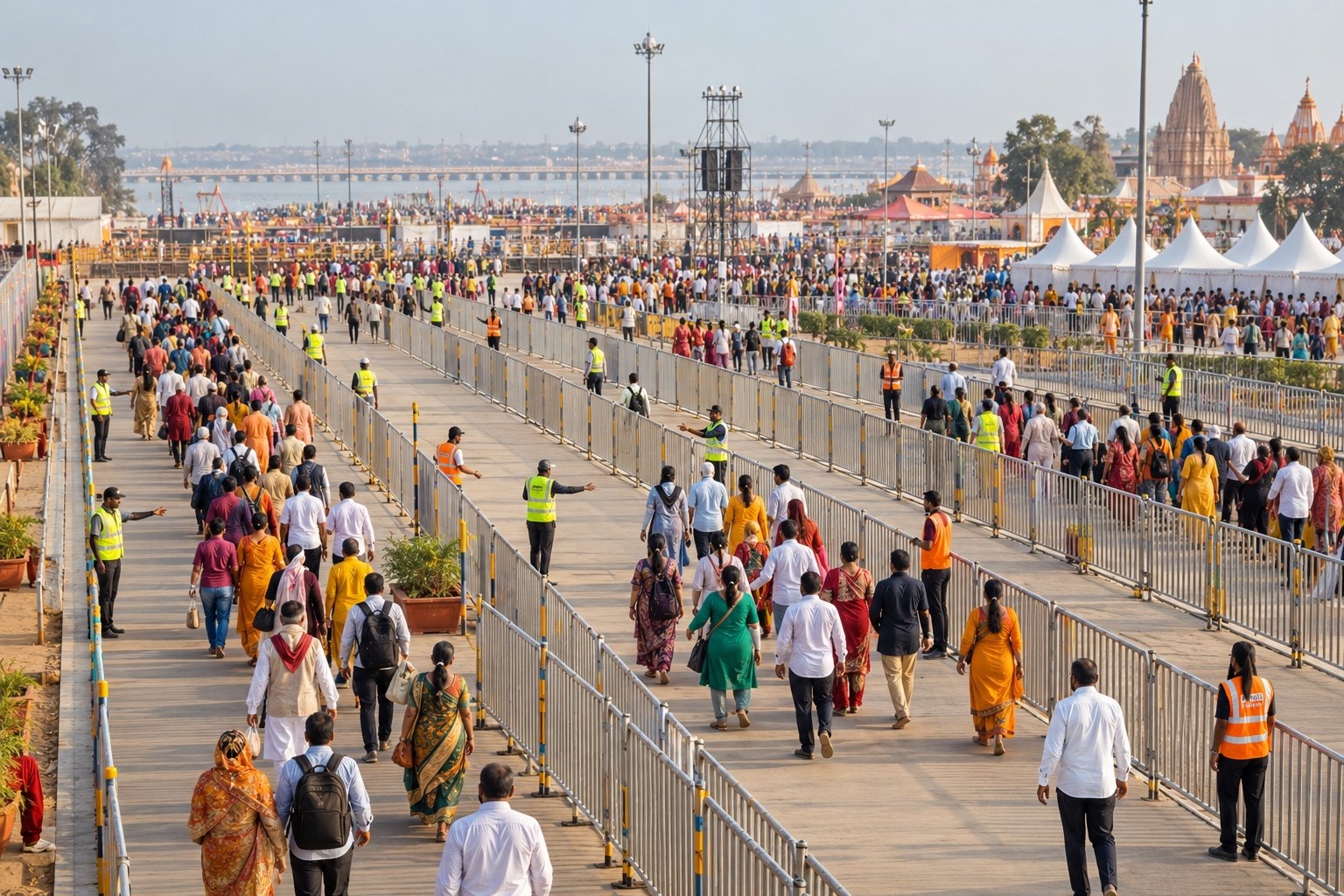
Crowd disasters such as stampedes are man-made and preventable, says the National Disaster Management Authority's 2014 guide, which sorts their causes into six groups and puts the first duty on organisers and district administrations. A crush at a Durga Puja pandal exit in north Kolkata on 17 October 2026 killed at least 19 people, per PTI.
Syllabus: Prelims · Polity & Governance; GS2 · Governance & e-Governance; GS3 · Disaster Management
Why this matters for UPSC
GS3 disaster management: Prelims can ask what the Disaster Management Act, 2005 lets district authorities do in a crowd and what Article 19(3) permits; Mains asks why stampedes recur and who must plan crowd safety.
In short
A crowd disaster is a crush or stampede at a mass gathering. The National Disaster Management Authority's 2014 guide calls such disasters man-made and preventable through proactive planning.
India's laws already give the powers; stampedes will stop only when organisers are made liable and every venue is audited and rehearsed before crowds arrive.
Why it matters
A family visiting a pandal, a pilgrim on a hill path or a fan outside a stadium is safe only if someone has counted how many people a lane, gate or bridge can hold. When that count is skipped, a sudden rush from rain, a rumour or an announcement can kill within minutes, and most of the dead are crushed or suffocated rather than hurt by any fire or collapse. Families then wait years for compensation because, as the Supreme Court has observed, no statutory formula fixes it. Planning costs little: lights in the approach lane, separate entry and exit, enough marshals and a public address system. The larger issue is whether India treats crowd safety as a routine duty of every organiser and district, or acts only after deaths.
Prelims pointers
- Section 2(d), Disaster Management Act, 2005: a disaster may arise from natural or man-made causes or from accident or negligence, beyond the affected community's coping capacity.
- Sections 24 and 34, DM Act: the State Executive Committee and the District Authority may control vehicular traffic and people's entry, movement and departure in a vulnerable area.
- Section 25, DM Act: the Collector or District Magistrate chairs the DDMA; the elected representative of the local authority is co-chairperson.
- Section 65, DM Act: executive committees and district authorities may requisition resources, provisions and vehicles for rescue operations.
- Article 19(3): the State may impose reasonable restrictions on peaceful assembly in the interests of the sovereignty and integrity of India or public order.
- Seventh Schedule, State List: public order is entry 1 and police is entry 2, so crowd policing is a State subject.
- Section 44, DM Act: the National Disaster Response Force is constituted for specialist response to a threatening disaster situation or disaster.
Practise a UPSC-style question
With reference to the Disaster Management Act, 2005, consider the following statements:
1. A District Authority may control and restrict the entry and movement of people in a vulnerable or affected area.
2. The Act's definition of a disaster excludes occurrences caused by accident or negligence.
Which of the statements given above is/are correct?
- (a) 1 only
- (b) 2 only
- (c) Both 1 and 2
- (d) Neither 1 nor 2
Show the answer
Answer: (a) 1 only
Answer: (a) 1 only. Section 34 gives district authorities movement powers, and section 2(d) expressly includes accident and negligence.
Statement 1: correct. Section 34 of the Disaster Management Act, 2005 lets the District Authority control and restrict entry, movement and departure of people in a vulnerable or affected area.
Statement 2: incorrect. Section 2(d) defines a disaster as arising from natural or man-made causes, or by accident or negligence, so a stampede can qualify.
Eliminate: statement 2 is surely wrong, since the definition names accident and negligence. Out: (b), (c).
Eliminate: statement 1 matches section 34's movement powers. Out: (d).
Trap: Wrong scope. Many assume the Act covers only natural calamities, so the definition is narrowed to exclude man-made accidents.
Remember: DM Act section 2(d): natural or man-made causes, accident or negligence.
In the news
More Explainers
- State Legislative Councils: Articles 168-172 and the graduates' and teachers' seats Polity
- Whales and dolphins in Indian waters: legal protection, IUCN status and strandings Environment
- The Aligarh Movement, AMU and the Article 30 minority test Polity
- Environmental clearance by States: SEIAA, SEAC and the EIA Notification, 2006 Environment
- Software vulnerabilities: CVE, CVSS, coordinated disclosure and CERT-In's role Sci-Tech
- Drug trafficking law in India: NDPS Act, PIT-NDPS, NCB and NCORD National
- Choosing the UN Secretary-General: Article 97, UNSC veto and straw polls World & IR
- UN Convention against Torture, and why India has not ratified it Polity
- NavIC: why India's navigation constellation cannot give a standalone position Sci-Tech
- International Energy Agency: membership, 90-day oil stocks and India's status World & IR
- PM Surya Ghar: Muft Bijli Yojana and the rooftop solar subsidy Economy
- HFSS foods: FSSAI's draft limits and front-of-pack warning labels National