
Coral reefs, bleaching and the IUCN Red List status of corals
Why in news: On 15 October 2026, Nature published the IUCN SSC Coral Specialist Group's reassessment: 44% of assessed reef-building coral species are threatened.
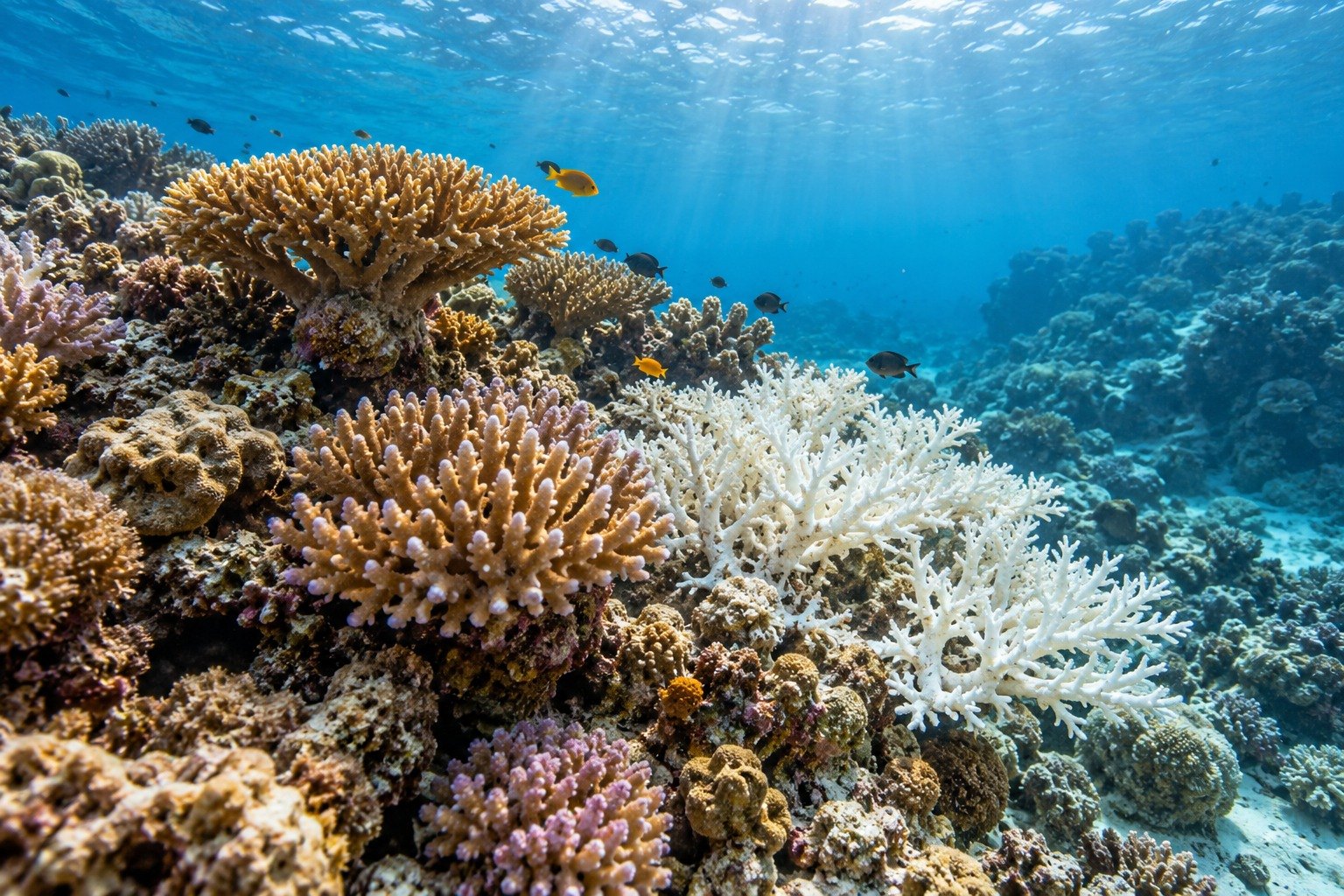
Coral reefs are built by colonies of tiny animals called polyps that lay down calcium carbonate and live with algae called zooxanthellae; heat-stressed corals expel the algae and bleach. An IUCN Species Survival Commission reassessment, published in Nature on 15 October 2026, classed 340 of 774 assessed reef-building coral species, or 44%, as threatened.
Syllabus: Prelims · Environment & Ecology; GS1 · Geophysical Phenomena; GS3 · Environment & Conservation
Why this matters for UPSC
GS3 environment and conservation, and Prelims ecology: Prelims can ask how zooxanthellae and coral bleaching work, which IUCN Red List categories count as threatened and how India protects corals; Mains, about reef conservation under climate change.
In short
Coral reefs are calcium carbonate structures built by colonies of coral polyps living in partnership with algae; warming seas break that partnership, making reefs among the most climate-threatened ecosystems.
Schedule I and CRZ rules guard reefs from local harm, but only curbing ocean warming and cutting local stress can keep corals surviving repeated bleaching.
Why it matters
Fishing families on the Lakshadweep and Gulf of Mannar coasts depend on reefs that hold the fish they catch and that break waves before they reach the shore. When corals bleach repeatedly, the algae that feed them leave, the reef stops growing, and the fish, the coastal protection and the tourism go with it. The new count matters because it is a floor, not a ceiling: it was measured before the worst bleaching on record, so the real loss is likely larger. For India, the lesson is that legal protection of corals on land and at sea cannot stop warming water, which only cuts in global emissions can slow.
Prelims pointers
- IUCN, the International Union for Conservation of Nature, was created in 1948, is headquartered in Gland, Switzerland, and its Species Survival Commission is one of its expert commissions.
- On the IUCN Red List, Vulnerable, Endangered and Critically Endangered species are together called threatened; Not Evaluated species are not on the list.
- Fringing reefs, the commonest form, grow seaward from the shore; a barrier reef lies farther out, separated from land by a lagoon of open, often deep water, per NOAA.
- Many shallow reef-building corals grow best between 23°C and 29°C and stay within about 30 metres, where enough light penetrates, per NOAA.
- India's main reef areas: Gulf of Kachchh, Gulf of Mannar, Palk Bay, Lakshadweep and the Andaman and Nicobar Islands; Malvan in Maharashtra also has reefs.
- The Coastal Regulation Zone Notification, 2019 was issued under the Environment (Protection) Act, 1986, not the Wild Life (Protection) Act, 1972.
- INCOIS, Hyderabad, under the Ministry of Earth Sciences, has issued coral bleaching alerts from satellite sea surface temperature data since 2011.
- NCSCM works under the Environment Ministry; NCCR, Chennai, under the Ministry of Earth Sciences, monitors bleaching in Palk Bay, Andaman and Lakshadweep.
Practise a UPSC-style question
With reference to reef-building corals, consider the following statements:
1. Zooxanthellae are photosynthetic algae that live in coral tissues and pass the products of photosynthesis to the coral.
2. Soft corals are the primary reef-builders, laying down rigid skeletons of calcium carbonate.
Which of the statements given above is/are correct?
- (a) 1 only
- (b) 2 only
- (c) Both 1 and 2
- (d) Neither 1 nor 2
Show the answer
Answer: (a) 1 only
Answer: (a) 1 only. Algae feed the coral, but reefs are built by hard corals, not soft ones.
Statement 1: correct. Most reef-building corals host zooxanthellae, which photosynthesise and supply sugars and proteins to the coral, per NOAA.
Statement 2: incorrect. Hard, or stony, corals secrete calcium carbonate skeletons and build reefs; soft corals do not form reefs, per NOAA.
Eliminate: Statement 2 is wrong because soft corals do not build reefs. Out: (b), (c).
Eliminate: Statement 1 is right since zooxanthellae feed the coral. Out: (d).
Trap: Look-alike names. Hard and soft corals share the name, and the question pins the reef-building role on the wrong kind.
Remember: Hard (stony) corals build reefs; zooxanthellae feed them.
More Explainers
- State Legislative Councils: Articles 168-172 and the graduates' and teachers' seats Polity
- Whales and dolphins in Indian waters: legal protection, IUCN status and strandings Environment
- The Aligarh Movement, AMU and the Article 30 minority test Polity
- Environmental clearance by States: SEIAA, SEAC and the EIA Notification, 2006 Environment
- Software vulnerabilities: CVE, CVSS, coordinated disclosure and CERT-In's role Sci-Tech
- Drug trafficking law in India: NDPS Act, PIT-NDPS, NCB and NCORD National
- Choosing the UN Secretary-General: Article 97, UNSC veto and straw polls World & IR
- UN Convention against Torture, and why India has not ratified it Polity
- NavIC: why India's navigation constellation cannot give a standalone position Sci-Tech
- International Energy Agency: membership, 90-day oil stocks and India's status World & IR
- PM Surya Ghar: Muft Bijli Yojana and the rooftop solar subsidy Economy
- HFSS foods: FSSAI's draft limits and front-of-pack warning labels National