
Cauvery water sharing: the 2018 judgment, CWMA and distress-year cuts
Why in news: On 12 October 2026 the Supreme Court heard Tamil Nadu's application on Karnataka's release backlog at Billigundulu and reserved its order.
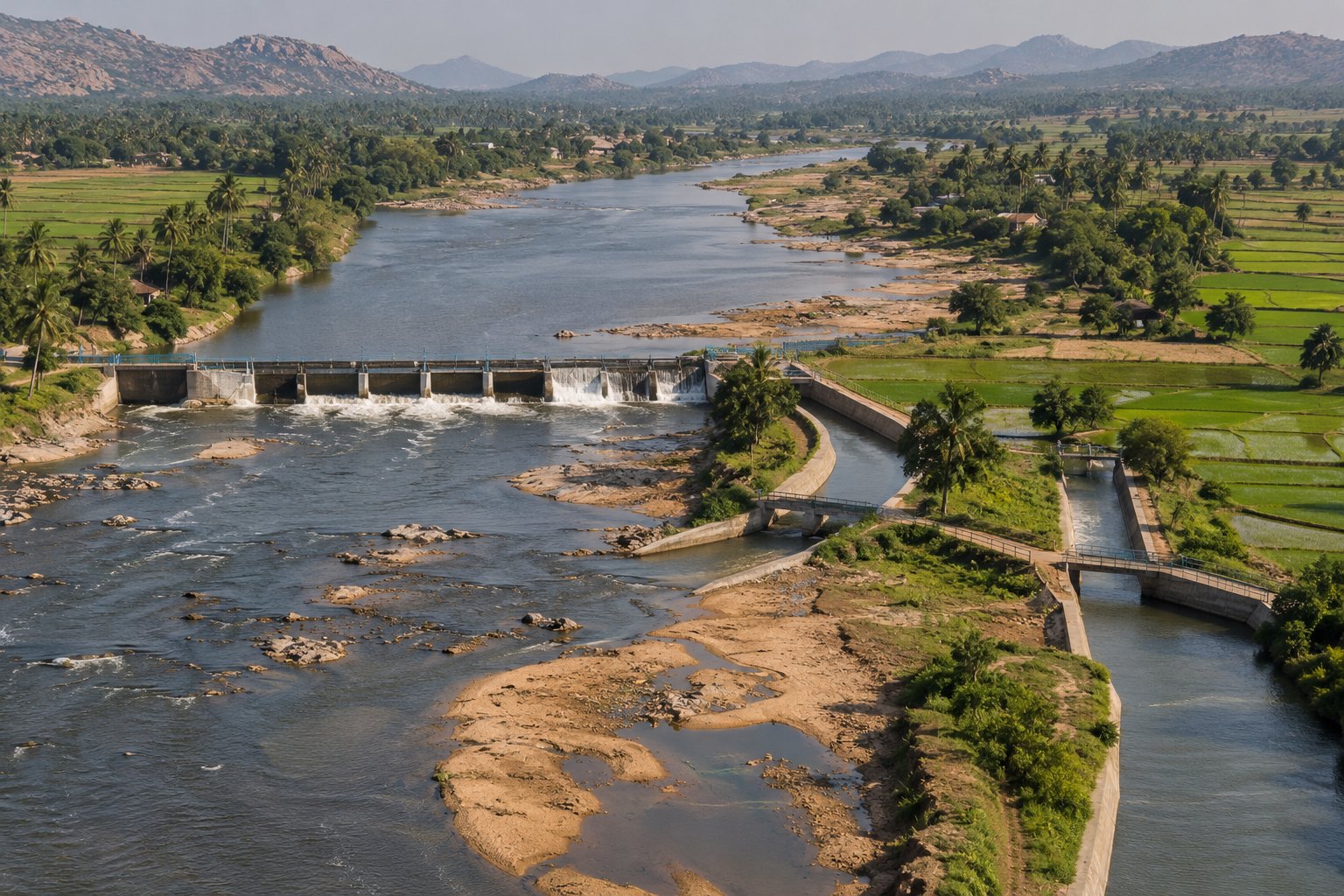
Cauvery water is shared under the Tribunal's 2007 award as modified by the Supreme Court on 16 February 2018: Karnataka 284.75 TMC, Tamil Nadu 404.25 TMC, Kerala 30 TMC, Puducherry 7 TMC. The Cauvery Water Management Authority enforces it, cutting shares proportionately in a distress year. On 12 October 2026 the Court reserved orders on Tamil Nadu's backlog plea.
Syllabus: GS2 · Federalism & Local Government; GS2 · Separation of Powers; GS3 · Agriculture & Irrigation
Why this matters for UPSC
GS2 covers inter-State disputes and federal institutions under the Inter-State River Water Disputes Act, 1956. Prelims can ask the Cauvery shares, the Authority's and Committee's roles and Article 262; Mains, how scarcity is shared.
In short
Under the 1956 Inter-State River Water Disputes Act, a tribunal award recast by the Supreme Court in 2018 divides the Cauvery; the CWMA enforces it, drought years included.
Cauvery's shares are settled; the test is whether the CWMA can split scarcity credibly enough to keep States out of court each dry year.
Why it matters
A paddy farmer in the Cauvery delta depends on water released upstream in Karnataka, because the delta's distributaries do not flow all year. In a dry year Bengaluru's residents need the same reservoirs for drinking water. The award and the 2018 judgment turn a fight over every drop into fixed shares, a monthly schedule and a rule that a shortfall is spread across all four parties. Since the Tribunal's shares use up almost the whole utilisable flow, any weak monsoon produces a shortage and a dispute about how to split it. The larger issue is federal: whether expert bodies like the CWMA, rather than courts in every bad year, can settle how scarcity is shared between States.
Prelims pointers
- Article 262: Parliament may provide by law for adjudicating inter-State river water disputes and may bar courts from hearing such disputes.
- Inter-State River Water Disputes Act, 1956, Section 6(2): a gazetted tribunal decision has the force of a Supreme Court order or decree.
- Section 6A: the Central Government frames a scheme to implement a tribunal's decision; the 2018 judgment held this duty binding despite the word 'may'.
- Entry 17, State List: water supplies, irrigation, canals and water storage, subject to Entry 56 of the Union List on inter-State rivers.
- CWMA: a Chairman, two whole-time members, two part-time members from the Water Resources and Agriculture Ministries, and four from the basin States and Puducherry.
- CWRC: a Chairman and eight members, including the basin States, Puducherry, the India Meteorological Department, the Central Water Commission and Agriculture Ministry.
- CWMA regulates Karnataka's releases at the contact point; the CWRC, on its directions, collects daily reservoir data and ensures ten-daily releases.
- Clause VII of the award: in a distress year, shares of Kerala, Karnataka, Tamil Nadu and Puducherry are reduced proportionately.
Practise a UPSC-style question
With reference to the Inter-State River Water Disputes Act, 1956, consider the following statements:
1. Under the Act, the Central Government publishes a tribunal's decision in the Official Gazette.
2. Under Section 6A of the Act, the Supreme Court frames a scheme to give effect to a tribunal's decision.
3. A tribunal's decision, once published in the Official Gazette, has the same force as an order or decree of the Supreme Court.
Which of the statements given above is/are correct?
- (a) 1 and 2 only
- (b) 2 and 3 only
- (c) 1 and 3 only
- (d) 1, 2 and 3
Show the answer
Answer: (c) 1 and 3 only
1 is correct: Section 6(1) has the Central Government publish the tribunal's decision in the Official Gazette, as it did for the Cauvery award in 2013. 2 is incorrect: Section 6A empowers the Central Government, not the Supreme Court, to frame a scheme; in 2018 the Court directed the Centre to do so. 3 is correct: Section 6(2) gives a published award the force of a Supreme Court order or decree.
More Explainers
- State Legislative Councils: Articles 168-172 and the graduates' and teachers' seats Polity
- Whales and dolphins in Indian waters: legal protection, IUCN status and strandings Environment
- The Aligarh Movement, AMU and the Article 30 minority test Polity
- Environmental clearance by States: SEIAA, SEAC and the EIA Notification, 2006 Environment
- Software vulnerabilities: CVE, CVSS, coordinated disclosure and CERT-In's role Sci-Tech
- Drug trafficking law in India: NDPS Act, PIT-NDPS, NCB and NCORD National
- Choosing the UN Secretary-General: Article 97, UNSC veto and straw polls World & IR
- UN Convention against Torture, and why India has not ratified it Polity
- NavIC: why India's navigation constellation cannot give a standalone position Sci-Tech
- International Energy Agency: membership, 90-day oil stocks and India's status World & IR
- PM Surya Ghar: Muft Bijli Yojana and the rooftop solar subsidy Economy
- HFSS foods: FSSAI's draft limits and front-of-pack warning labels National