
Carbon capture, utilisation and storage (CCUS) and direct air capture
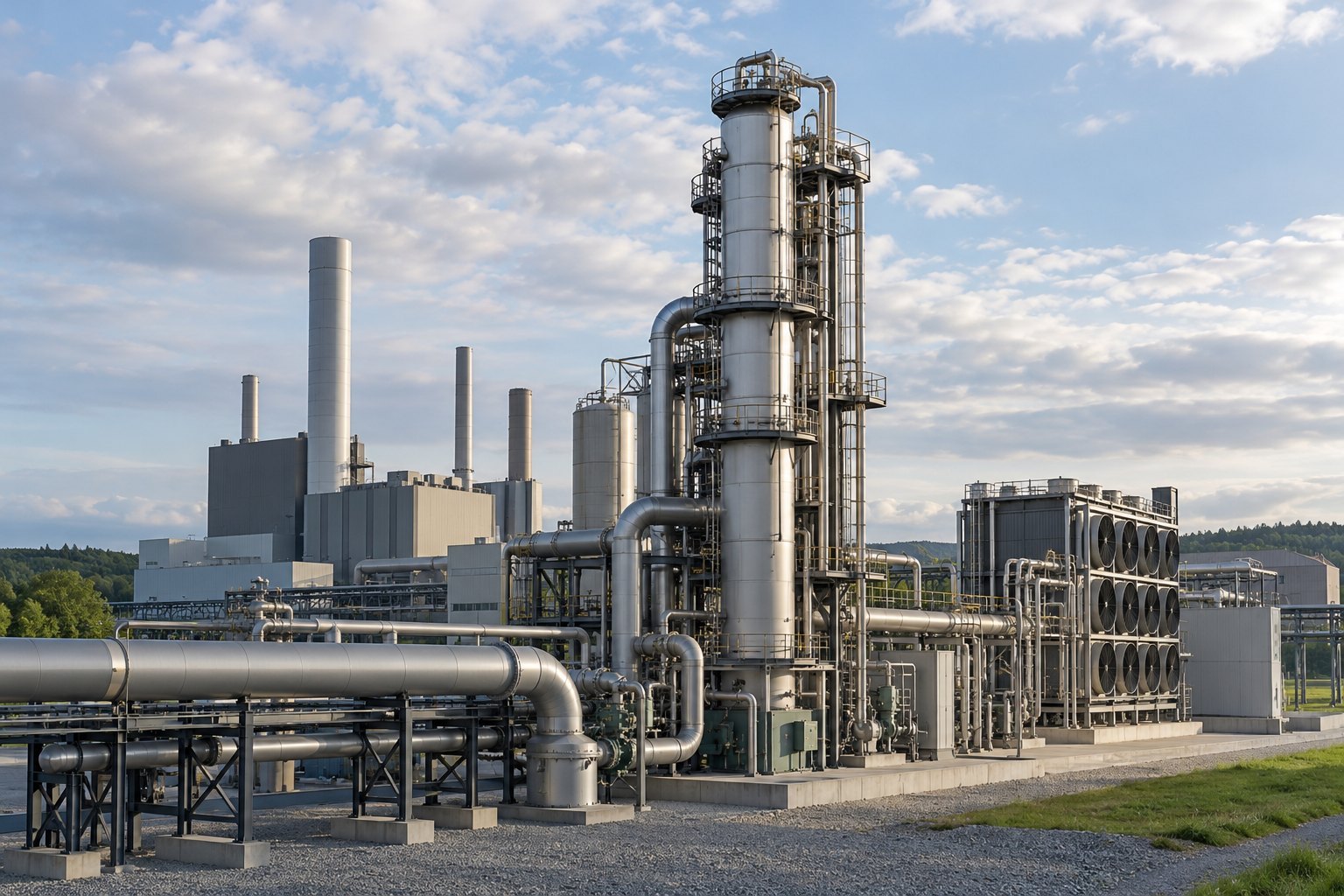
Carbon Capture, Utilisation and Storage (CCUS) traps carbon dioxide at a factory or power plant, then reuses it or locks it deep underground; direct air capture takes the gas from open air instead. The Union Budget 2026-27 proposed ₹20,000 crore over five years for CCUS in five industries, aligned with a December 2025 DST roadmap.
Syllabus: Prelims · Environment & Ecology; GS3 · Science & Technology; GS3 · Environment & Conservation
Why this matters for UPSC
GS3 environment and science and technology: Prelims can ask how capture and storage, utilisation and direct air capture differ and which sectors are hard to abate; Mains, whether CCUS fits India's Net Zero 2070 path.
In short
Carbon Capture, Utilisation and Storage (CCUS) separates carbon dioxide from flue gas or air, then reuses or buries it, cutting emissions where cleaner alternatives are scarce.
CCUS should stay a targeted tool for residual industrial emissions, backed by storage rules, never a reason to slow India's exit from fossil fuels.
Why it matters
A cement plant gives off carbon dioxide even when it runs on solar power, because the chemistry of making cement releases the gas. Clean electricity cannot fix that, so such a plant must either capture the gas or keep emitting it. Carbon capture offers these industries, and the workers and towns that depend on them, a way to keep running while India heads for net zero. Cost is the catch: capture adds a large expense to each tonne of output, so few firms will adopt it without public support. Used too widely, it could also keep coal and oil in use longer than the climate can bear, which is why critics want it kept for emissions nothing else can cut.
Prelims pointers
- India has announced a Net Zero emissions target for 2070 under its long-term commitments to the Paris Agreement (2015).
- The IPCC treats CCU as CCUS only when the carbon dioxide stays stored in a product for a climate-relevant time horizon.
- In the IPCC glossary, carbon dioxide removal includes human enhancement of biological or geochemical sinks and direct air capture and storage, but excludes natural uptake not caused by humans.
- NITI Aayog published CCUS: Policy Framework and Deployment Mechanism in India in 2022.
- Captured carbon dioxide combined with green hydrogen yields methanol, the route used at NTPC's Vindhyachal Super Thermal Power Station in Madhya Pradesh.
- The IPCC was created in 1988 by the World Meteorological Organization and the UN Environment Programme; its Sixth Assessment Report is AR6.
Practise a UPSC-style question
With reference to carbon capture technologies, consider the following statements:
1. Carbon capture and storage fitted at a coal power plant removes carbon dioxide already present in the atmosphere.
2. Direct air capture takes carbon dioxide from ambient air instead of from an industrial plant's flue gas.
Which of the statements given above is/are correct?
- (a) 1 only
- (b) 2 only
- (c) Both 1 and 2
- (d) Neither 1 nor 2
Show the answer
Answer: (b) 2 only
Answer: (b) 2 only. Only direct air capture draws from the open air; capture at a plant prevents new emissions.
Statement 1: incorrect. Capture at a power plant stops the plant's own new carbon dioxide reaching the air; it does not lower the stock already there (IPCC glossary).
Statement 2: correct. The IPCC defines direct air carbon dioxide capture and storage as capturing carbon dioxide directly from the ambient air, followed by storage.
Eliminate: Statement 2 is the definition of direct air capture, so it is correct. Out: (a), (d).
Eliminate: Statement 1 confuses avoiding emissions with removing them, so it is incorrect. Out: (c).
Trap: Reversed direction. The question turns capture at a chimney, which only prevents new emissions, into removal from the air, which needs direct air capture or bioenergy with storage.
Remember: Chimney capture avoids emissions; direct air capture with storage removes them.
More Explainers
- State Legislative Councils: Articles 168-172 and the graduates' and teachers' seats Polity
- Whales and dolphins in Indian waters: legal protection, IUCN status and strandings Environment
- The Aligarh Movement, AMU and the Article 30 minority test Polity
- Environmental clearance by States: SEIAA, SEAC and the EIA Notification, 2006 Environment
- Software vulnerabilities: CVE, CVSS, coordinated disclosure and CERT-In's role Sci-Tech
- Drug trafficking law in India: NDPS Act, PIT-NDPS, NCB and NCORD National
- Choosing the UN Secretary-General: Article 97, UNSC veto and straw polls World & IR
- UN Convention against Torture, and why India has not ratified it Polity
- NavIC: why India's navigation constellation cannot give a standalone position Sci-Tech
- International Energy Agency: membership, 90-day oil stocks and India's status World & IR
- PM Surya Ghar: Muft Bijli Yojana and the rooftop solar subsidy Economy
- HFSS foods: FSSAI's draft limits and front-of-pack warning labels National