
Biofortification and hidden hunger: ICAR-CPRI's coloured potatoes
Why in news: A PIB backgrounder on 18 October 2026 presented ICAR-CPRI's Kufri Jamunia, a purple-fleshed potato released in 2024, as a biofortified answer to hidden hunger.
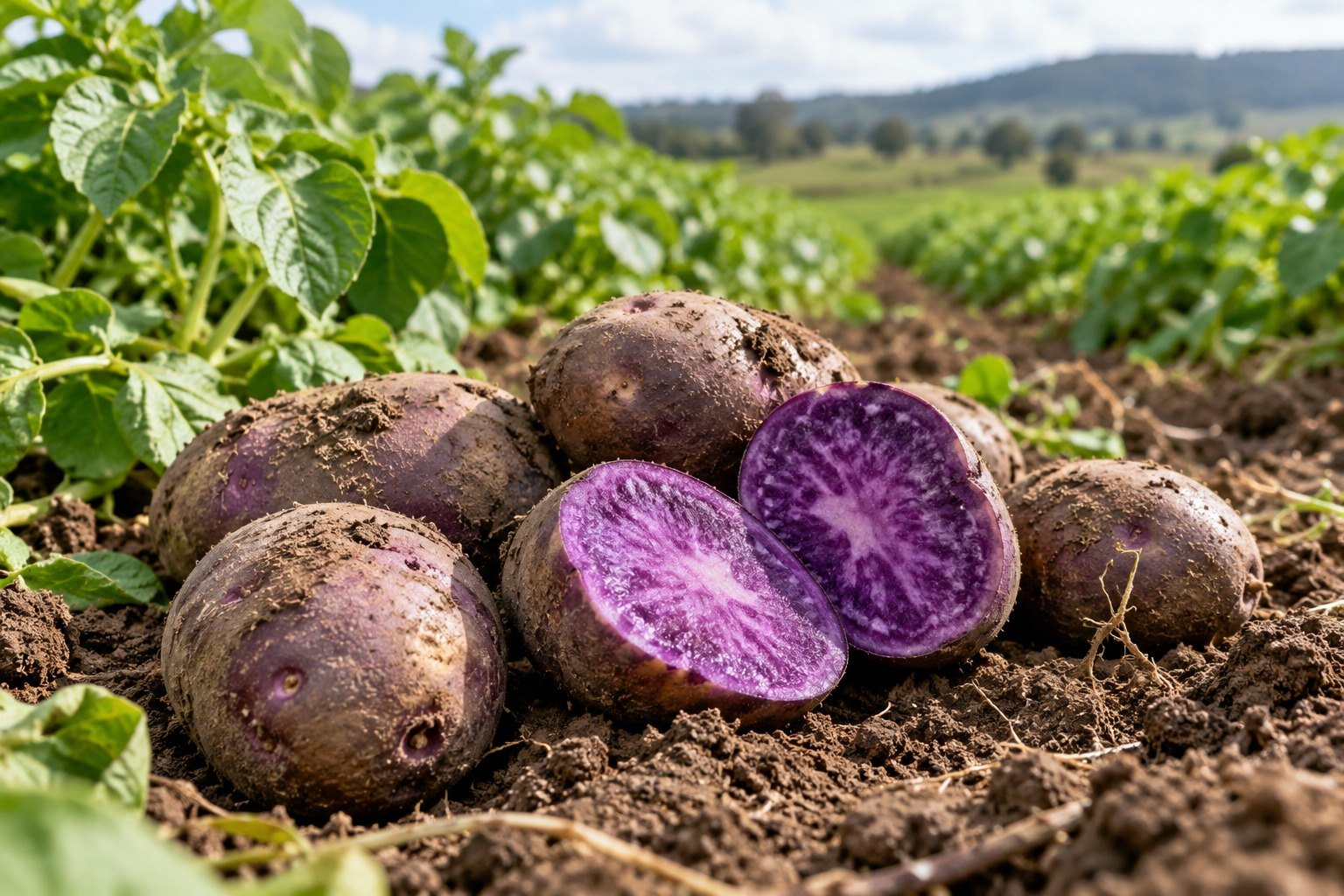
Biofortification raises the vitamin and mineral content of a crop through plant breeding, so everyday staples counter hidden hunger, a lack of micronutrients despite enough calories. Unlike fortification, nothing is added during processing. A PIB backgrounder of 18 October 2026 presented ICAR-CPRI's purple-fleshed Kufri Jamunia, released in 2024, as an example.
Syllabus: GS3 · Agriculture & Irrigation; Prelims · Science & Technology; GS3 · Indian Achievements in S&T
Why this matters for UPSC
Biofortification belongs to GS3 agriculture and science and GS2 hunger and nutrition. Prelims can ask how it differs from fortification, what FSSAI's '+F' logo marks and what ICAR-CPRI's Kufri varieties carry; Mains, how breeding can tackle hidden hunger.
In short
Biofortification breeds extra vitamins and minerals into a staple crop itself, so daily food fights hidden hunger: micronutrient deficiency that persists despite enough calories.
Biofortified staples such as Kufri Jamunia make nutrition part of farming itself; their reach now depends on seed systems, markets and food schemes.
Why it matters
A family that eats potatoes most days but can afford little fruit or pulses could get more iron, zinc and Vitamin C from the same plate, with no new habit to learn and no supplement to buy. Farmers need not choose between nutrition and income: the new variety yields well and keeps in store with little rotting. The larger issue is hidden hunger, which persists even where people eat enough. Breeding nutrients into staples reaches people through food they already grow and buy, but it works best beside a varied diet, fortified staples and nutrition schemes, not in place of them.
Prelims pointers
- ICAR: founded 16 July 1929 as the Imperial Council of Agricultural Research, registered under the Societies Registration Act, 1860, on the Royal Commission on Agriculture's report.
- ICAR's parent: Department of Agricultural Research and Education (DARE), Ministry of Agriculture and Farmers Welfare; headquarters New Delhi.
- ICAR-Central Potato Research Institute is located at Shimla; its released varieties carry the name 'Kufri', such as Kufri Lalit and Kufri Sindhuri.
- FSSAI fortification standards (2016): wheat flour and rice get iron, folic acid, Vitamin B12; milk and edible oil, Vitamins A and D; double fortified salt, iodine and iron.
- '+F' logo: notified by FSSAI to identify fortified foods; Fortification of Foods Regulations, 2018 notified in the Gazette of India on 9 August 2018.
- HarvestPlus is part of CGIAR and leads the global scaling up of biofortified staples; it records iron pearl millet as first released in India in 2014.
Practise a UPSC-style question
With reference to biofortification, consider the following statements:
1. In biofortification, micronutrients are added to the harvested grain or tuber during milling or processing.
2. Food fortification adds nutrients during processing, and FSSAI has notified the '+F' logo to identify fortified foods.
Which of the statements given above is/are correct?
- (a) 1 only
- (b) 2 only
- (c) Both 1 and 2
- (d) Neither 1 nor 2
Show the answer
Answer: (b) 2 only
Answer: (b) 2 only. Adding nutrients in processing is fortification; biofortification breeds them into the crop.
Statement 1: incorrect. Biofortification raises nutrient content through plant breeding, so the nutrient is already inside the harvested grain or tuber.
Statement 2: correct. Fortification adds micronutrients during processing, and FSSAI notified the '+F' logo to mark fortified foods.
Eliminate: statement 2 describes fortification and the FSSAI logo exactly, so it is correct. Out: (a), (d).
Eliminate: statement 1 describes fortification, not biofortification, so it is incorrect. Out: (c).
Trap: Look-alike names. Biofortification and fortification sound alike; statement 1 pins the processing step of fortification on biofortification.
Remember: Biofortification happens in the field through breeding; fortification happens in the factory.
More Explainers
- State Legislative Councils: Articles 168-172 and the graduates' and teachers' seats Polity
- Whales and dolphins in Indian waters: legal protection, IUCN status and strandings Environment
- The Aligarh Movement, AMU and the Article 30 minority test Polity
- Environmental clearance by States: SEIAA, SEAC and the EIA Notification, 2006 Environment
- Software vulnerabilities: CVE, CVSS, coordinated disclosure and CERT-In's role Sci-Tech
- Drug trafficking law in India: NDPS Act, PIT-NDPS, NCB and NCORD National
- Choosing the UN Secretary-General: Article 97, UNSC veto and straw polls World & IR
- UN Convention against Torture, and why India has not ratified it Polity
- NavIC: why India's navigation constellation cannot give a standalone position Sci-Tech
- International Energy Agency: membership, 90-day oil stocks and India's status World & IR
- PM Surya Ghar: Muft Bijli Yojana and the rooftop solar subsidy Economy
- HFSS foods: FSSAI's draft limits and front-of-pack warning labels National