
BHASHINI: the National Language Translation Mission
Why in news: On 13 October 2026, MeitY said BHASHINI's Shrutlekh gave live English-Spanish translation at NCGG's Mussoorie programme for foreign civil servants.
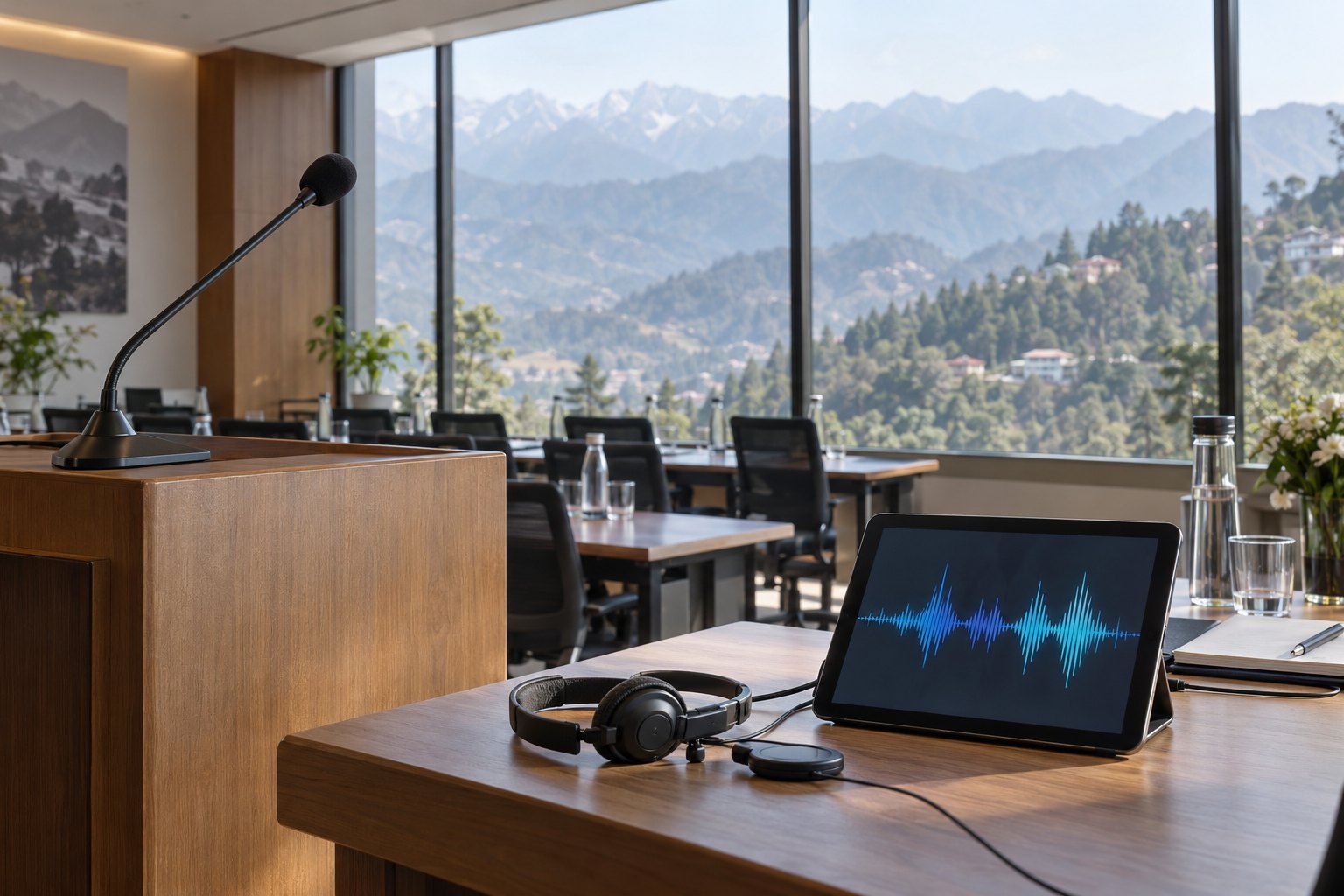
BHASHINI (BHASHa INterface for India) is the AI language platform of the National Language Translation Mission, run by the Ministry of Electronics and Information Technology, offering speech and text tools in Indian languages. In October 2026, its Shrutlekh tool gave live English-Spanish translation at a National Centre for Good Governance programme for foreign civil servants in Mussoorie.
Syllabus: GS3 · Indian Achievements in S&T; GS3 · IT, Space, Biotech & IPR; GS2 · Governance & e-Governance
Why this matters for UPSC
GS3 science and technology and GS2 e-governance: Prelims can ask BHASHINI's parent ministry, how Bhasha Daan collects data and which languages the Eighth Schedule lists; Mains, whether language AI makes digital public services inclusive.
In short
BHASHINI (BHASHa INterface for India) is MeitY's AI platform under the National Language Translation Mission, giving speech and text tools so citizens can use digital services in their own languages.
BHASHINI should be judged by accuracy in India's smallest languages, not platform counts; open benchmarks and speaker-checked data must keep pace with its growth.
Why it matters
A farmer who reads only Odia, or a pensioner who can speak but struggles to type, is shut out of a government portal that works in English alone. BHASHINI lets the teams that build such portals add speech and translation in Indian languages without training their own models, so one public investment serves many departments at once. That matters because pensions, land records, health advice and complaints to government now move online, and a citizen who cannot read the screen depends on a middleman. Offered abroad, the same tools let India show working technology to partner countries while it trains their officials. The catch is quality: a wrong translation of a legal notice or a medical instruction can mislead the person relying on it.
Prelims pointers
- BHASHINI launch: unveiled by the Prime Minister at Digital India Week 2022 in Gandhinagar, Gujarat (PIB factsheet, August 2022).
- Bhasha Daan streams: Suno India (type the audio heard), Bolo India (record sentences), Likho India (translate prompted text), Dekho India (label images).
- Eighth Schedule to the Constitution lists 22 languages, among them Bodo, Dogri, Maithili, Santhali, Konkani and Nepali; English is not on it.
- NCGG: set up in 2014 as an apex autonomous institution under the Ministry of Personnel, Public Grievances and Pensions; head office New Delhi, a campus at Mussoorie.
- SPPEL: launched in 2013 by the Ministry of Education, run by the Central Institute of Indian Languages, Mysuru, for languages with fewer than 10,000 speakers.
- BharatGen builds text-to-text and text-to-speech models for all 22 Scheduled Languages, drawing on SPPEL and Sanchika data (PIB backgrounder, October 2025).
- Adi-Vaani is an AI platform for real-time translation of tribal languages such as Santali, Bhili, Mundari and Gondi (PIB backgrounder, October 2025).
Practise a UPSC-style question
With reference to BHASHINI, consider the following statements:
1. It is implemented by the Ministry of Education through the Central Institute of Indian Languages, Mysuru.
2. Bhasha Daan is its crowdsourcing initiative through which citizens contribute and validate language data.
3. It offers speech recognition, machine translation and text-to-speech models to other platforms through APIs.
Which of the statements given above is/are correct?
- (a) 1 and 2 only
- (b) 2 and 3 only
- (c) 1 and 3 only
- (d) 1, 2 and 3
Show the answer
Answer: (b) 2 and 3 only
Answer: (b) 2 and 3 only. BHASHINI is MeitY's platform; Bhasha Daan and the API-based models are its parts.
Statement 1: incorrect. BHASHINI is run by the Ministry of Electronics and Information Technology through the Digital India BHASHINI Division of Digital India Corporation; CIIL runs SPPEL.
Statement 2: correct. Bhasha Daan asks citizens to transcribe, record, translate and label language data and to validate others' contributions.
Statement 3: correct. BHASHINI lends ASR, neural machine translation and text-to-speech to government and private platforms through APIs.
Eliminate: Statement 1 credits the wrong ministry, since BHASHINI belongs to MeitY. Out: (a), (c), (d).
Trap: Swapped attribution. CIIL, Mysuru, is a real language body that feeds data to language AI, so pinning BHASHINI on the Ministry of Education sounds plausible.
Remember: BHASHINI = MeitY, via Digital India Corporation; SPPEL = Ministry of Education, via CIIL.
More Explainers
- State Legislative Councils: Articles 168-172 and the graduates' and teachers' seats Polity
- Whales and dolphins in Indian waters: legal protection, IUCN status and strandings Environment
- The Aligarh Movement, AMU and the Article 30 minority test Polity
- Environmental clearance by States: SEIAA, SEAC and the EIA Notification, 2006 Environment
- Software vulnerabilities: CVE, CVSS, coordinated disclosure and CERT-In's role Sci-Tech
- Drug trafficking law in India: NDPS Act, PIT-NDPS, NCB and NCORD National
- Choosing the UN Secretary-General: Article 97, UNSC veto and straw polls World & IR
- UN Convention against Torture, and why India has not ratified it Polity
- NavIC: why India's navigation constellation cannot give a standalone position Sci-Tech
- International Energy Agency: membership, 90-day oil stocks and India's status World & IR
- PM Surya Ghar: Muft Bijli Yojana and the rooftop solar subsidy Economy
- HFSS foods: FSSAI's draft limits and front-of-pack warning labels National