
Bamboo: the 2017 Indian Forest Act change and National Bamboo Mission
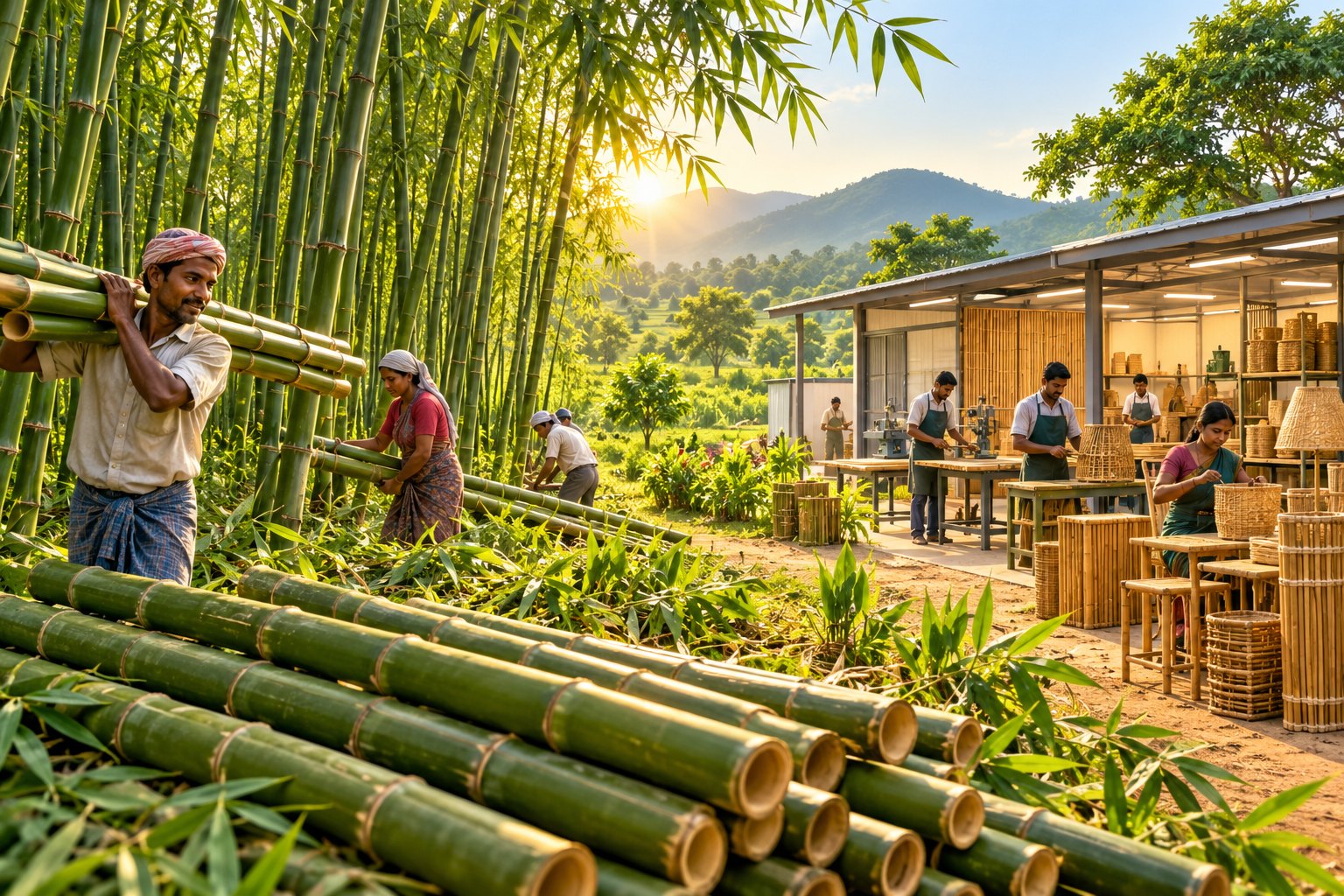
Bamboo is a fast-growing grass that the Indian Forest Act, 1927 counted as a 'tree' until a 2017 amendment removed it, freeing bamboo grown outside forests from felling and transit permits. The National Bamboo Mission funds plantation, processing and marketing. In a 12 September 2026 note, the government credited the change with new bamboo enterprises, notably in the Northeast.
Syllabus: GS3 · Agriculture & Irrigation; Prelims · Environment & Ecology; GS2 · NGOs, SHGs & Civil Society
In short
Bamboo, a fast-growing grass that the Indian Forest Act, 1927 counted as a 'tree', was freed from felling and transit permits on non-forest land by a 2017 amendment.
Bamboo's promise lies on farms and reclaimed land; forest bamboo sales need Gram Sabha control so livelihoods grow without thinning forests.
Why it matters
A farmer in Madhya Pradesh or Tripura can now grow bamboo on a field and sell the poles without first seeking a forest permit, which makes the crop worth planting. Because it regrows from its rhizomes, one planting yields for years, and the government cites a farmer who grew chilli, ginger and garlic between the rows. Most of the money lies in processing: the government says support from NECTAR raised value addition on bamboo goods from 10% to as much as 70%. Bamboo craft and agarbatti work suit self-help groups of women close to home, and engineered bamboo is entering construction. The larger issue is building a farm-based bamboo economy without stripping natural forests.
Prelims pointers
- Bamboo: a grass (family Poaceae), not a tree; it spreads by rhizomes, and many species flower gregariously at long intervals, after which the clumps die.
- Indian Forest Act, 1927, Section 2(7): 'tree' includes palms, stumps, brushwood and canes; 'bamboos' was deleted from the list in 2017.
- Indian Forest Act, 1927 provides for three kinds of forest: reserved forests, village forests and protected forests.
- Forests moved from the State List to the Concurrent List through the 42nd Amendment, 1976.
- Forest Rights Act, 2006 (Ministry of Tribal Affairs): bamboo is a minor forest produce; the Gram Sabha starts the process of recognising forest rights.
- Mautam: the gregarious flowering of Melocanna baccifera bamboo in Mizoram, followed by rat outbreaks that destroy crops and have caused famine.
- National Bamboo Mission runs through State Bamboo Missions; its plantation support covers non-forest government land and farmers' fields.
- NECTAR (set up in 2012, Shillong), under the Department of Science and Technology, absorbed the National Mission on Bamboo Application and the Mission for Geospatial Applications in 2014.
Practise a UPSC-style question
With reference to bamboo in India, consider the following statements:
1. Botanically, bamboo is a grass belonging to the family Poaceae.
2. Its legal status changed in 2017 through an amendment to the Forest (Conservation) Act, 1980.
3. Bamboo grown in forest areas continues to be governed by the Indian Forest Act, 1927.
Which of the statements given above is/are correct?
- (a) 1 and 2 only
- (b) 2 and 3 only
- (c) 1 and 3 only
- (d) 1, 2 and 3
Show the answer
Answer: (c) 1 and 3 only
1 is correct: bamboo is a giant grass of the family Poaceae. 2 is incorrect: the 2017 change amended Section 2(7) of the Indian Forest Act, 1927, not the Forest (Conservation) Act, 1980. 3 is correct: the amendment freed bamboo grown on non-forest land; the government stated that bamboo in forest areas stays under the 1927 Act.
More Explainers
- State Legislative Councils: Articles 168-172 and the graduates' and teachers' seats Polity
- Whales and dolphins in Indian waters: legal protection, IUCN status and strandings Environment
- The Aligarh Movement, AMU and the Article 30 minority test Polity
- Environmental clearance by States: SEIAA, SEAC and the EIA Notification, 2006 Environment
- Software vulnerabilities: CVE, CVSS, coordinated disclosure and CERT-In's role Sci-Tech
- Drug trafficking law in India: NDPS Act, PIT-NDPS, NCB and NCORD National
- Choosing the UN Secretary-General: Article 97, UNSC veto and straw polls World & IR
- UN Convention against Torture, and why India has not ratified it Polity
- NavIC: why India's navigation constellation cannot give a standalone position Sci-Tech
- International Energy Agency: membership, 90-day oil stocks and India's status World & IR
- PM Surya Ghar: Muft Bijli Yojana and the rooftop solar subsidy Economy
- HFSS foods: FSSAI's draft limits and front-of-pack warning labels National