
Article 348: the language of the Supreme Court and High Courts
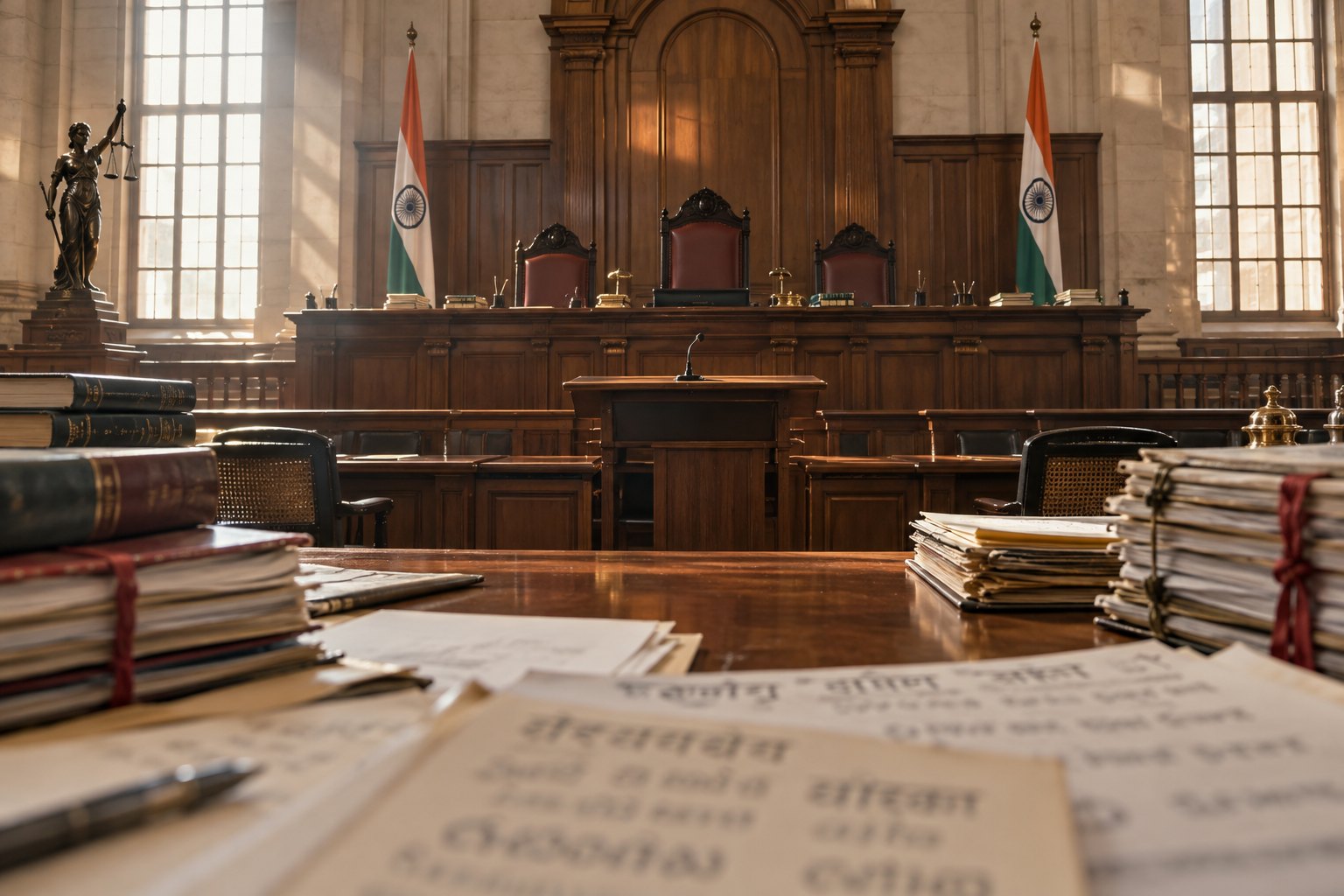
Article 348 makes English the language of all proceedings in the Supreme Court and every High Court until Parliament provides otherwise. A Governor, with the President's previous consent, may allow Hindi or the State's official language in a High Court's proceedings, as in Rajasthan, Uttar Pradesh, Madhya Pradesh and Bihar. The Supreme Court also publishes AI-translated judgments in Indian languages.
Syllabus: GS2 · Constitution; Prelims · Polity & Governance; GS2 · Executive & Judiciary
Why this matters for UPSC
GS Paper 2, the Constitution and the judiciary: Prelims asks which Article sets the language of the higher courts, who authorises Hindi and with whose consent; Mains asks about access to justice in Indian languages.
In short
Article 348, in Part XVII, keeps English in Supreme Court and High Court proceedings until Parliament by law provides otherwise, setting one judicial language against citizens' access to justice.
Translation, funded and accurate, offers litigants access without unsettling the common language that transferred judges and a national body of precedent need.
Why it matters
A litigant in a village court who reads only Tamil or Hindi may never understand the High Court judgment that decides her land or liberty, because it is written in English. The Constitution chose English for the higher courts to keep one common language for judges who are transferred across States, for lawyers moving to the Supreme Court and for a single body of precedent. The cost is distance between courts and citizens. Two answers are on the table: allowing a State's language in its High Court, which needs the Governor, the President and the Chief Justice of India to agree, and translating judgments into Indian languages. The larger issue is access to justice in a multilingual federation, and how to widen it without imposing one language on unwilling States.
Prelims pointers
- Part XVII of the Constitution (Articles 343 to 351) deals with official language; Article 348 covers the Supreme Court, High Courts, Acts and Bills.
- Article 348(2) needs two actors: the Governor authorises, with the President's previous consent; it covers proceedings, not judgments, decrees or orders.
- Section 7 of the Official Languages Act, 1963 covers High Court judgments, decrees and orders; a translation into English under the High Court's authority must accompany them.
- Article 348(3): where a State legislates in another language, the English translation published under the Governor's authority is the authoritative English text.
- Article 349 required the President's previous sanction for any Bill on the languages under Article 348(1) during the first fifteen years.
- Article 343 makes Hindi the official language of the Union; Article 345 lets a State Legislature adopt the State's official language; Article 351 directs the spread of Hindi.
- The Committee of Parliament on Official Language is set up under section 4 of the Official Languages Act, 1963, with 20 Lok Sabha and 10 Rajya Sabha members.
- The Bar Council of India's Bharatiya Bhasha Samiti, under the aegis of the Ministry of Law and Justice, is building a common core vocabulary for legal translation.
Practise a UPSC-style question
With reference to Article 348 of the Constitution of India, consider the following statements:
1. Until Parliament by law otherwise provides, all proceedings in the Supreme Court and in every High Court shall be in English.
2. The Governor of a State may, with the previous consent of the President, authorise Hindi in proceedings of the High Court having its principal seat in that State.
3. An authorisation under Article 348(2) extends to the judgments, decrees and orders passed by that High Court.
Which of the statements given above is/are correct?
- (a) 1 and 2 only
- (b) 2 and 3 only
- (c) 1 and 3 only
- (d) 1, 2 and 3
Show the answer
Answer: (a) 1 and 2 only
1 is correct: Article 348(1)(a) keeps all proceedings of the Supreme Court and every High Court in English until Parliament by law provides otherwise. 2 is correct: Article 348(2) gives this power to the Governor, acting with the President's previous consent. 3 is incorrect: the proviso to Article 348(2) says the clause does not apply to any judgment, decree or order; those are covered by section 7 of the Official Languages Act, 1963.
More Explainers
- State Legislative Councils: Articles 168-172 and the graduates' and teachers' seats Polity
- Whales and dolphins in Indian waters: legal protection, IUCN status and strandings Environment
- The Aligarh Movement, AMU and the Article 30 minority test Polity
- Environmental clearance by States: SEIAA, SEAC and the EIA Notification, 2006 Environment
- Software vulnerabilities: CVE, CVSS, coordinated disclosure and CERT-In's role Sci-Tech
- Drug trafficking law in India: NDPS Act, PIT-NDPS, NCB and NCORD National
- Choosing the UN Secretary-General: Article 97, UNSC veto and straw polls World & IR
- UN Convention against Torture, and why India has not ratified it Polity
- NavIC: why India's navigation constellation cannot give a standalone position Sci-Tech
- International Energy Agency: membership, 90-day oil stocks and India's status World & IR
- PM Surya Ghar: Muft Bijli Yojana and the rooftop solar subsidy Economy
- HFSS foods: FSSAI's draft limits and front-of-pack warning labels National