
Article 226 and private bodies: the public-function test
Why in news: Running an email service is a commercial activity, not a public function open to writs, the Delhi High Court held on 8 October 2026.
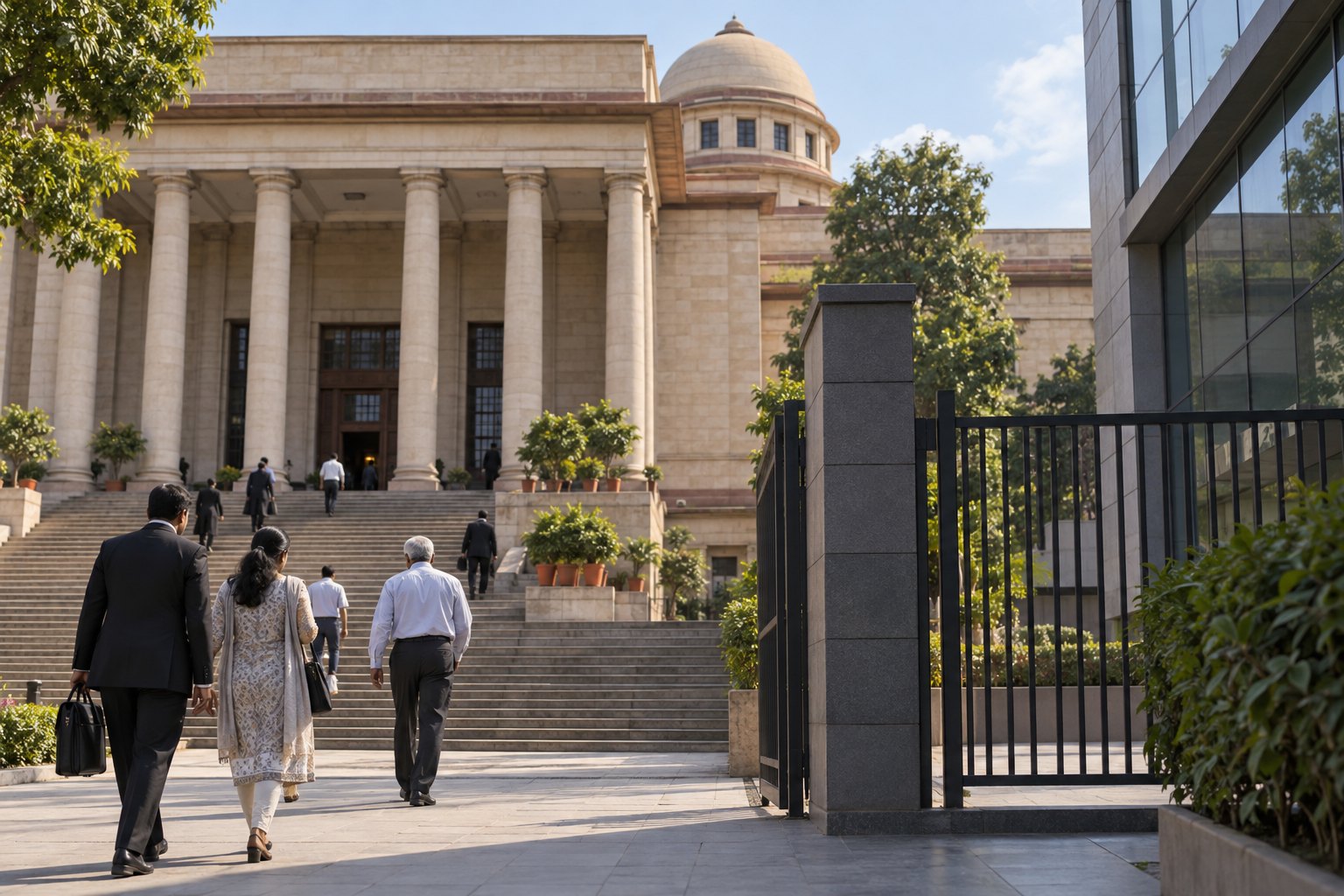
Article 226 lets a High Court issue writs to 'any person or authority'. A private body that is not 'State' under Article 12 can face one when it performs a public function: what counts is the function, not the body's form. In October 2026, two High Courts held neither an email service nor a book-fair organiser performs one.
Syllabus: GS2 · Constitution; GS2 · Separation of Powers; Prelims · Polity & Governance
In short
Article 226 lets a High Court issue writs to 'any person or authority', so a private body outside Article 12's 'State' can answer one when it performs a public function.
The public-function test rightly looks at the task, not the body's size; statutory duties, not stretched writs, should close the remaining gaps.
Why it matters
A user locked out of an email account, a publisher refused a stall at a book fair, or a cricketer dropped by a sports board all ask one question: can a High Court order a private body to act? If the body performs a public function, a writ petition is quick, and the body must act fairly and give reasons. If not, the person must file a civil suit, go to a consumer commission or use the company's own grievance officer, which takes longer. As private firms run more of daily life, from email to payments, this test decides how far the Constitution's standards of fairness follow power from government into the market.
Prelims pointers
- Article 226 sits in Part VI (the High Courts); Article 32 sits in Part III and is itself a fundamental right.
- Article 226(2): a High Court may issue writs where the cause of action arises, even if the respondent sits outside its territory.
- Five writs: habeas corpus (produce a detainee), mandamus (perform a duty), writ of prohibition (stop excess of jurisdiction), certiorari (quash an order), quo warranto (test a claim to office).
- Mandamus does not lie against the President or a State Governor, nor against a private body that owes no public duty.
- Quo warranto lies for a substantive public office created by statute or the Constitution; any interested person may seek it, not only an aggrieved one.
- G. Bassi Reddy v ICRISAT (2003): public functions are those similar or closely related to functions the State performs in its sovereign capacity.
- Kaushal Kishor (2023), Constitution Bench, 4:1: rights under Articles 19 and 21 can be enforced even against persons other than the State.
Practise a UPSC-style question
With reference to Article 226 of the Constitution of India, consider the following statements:
1. A High Court may issue writs for the enforcement of fundamental rights and also for any other purpose.
2. Like Article 32, Article 226 is placed in Part III of the Constitution of India.
3. A High Court may issue a writ to an authority located outside its territory if the cause of action arises within it.
Which of the statements given above is/are correct?
- (a) 1 and 2 only
- (b) 2 and 3 only
- (c) 1 and 3 only
- (d) 1, 2 and 3
Show the answer
Answer: (c) 1 and 3 only
1 is correct: Article 226 empowers High Courts to issue writs for Part III rights 'and for any other purpose', a wider reach than Article 32. 2 is incorrect: Article 226 is in Part VI, in the chapter on the High Courts; only Article 32 is in Part III and is itself a fundamental right. 3 is correct: Article 226(2) lets a High Court act where the cause of action arises, wholly or in part, even if the authority's seat is elsewhere.
More Explainers
- State Legislative Councils: Articles 168-172 and the graduates' and teachers' seats Polity
- Whales and dolphins in Indian waters: legal protection, IUCN status and strandings Environment
- The Aligarh Movement, AMU and the Article 30 minority test Polity
- Environmental clearance by States: SEIAA, SEAC and the EIA Notification, 2006 Environment
- Software vulnerabilities: CVE, CVSS, coordinated disclosure and CERT-In's role Sci-Tech
- Drug trafficking law in India: NDPS Act, PIT-NDPS, NCB and NCORD National
- Choosing the UN Secretary-General: Article 97, UNSC veto and straw polls World & IR
- UN Convention against Torture, and why India has not ratified it Polity
- NavIC: why India's navigation constellation cannot give a standalone position Sci-Tech
- International Energy Agency: membership, 90-day oil stocks and India's status World & IR
- PM Surya Ghar: Muft Bijli Yojana and the rooftop solar subsidy Economy
- HFSS foods: FSSAI's draft limits and front-of-pack warning labels National