
Adaptation finance: the Global Goal on Adaptation and the Adaptation Fund
Why in news: India's Permanent Mission to the UN sought predictable adaptation finance at a UN General Assembly event ahead of COP31, reported on 17 October 2026.
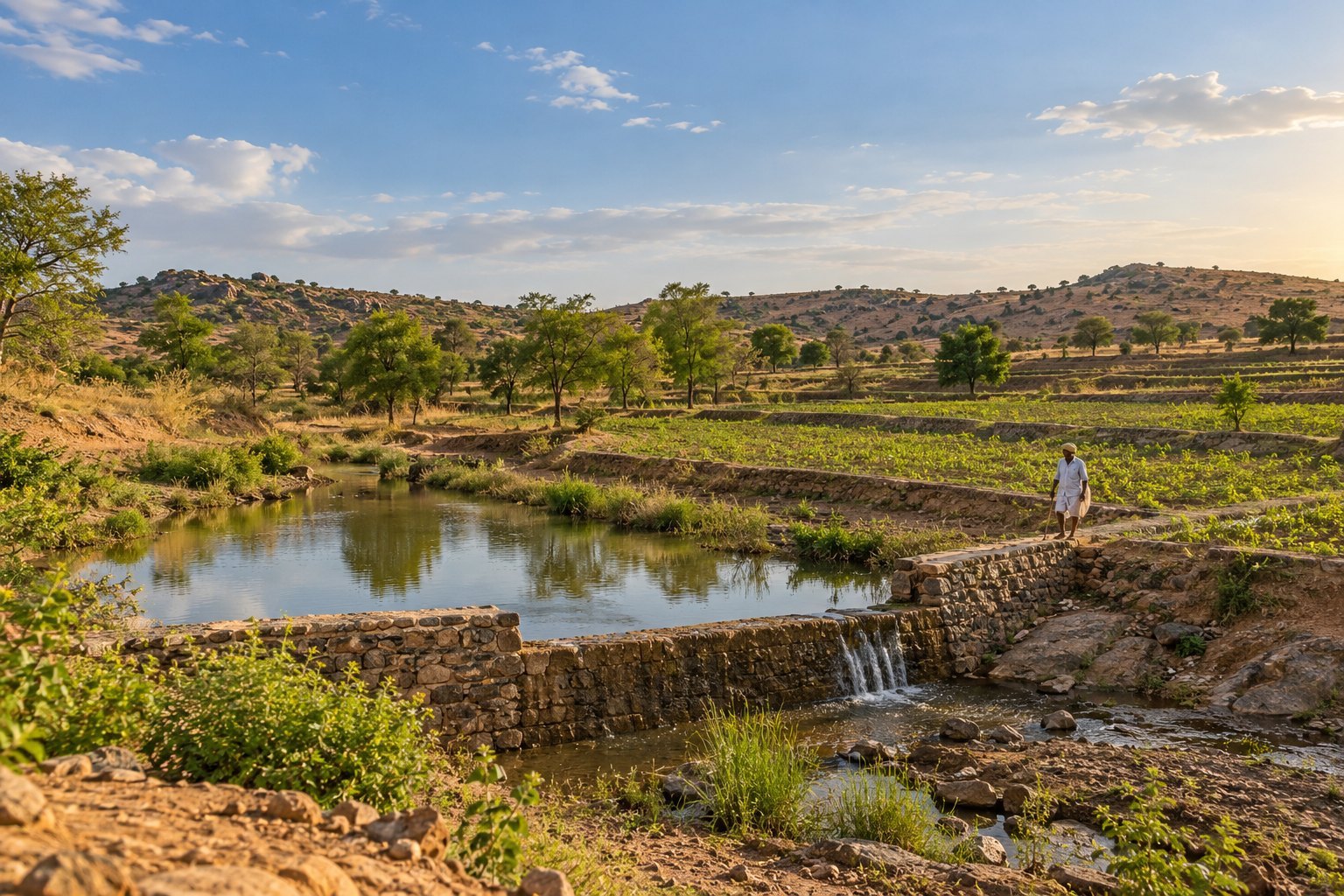
Adaptation finance is money that helps countries cope with climate impacts they cannot avoid. Article 7 of the Paris Agreement set a global goal on adaptation, and the Adaptation Fund and the Green Climate Fund channel support to developing countries. Ahead of COP31, India called for predictable adaptation finance and said its first national adaptation plan is being finalised.
Syllabus: Prelims · Environment & Ecology; GS3 · Environment & Conservation; GS2 · International Institutions
Why this matters for UPSC
GS3 environment and Prelims climate questions turn on Article 7 and Article 9 of the Paris Agreement, the Adaptation Fund and the Green Climate Fund; Mains can ask whether the new collective quantified goal meets adaptation needs.
In short
Adaptation finance pays for steps that limit unavoidable climate harm. Article 7 of the Paris Agreement sets the adaptation goal; Article 9 says who pays.
Adaptation finance will stay a promise until the Article 9.1 work programme fixes who pays and how much, in grants that reach vulnerable farmers.
Why it matters
A small farmer without irrigation feels a hot October first: seeds fail to sprout, pests spread and a banana bunch shrinks. Paying for heat-tolerant seed, water harvesting, weather alerts and crop insurance before the damage is what adaptation finance does. When that money is short, families absorb the loss, often through debt, and States divert scarce budgets to relief. Because most adaptation spending in India is still met at home, any shortfall in money promised abroad must come from budgets that also pay for schools and roads. The larger question is fairness: the countries that did least to warm the planet are left to pay most of the cost of coping with it.
Prelims pointers
- Adaptation Fund trustee: the World Bank serves as interim trustee at the invitation of the Kyoto Protocol Parties and sells the Fund's CERs.
- Green Climate Fund: set up in 2010 by the UNFCCC Parties; an operating entity of the UNFCCC Financial Mechanism.
- GCF allocation: its Board aims for a floor of 50 per cent of adaptation allocation for particularly vulnerable countries, including LDCs, SIDS and African States.
- Article 9.5, Paris Agreement: developed countries communicate indicative finance information every two years, including projected public finance where available; other providers may do so voluntarily.
- Belém Adaptation Indicators: may not be used as a condition for developing countries to access funding under the Convention and the Paris Agreement.
- NAFCC: implemented in project mode by the Ministry of Environment, Forest and Climate Change, with funds released to NABARD in instalments.
Practise a UPSC-style question
With reference to the Paris Agreement, consider the following statements:
1. Article 7 establishes a global goal on adaptation of enhancing adaptive capacity, strengthening resilience and reducing vulnerability.
2. Article 9 requires developed country Parties to provide financial resources to developing country Parties for both mitigation and adaptation.
3. Article 9 says scaled-up finance should aim at a balance between mitigation and loss and damage.
Which of the statements given above is/are correct?
- (a) 1 and 2 only
- (b) 2 and 3 only
- (c) 1 and 3 only
- (d) 1, 2 and 3
Show the answer
Answer: (a) 1 and 2 only
Answer: (a) 1 and 2 only. Article 9.4 seeks a balance between adaptation and mitigation, not loss and damage.
Statement 1: correct. Article 7.1 of the Paris Agreement establishes the global goal on adaptation in exactly these three parts, linked to the temperature goal.
Statement 2: correct. Article 9.1 says developed country Parties shall provide financial resources for both mitigation and adaptation, continuing their Convention obligations.
Statement 3: incorrect. Article 9.4 says scaled-up finance should aim to balance adaptation and mitigation, noting the need for public and grant-based resources for adaptation.
Eliminate: Judge statement 3 first: the balance in Article 9.4 is between adaptation and mitigation. Out: (b), (c), (d).
Trap: Swapped attribution. Loss and damage is a real Paris theme (Article 8), so pinning it on the Article 9.4 balance sounds plausible.
Remember: Article 7 = adaptation goal; Article 9.1 = developed countries shall pay; Article 9.4 = adaptation-mitigation balance.
More Explainers
- State Legislative Councils: Articles 168-172 and the graduates' and teachers' seats Polity
- Whales and dolphins in Indian waters: legal protection, IUCN status and strandings Environment
- The Aligarh Movement, AMU and the Article 30 minority test Polity
- Environmental clearance by States: SEIAA, SEAC and the EIA Notification, 2006 Environment
- Software vulnerabilities: CVE, CVSS, coordinated disclosure and CERT-In's role Sci-Tech
- Drug trafficking law in India: NDPS Act, PIT-NDPS, NCB and NCORD National
- Choosing the UN Secretary-General: Article 97, UNSC veto and straw polls World & IR
- UN Convention against Torture, and why India has not ratified it Polity
- NavIC: why India's navigation constellation cannot give a standalone position Sci-Tech
- International Energy Agency: membership, 90-day oil stocks and India's status World & IR
- PM Surya Ghar: Muft Bijli Yojana and the rooftop solar subsidy Economy
- HFSS foods: FSSAI's draft limits and front-of-pack warning labels National