
Law Ministry enlists National Law Universities against pendency in 100 districts
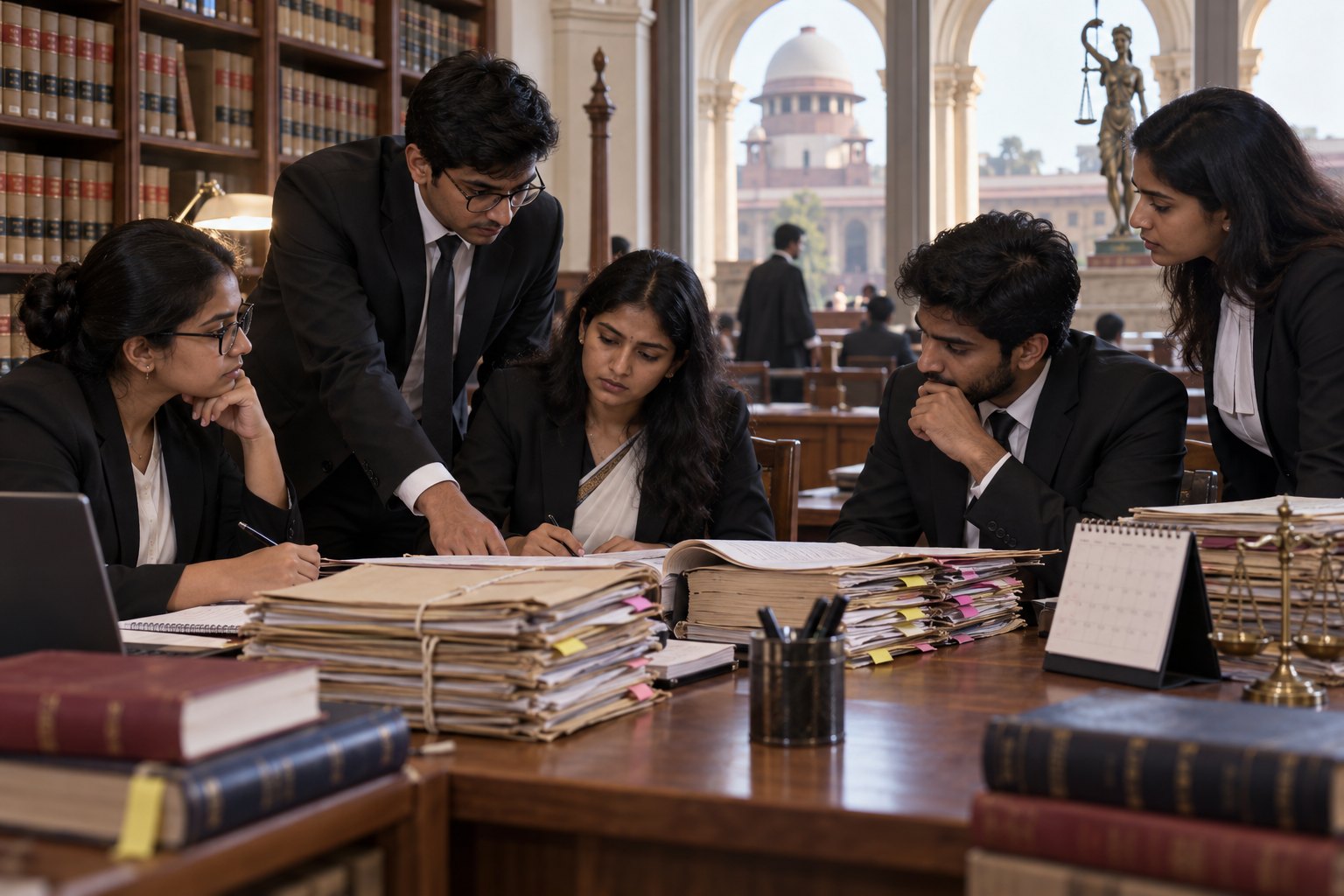
The Ministry of Law and Justice has begun a research-based mission against case pendency in 100 hotspot judicial districts and has asked 19 National Law Universities from 16 States to diagnose each district's causes of delay and suggest remedies. Per the ministry, over 5.8 crore cases are pending nationwide, most of them in district and subordinate courts.
Syllabus: GS2 · Separation of Powers; Prelims · Polity & Governance; GS2 · Executive & Judiciary
Why this matters for UPSC
GS2 Mains, on the structure and functioning of the Judiciary and dispute redressal, can ask about judicial pendency; Prelims can ask about plea bargaining and summary trials under the BNSS, Article 39A and NALSA.
Why it matters
A villager accused of a petty theft, or a family waiting on a land dispute, can spend years going back to the same court because hearings are adjourned and old files never close. When cases pile up in a few districts, the delay falls hardest on people who cannot afford lawyers, and undertrials can spend long spells in jail before any verdict. If law students map why cases stall in each district, remedies can be matched to the real cause: a weak prosecution, missing witnesses or cases that are simply dead. The larger question is whether quicker routes such as plea bargaining and mediation can speed justice without pressuring the poor into giving up a fair trial.
Prelims pointers
- Plea bargaining (BNSS, Chapter XXIII): unavailable for offences punishable with death, life imprisonment or over seven years; application within 30 days of framing of charge.
- Plea bargaining sentence (BNSS section 293): half the minimum punishment, one-fourth for a first-time offender; with no minimum, one-fourth of the maximum, one-sixth for a first-time offender.
- A plea-bargaining judgment is final: only a special leave petition under Article 136 or writs under Articles 226 and 227 lie against it.
- Summary trial (BNSS section 283): theft or receiving stolen property worth up to Rs 20,000; other offences up to three years' imprisonment, for recorded reasons.
- Legal Services Authorities Act, 1987: came into force on 9 November 1995; section 12 entitles persons in custody, women, children, SC and ST members to free legal services.
- A State Legal Services Authority's Patron-in-Chief is the Chief Justice of the High Court; a District Legal Services Authority is chaired by the District Judge.
- BNSS section 479: an undertrial for an offence not punishable with death or life imprisonment is ordinarily released after one-half of the maximum term (one-third, on bond, for first-time offenders).
Practise a UPSC-style question
With reference to plea bargaining under the Bharatiya Nagarik Suraksha Sanhita, 2023, consider the following statements:
1. It is available for offences punishable with imprisonment of up to ten years.
2. An accused may apply for it within thirty days from the date of framing of charge.
Which of the statements given above is/are correct?
- (a) 1 only
- (b) 2 only
- (c) Both 1 and 2
- (d) Neither 1 nor 2
Show the answer
Answer: (b) 2 only
Answer: (b) 2 only. Plea bargaining is limited to offences punishable up to seven years, and the application window is 30 days from framing of charge.
Statement 1: incorrect. Section 289 of the BNSS, 2023 excludes offences punishable with death, life imprisonment or imprisonment exceeding seven years, not ten.
Statement 2: correct. Section 290 of the BNSS, 2023 lets the accused apply within thirty days from the date of framing of charge, in the court where the case is pending.
Eliminate: Statement 1 sets the ceiling at ten years, but the BNSS ceiling is seven. Out: (a), (c).
Eliminate: Statement 2 matches the 30-day window in section 290. Out: (d).
Trap: Near-miss figure. The ten-year ceiling sounds plausible, and the 60 days in the same section is the time for working out a settlement, not for applying.
Remember: Plea bargaining: offences up to 7 years; apply within 30 days of framing of charge.
More from the 15 October 2026 edition
- IMF Fiscal Monitor urges better tax design as sovereign yields rise Economy
- DoT orders Calling Name Presentation on 4G and above from 1 November National
- India asks OHCHR at UN Third Committee for PoK rights report World & IR
- Article 243E: Allahabad HC orders UP panchayat polls within three months Polity
- India leads IBSAMAR IX naval exercise with Brazil, South Africa Defence
- Cholera spreads across 21 DR Congo provinces, WHO warns Sci-Tech
- NITI Aayog paper proposes 9.5% social discount rate for public projects Economy
- Supreme Court: professional course fees fixed before admission, not midstream Polity
- UN Security Council renews Haiti sanctions regime for a year World & IR
- Privacy: Supreme Court quashes police notice to X for journalist's data Polity
- Draft rules propose BS-VII emission norms for new cars from April 2029 Environment
- Keralam Bill proposes registering elder-care centres, recognising living wills National