
India asks OHCHR at UN Third Committee for PoK rights report
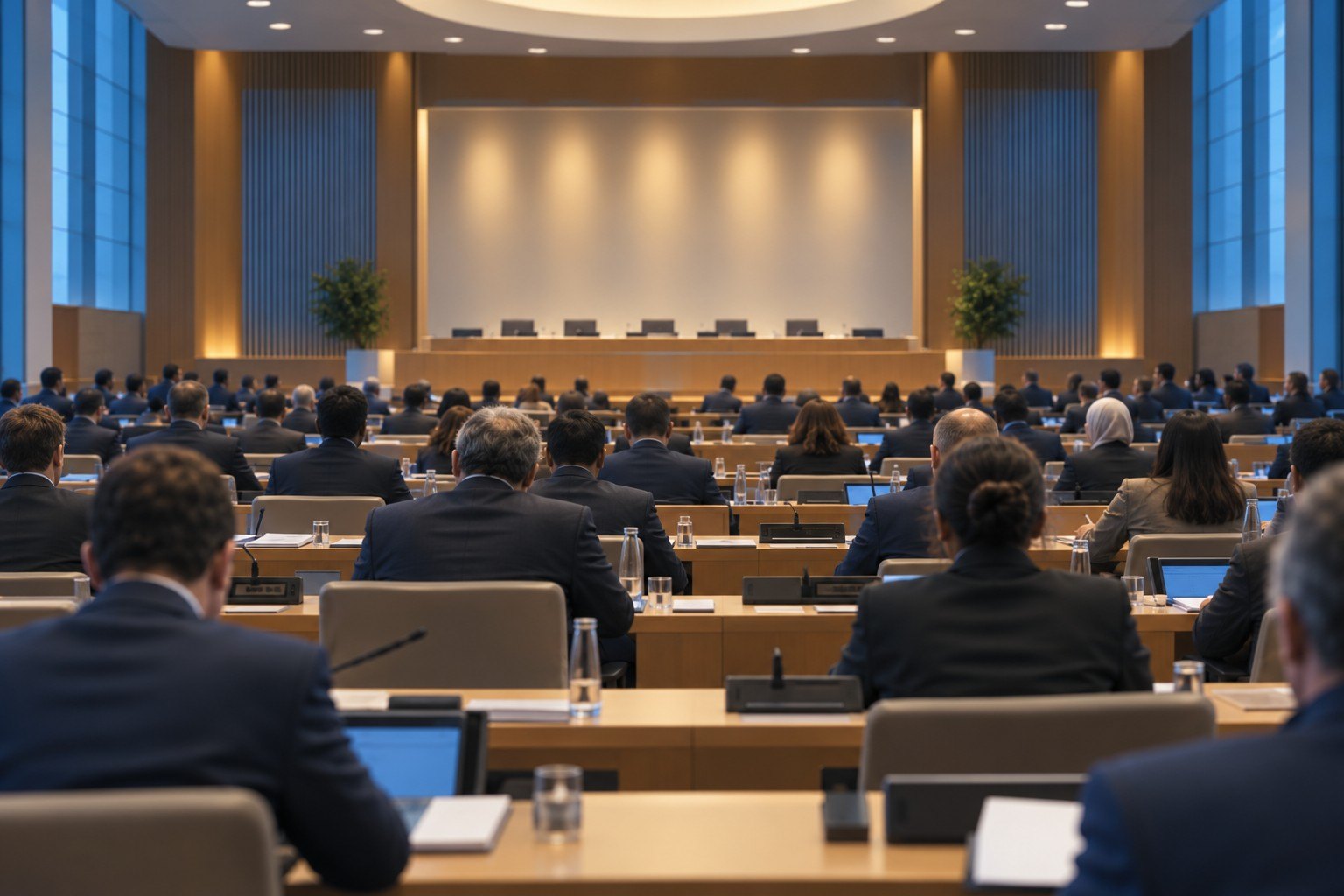
India on 14 October 2026 asked the Office of the High Commissioner for Human Rights (OHCHR) when it would report on Pakistan's steps in Pakistan-occupied Kashmir (PoK), at the UN General Assembly's Third Committee. India cited the OHCHR's own calls for impartial probes into killings, fair trials for detained leaders and an end to internet curbs there.
Syllabus: Prelims · Current Affairs & IR; GS2 · India & its Neighbourhood; GS2 · International Institutions
Why this matters for UPSC
GS2 international relations: India and its neighbourhood, and international institutions. Prelims can ask about the General Assembly's Main Committees, the High Commissioner under resolution 48/141 and the Human Rights Council; Mains, about selectivity in UN human rights scrutiny.
Why it matters
People in PoK who lost relatives in the summer's unrest, or were cut off from the internet, depend on outside scrutiny because their own government is the party accused. A formal question at the General Assembly puts that on the UN record and presses the OHCHR to show whether it followed up. For India, the move answers criticism of its own handling of protests: it argues that the Office comments on some countries and stays silent on others. If UN bodies are seen as picking targets, governments stop cooperating with them, and the people whose rights are at risk lose a forum that can name abuses.
Prelims pointers
- UNGA Main Committees: First (Disarmament and International Security), Second (Economic and Financial), Fourth (Special Political and Decolonization), Fifth (Administrative and Budgetary), Sixth (Legal).
- Third Committee subjects: advancement of women, protection of children, indigenous issues, refugees, elimination of racism and racial discrimination, and the right to self-determination.
- High Commissioner appointment (resolution 48/141): by the UN Secretary-General, approved by the General Assembly, with geographical rotation; fixed four-year term, renewable once.
- The High Commissioner is accountable to the Secretary-General, advises the Secretary-General on UN human rights policy and represents the Secretary-General at human rights meetings.
- Human Rights Council: established on 15 March 2006 by General Assembly resolution 60/251; reports directly to the General Assembly; replaced the Commission on Human Rights.
- Universal Periodic Review: the Human Rights Council's review of every country's human rights record; its Working Group meets three times a year.
- UN General Assembly: set up in 1945 under the UN Charter; its main part meets from September to December each year.
Practise a UPSC-style question
With reference to the Third Committee of the United Nations General Assembly, consider the following statements:
1. It is the Main Committee of the General Assembly that deals with disarmament and international security questions.
2. It hears and interacts with special rapporteurs and independent experts mandated by the Human Rights Council.
Which of the statements given above is/are correct?
- (a) 1 only
- (b) 2 only
- (c) Both 1 and 2
- (d) Neither 1 nor 2
Show the answer
Answer: (b) 2 only
Answer: (b) 2 only. The Third Committee handles social, humanitarian and cultural questions, including human rights.
Statement 1: incorrect. Disarmament and international security belong to the First Committee; the Third Committee is the Social, Humanitarian and Cultural Committee.
Statement 2: correct. Its work includes human rights questions, and it hears special rapporteurs, independent experts and chairs of treaty bodies mandated by the Human Rights Council.
Eliminate: Statement 1 is surest to judge: disarmament is the First Committee's subject, so it is wrong. Out: (a), (c).
Eliminate: Statement 2 holds, since the Committee hears the Council's special procedures. Out: (d).
Trap: Swapped attribution. The subject of the First Committee is pinned on the Third, counting on students who know the six committees only by number.
Remember: First is disarmament, Third is social, humanitarian and cultural, Sixth is legal.
More from the 15 October 2026 edition
- IMF Fiscal Monitor urges better tax design as sovereign yields rise Economy
- DoT orders Calling Name Presentation on 4G and above from 1 November National
- Article 243E: Allahabad HC orders UP panchayat polls within three months Polity
- India leads IBSAMAR IX naval exercise with Brazil, South Africa Defence
- Cholera spreads across 21 DR Congo provinces, WHO warns Sci-Tech
- NITI Aayog paper proposes 9.5% social discount rate for public projects Economy
- Supreme Court: professional course fees fixed before admission, not midstream Polity
- UN Security Council renews Haiti sanctions regime for a year World & IR
- Privacy: Supreme Court quashes police notice to X for journalist's data Polity
- Draft rules propose BS-VII emission norms for new cars from April 2029 Environment
- Keralam Bill proposes registering elder-care centres, recognising living wills National
- NITI Aayog framework ties State data-centre approvals to water, power Economy