
UN Security Council renews Haiti sanctions regime for a year
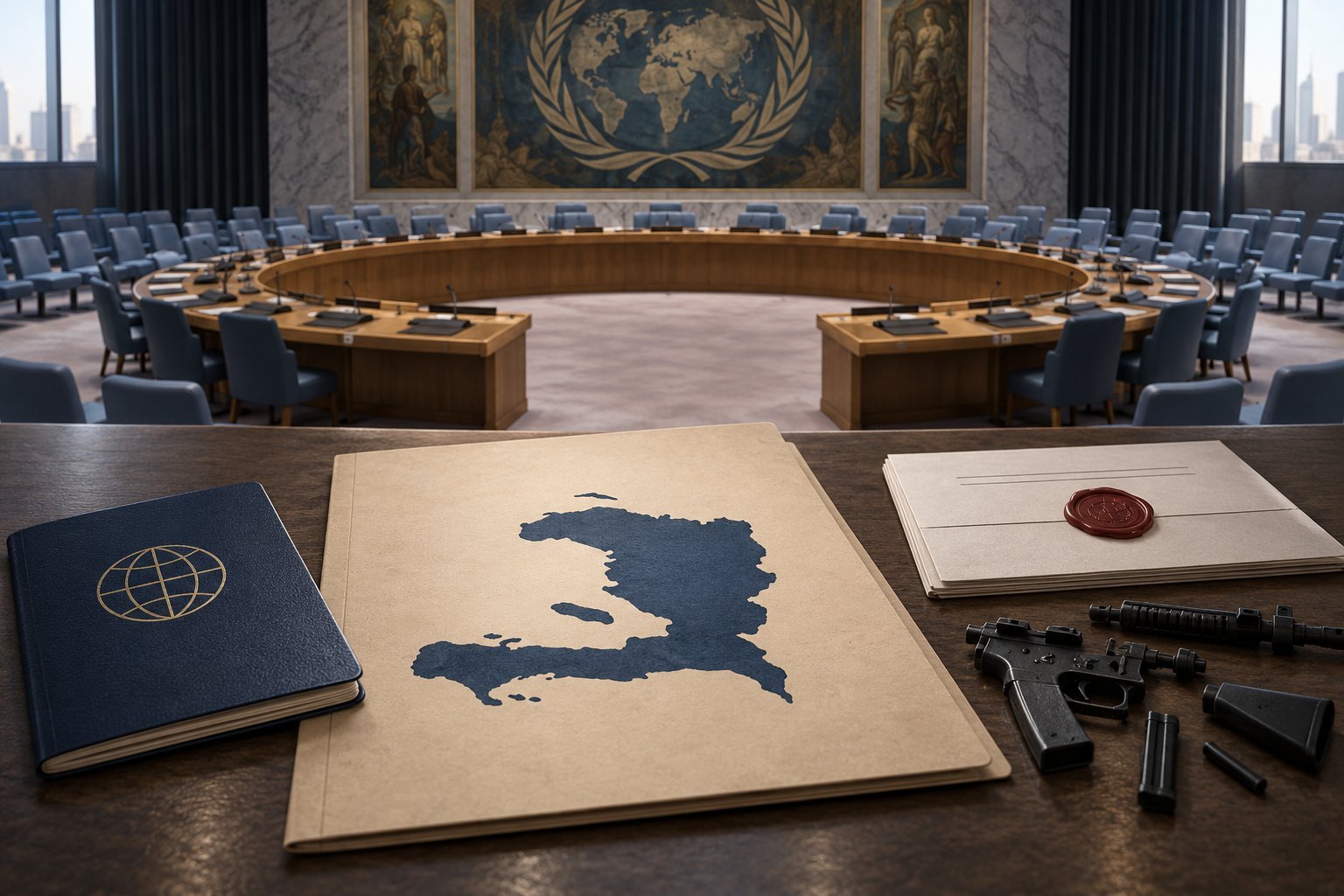
The UN Security Council on 14 October 2026 adopted resolution 2831, renewing for one year the Haiti sanctions regime of a travel ban, an asset freeze and an arms embargo. The vote was 14 in favour and none against, with the Russian Federation abstaining. Nine individuals and two groups are currently on the sanctions list.
Syllabus: Prelims · Current Affairs & IR; GS3 · Border Security & Organised Crime; GS2 · International Institutions
Why this matters for UPSC
GS2, important international institutions: Prelims can ask Chapter VII and Article 41 of the UN Charter, Security Council voting and how a sanctions committee works; Mains, whether targeted sanctions curb armed groups.
Why it matters
Haiti makes none of the guns its gangs use, so cutting the flow of weapons and money is one of the few levers the world has. For a family in Port-au-Prince, a seized shipment can mean one less gang raid on their street; an asset freeze that banks apply slowly means gang leaders and their backers keep paying fighters. The renewal keeps the legal duty on every UN member to stop arms, travel and money reaching listed people. It also shows the limits of sanctions: a list of a few names cannot reach the wider network of political and business patrons who fund the gangs, which is why some Council members want the list expanded.
Prelims pointers
- Article 39, UN Charter: the Security Council determines any threat to the peace, breach of the peace or act of aggression before choosing measures.
- Article 42, UN Charter: if non-military measures prove inadequate, the Council may act by air, sea or land forces.
- Article 25, UN Charter: Member States agree to accept and carry out the decisions of the Security Council.
- Article 27, UN Charter: substantive decisions need nine affirmative votes including the concurring votes of the five permanent members.
- First UN sanctions regime: Southern Rhodesia, 1966; Haiti has had two UN sanctions regimes, the current one under resolution 2653.
- Office of the Ombudsperson: reviews delisting requests only under the ISIL (Da'esh) and Al-Qaida sanctions regime; others use the Focal Point for De-listing.
- Resolution 2653 listing grounds include arms trafficking, sexual and gender-based violence, attacks on UN missions and obstructing humanitarian aid.
Practise a UPSC-style question
With reference to the powers of the UN Security Council under the UN Charter, consider the following statements:
1. Sanctions such as interrupting economic relations are measures not involving armed force under Article 41.
2. Under Article 25, Member States agree to accept and carry out the decisions of the General Assembly.
Which of the statements given above is/are correct?
- (a) 1 only
- (b) 2 only
- (c) Both 1 and 2
- (d) Neither 1 nor 2
Show the answer
Answer: (a) 1 only
Answer: (a) 1 only. Article 41 covers sanctions; Article 25 binds members to Security Council decisions, not the General Assembly's.
Statement 1: correct. Article 41 lets the Council decide measures without armed force, including interruption of economic relations and communications.
Statement 2: incorrect. Article 25 says Members accept and carry out the decisions of the Security Council; General Assembly resolutions are generally recommendations.
Eliminate: Statement 2 names the General Assembly, whose resolutions do not bind members. Out: (b), (c).
Eliminate: Statement 1 is the textbook basis of every UN sanctions regime. Out: (d).
Trap: Swapped attribution. The binding duty of Article 25 is pinned on the General Assembly instead of the Security Council.
Remember: Article 41 is sanctions, Article 42 is force, Article 25 makes Council decisions binding.
More from the 15 October 2026 edition
- IMF Fiscal Monitor urges better tax design as sovereign yields rise Economy
- DoT orders Calling Name Presentation on 4G and above from 1 November National
- India asks OHCHR at UN Third Committee for PoK rights report World & IR
- Article 243E: Allahabad HC orders UP panchayat polls within three months Polity
- India leads IBSAMAR IX naval exercise with Brazil, South Africa Defence
- Cholera spreads across 21 DR Congo provinces, WHO warns Sci-Tech
- NITI Aayog paper proposes 9.5% social discount rate for public projects Economy
- Supreme Court: professional course fees fixed before admission, not midstream Polity
- Privacy: Supreme Court quashes police notice to X for journalist's data Polity
- Draft rules propose BS-VII emission norms for new cars from April 2029 Environment
- Keralam Bill proposes registering elder-care centres, recognising living wills National
- NITI Aayog framework ties State data-centre approvals to water, power Economy