
Draft rules propose BS-VII emission norms for new cars from April 2029
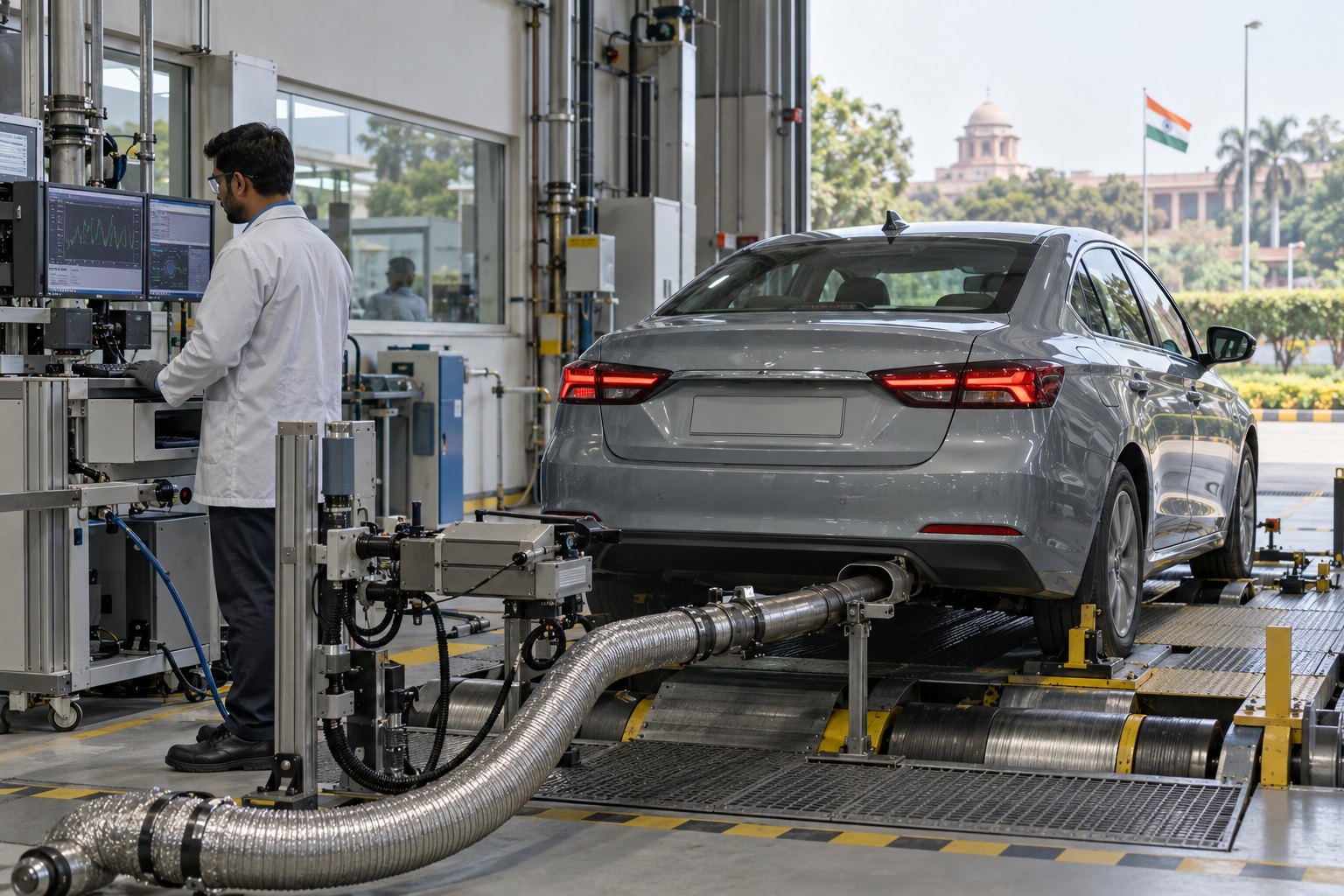
The Ministry of Road Transport and Highways has proposed Bharat Stage VII (BS-VII) emission norms for M1 vehicles, mainly passenger cars, made from 1 April 2029, in a draft notification dated 12 October 2026. Further phases in 2031 and 2035 would add brake-particle and tyre-abrasion limits. Public comments are invited for 30 days.
Syllabus: Prelims · Environment & Ecology; GS3 · Infrastructure; GS3 · Environment & Conservation
Why this matters for UPSC
GS3 environmental pollution and infrastructure: Prelims can ask about Bharat Stage norms, the BS-V leapfrog, BS-VI fuel sulphur and real driving emissions; Mains, about controlling vehicular air pollution, including non-exhaust emissions.
Why it matters
Anyone buying a new car from 2029 would get one that pollutes less on real roads, not just in a test lab, and would be told its emissions, fuel use and battery health through a vehicle passport. People living beside busy roads breathe what vehicles shed, and as tailpipes get cleaner, dust from brakes and tyres makes up more of it; an electric car still produces that dust. Owners of electric cars would gain a promised floor on how fast their battery wears out. Carmakers would need new parts and testing, which may raise prices. The larger issue is how India controls urban air pollution while vehicle numbers keep rising.
Prelims pointers
- BS-V leapfrog: in January 2016 the road transport ministry decided to move directly from BS-IV to BS-VI from 1 April 2020, skipping BS-V.
- Fuel sulphur: at most 50 ppm under BS-IV and 10 ppm under BS-VI, which allowed Diesel Particulate Filters (particulate matter) and Selective Catalytic Reduction (NOx).
- Supreme Court order of 24 October 2018: no BS-IV vehicle to be sold or registered in India from 1 April 2020.
- M1 category: a motor vehicle carrying passengers, with not more than eight seats besides the driver's seat.
- Rule 115G, Central Motor Vehicles Rules, 1989: Fuel Consumption Standards; a July 2022 draft notification proposed widening them beyond M1 cars to light, medium and heavy vehicles.
- Auto Fuel Policy: an expert committee under Dr R. A. Mashelkar, Director General of CSIR, set up in 2001, drew the road map for fuel quality.
- Euro 7: the EU standard proposed by the European Commission in November 2022, covering light and heavy vehicles, brake and tyre emissions and battery durability.
Practise a UPSC-style question
With reference to the Bharat Stage emission norms in India, consider the following statements:
1. India moved from BS-IV directly to BS-VI norms from 1 April 2020, skipping BS-V altogether.
2. BS-VI grade auto fuel may carry at most 10 parts per million of sulphur.
Which of the statements given above is/are correct?
- (a) 1 only
- (b) 2 only
- (c) Both 1 and 2
- (d) Neither 1 nor 2
Show the answer
Answer: (c) Both 1 and 2
Answer: (c) Both 1 and 2. Both statements describe the BS-VI switch correctly.
Statement 1: correct. The Ministry of Road Transport and Highways decided in January 2016 to leapfrog from BS-IV to BS-VI from 1 April 2020 and to skip BS-V.
Statement 2: correct. BS-VI fuel allows at most 10 ppm of sulphur, down from 50 ppm under BS-IV, per the Ministry of Petroleum and Natural Gas.
Eliminate: Statement 1 is the surest: the skipped BS-V stage is the best-known fact of the switch. Out: (b), (d).
Eliminate: Statement 2 is also correct, so 1 cannot stand alone. Out: (a).
Trap: Near-miss figure. The 50 ppm limit belongs to BS-IV fuel; a student who mixes the two stages doubts the correct 10 ppm figure in statement 2.
Remember: Sulphur in fuel: BS-IV 50 ppm, BS-VI 10 ppm; BS-V was skipped.
More from the 15 October 2026 edition
- IMF Fiscal Monitor urges better tax design as sovereign yields rise Economy
- DoT orders Calling Name Presentation on 4G and above from 1 November National
- India asks OHCHR at UN Third Committee for PoK rights report World & IR
- Article 243E: Allahabad HC orders UP panchayat polls within three months Polity
- India leads IBSAMAR IX naval exercise with Brazil, South Africa Defence
- Cholera spreads across 21 DR Congo provinces, WHO warns Sci-Tech
- NITI Aayog paper proposes 9.5% social discount rate for public projects Economy
- Supreme Court: professional course fees fixed before admission, not midstream Polity
- UN Security Council renews Haiti sanctions regime for a year World & IR
- Privacy: Supreme Court quashes police notice to X for journalist's data Polity
- Keralam Bill proposes registering elder-care centres, recognising living wills National
- NITI Aayog framework ties State data-centre approvals to water, power Economy