
Article 243E: Allahabad HC orders UP panchayat polls within three months
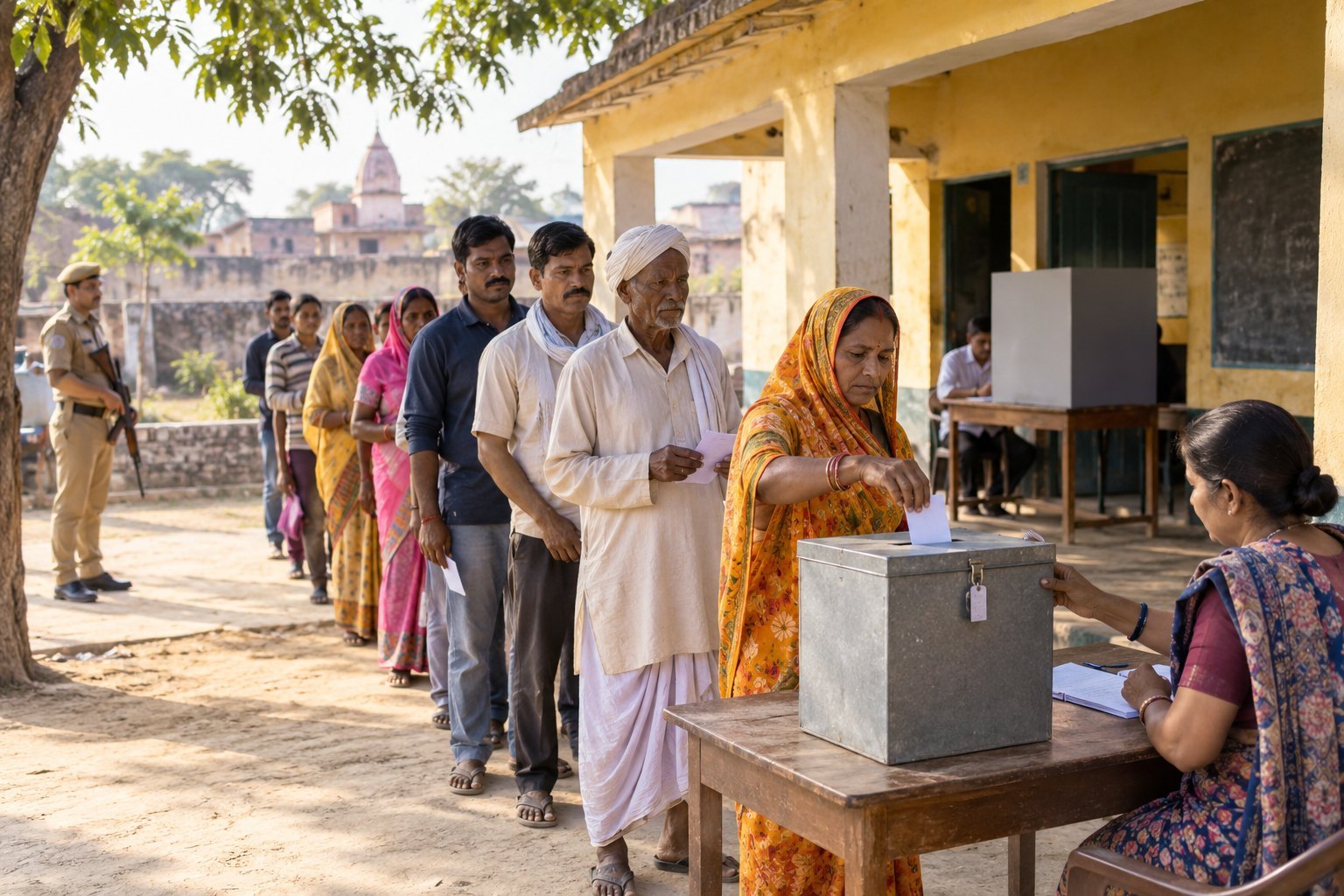
The Allahabad High Court on 14 October 2026 directed the Uttar Pradesh government and the State Election Commission to complete three-tier panchayat polls within three months. A division bench upheld outgoing gram pradhans serving as administrators meanwhile. The polls will follow existing rules with the 27 per cent reservation provision, without waiting for the State's OBC Commission.
Syllabus: GS2 · Federalism & Local Government; Prelims · Polity & Governance; GS2 · Constitutional Bodies
Why this matters for UPSC
GS2, Panchayati Raj and constitutional bodies: Prelims can ask Article 243E's five-year term and six-month rule, the State Election Commission under Article 243K and Article 243D(6); Mains, about delayed local elections.
Why it matters
Villagers in Uttar Pradesh have been governed by former heads whose elected terms have ended, so local works, spending and complaints are handled by people no fresh vote has chosen. The deadline means villages should elect new heads and members within three months instead of waiting indefinitely. Reservation will follow the existing rules, as the court directed, rather than wait for the OBC Commission to finish its exercise. The larger question is whether a State can keep an elected body's place filled by administrators while its constitutional term has run out, and who answers for the delay: the State government or the election commission.
Prelims pointers
- Article 243E(1): a Panchayat continues five years from the date appointed for its first meeting, unless dissolved sooner under any law in force.
- Article 243E(3): the election must be completed before the term expires, or within six months of dissolution; none is needed if under six months remain.
- Article 243E(4): a Panchayat elected after an early dissolution serves only the remainder of the dissolved body's term.
- Article 243K(2): the State Election Commissioner can be removed only like a High Court Judge; service conditions cannot be varied to his disadvantage after appointment.
- Article 243K(4): subject to the Constitution, the State Legislature makes the law on all matters of panchayat elections.
- Article 243D(3): not less than one-third of directly elected seats in every Panchayat are reserved for women.
- Article 243O(b): a panchayat election can be questioned only by an election petition under a law of the State Legislature.
- Article 243I: the Governor constitutes a Finance Commission every fifth year to review the financial position of the Panchayats.
Practise a UPSC-style question
With reference to Article 243E of the Constitution of India, consider the following statements:
1. After a Panchayat is dissolved early, the election to reconstitute it must be completed within one year of the dissolution.
2. Every Panchayat, unless dissolved sooner under law, continues for five years from the date appointed for its first meeting.
Which of the statements given above is/are correct?
- (a) 1 only
- (b) 2 only
- (c) Both 1 and 2
- (d) Neither 1 nor 2
Show the answer
Answer: (b) 2 only
Answer: (b) 2 only. Article 243E(1) fixes the five-year term; the deadline after early dissolution is six months, not one year.
Statement 1: incorrect. Article 243E(3)(b) requires the election to be completed before six months pass from the date of dissolution.
Statement 2: correct. Article 243E(1) says a Panchayat continues for five years from the date appointed for its first meeting and no longer, unless dissolved sooner.
Eliminate: Statement 1 changes six months to one year, so it is wrong. Out: (a), (c).
Eliminate: Statement 2 restates Article 243E(1) as written, so it is right. Out: (d).
Trap: Near-miss figure. The first statement keeps the real rule of a time limit after dissolution but stretches six months to a year.
Remember: Article 243E: five years from the first meeting; a fresh election within six months of dissolution.
More from the 15 October 2026 edition
- IMF Fiscal Monitor urges better tax design as sovereign yields rise Economy
- DoT orders Calling Name Presentation on 4G and above from 1 November National
- India asks OHCHR at UN Third Committee for PoK rights report World & IR
- India leads IBSAMAR IX naval exercise with Brazil, South Africa Defence
- Cholera spreads across 21 DR Congo provinces, WHO warns Sci-Tech
- NITI Aayog paper proposes 9.5% social discount rate for public projects Economy
- Supreme Court: professional course fees fixed before admission, not midstream Polity
- UN Security Council renews Haiti sanctions regime for a year World & IR
- Privacy: Supreme Court quashes police notice to X for journalist's data Polity
- Draft rules propose BS-VII emission norms for new cars from April 2029 Environment
- Keralam Bill proposes registering elder-care centres, recognising living wills National
- NITI Aayog framework ties State data-centre approvals to water, power Economy