
WTO Agreement on Agriculture: subsidy boxes, de minimis and the peace clause
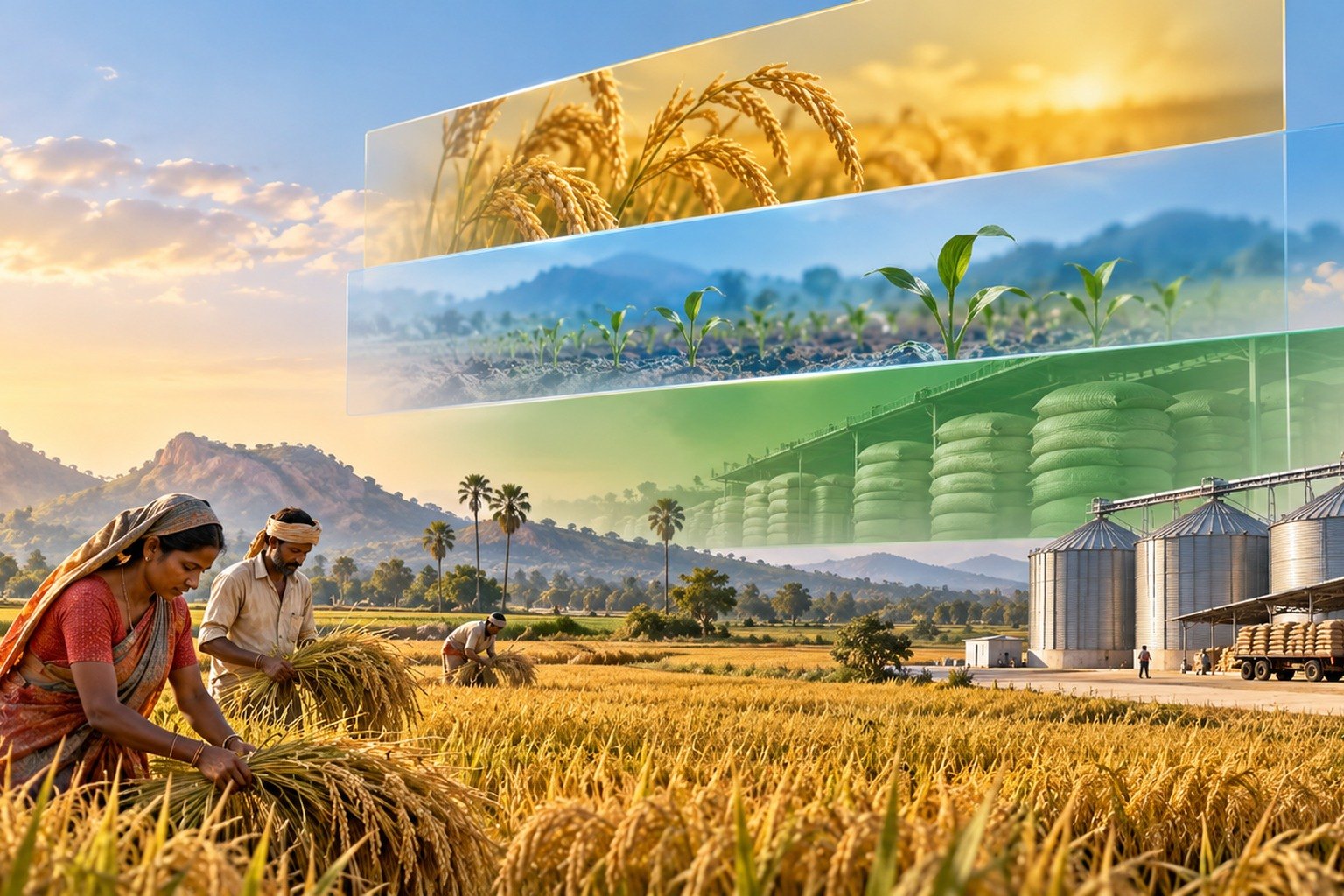
The WTO Agreement on Agriculture sorts farm subsidies into boxes: trade-distorting amber support is capped, for most developing countries at 10% of production value, while blue and green box support is not. A 2013 Bali peace clause, made open-ended in 2014, shields grain stocks bought at fixed prices. India sought priority for public stockholding at MC14 in March 2026.
Syllabus: GS3 · MSP, Subsidies & Food Security; GS2 · Groupings & Agreements; GS2 · International Institutions
Why this matters for UPSC
GS3 farm subsidies, MSP and food security, and GS2 international bodies: Prelims asks what the amber, blue and green boxes and de minimis are; Mains asks how WTO rules constrain India's public stockholding.
In short
The WTO Agreement on Agriculture, negotiated in the Uruguay Round, disciplines farm trade through market access, export competition and domestic support, sorting subsidies into colour-coded boxes.
A permanent solution with an updated reference price would let developing countries buy food for the poor without relying on a conditional legal shield.
Why it matters
A paddy or wheat farmer who sells to the government at the minimum support price, and a poor family that draws subsidised grain, both depend on India's public food stocks. If other WTO members could challenge those purchases, India would face pressure to pay farmers less or buy less, weakening farm incomes and the grain reserve that cushions droughts and price spikes. The peace clause removes that threat for now, but only for staple crops and on conditions. The larger question is whether trade rules written in the early 1990s leave developing countries enough room to support farmers and feed their people.
Prelims pointers
- Amber box is defined in Article 6 of the Agreement on Agriculture; the green box in Annex 2; developing-country development measures in Article 6.2.
- Blue box payments qualify if made on fixed area and yields, a fixed number of livestock, or 85% or less of base-period production.
- De minimis ceilings apply to both product-specific and non-product-specific support: 10% for developing members, 5% for developed members.
- AMS reduction from base-period levels: 20% over 6 years for developed members, 13% over 10 years for developing members.
- Peace clause scope: only traditional staple food crops, in stockholding programmes that existed on 7 December 2013, meeting Annex 2 criteria.
- CACP recommends MSPs for 22 crops and the Fair and Remunerative Price of sugarcane; it is an attached office of the Department of Agriculture and Farmers Welfare.
- G-33: a coalition of developing WTO members, India among them, that has proposed moving stockholding programmes into the green box.
Practise a UPSC-style question
With reference to domestic support under the WTO Agreement on Agriculture, consider the following statements:
1. Blue box support is capped at 5% of the value of agricultural production.
2. Green box support must be government-funded and must not provide price support to producers.
3. The Agreement on Agriculture has no red box of prohibited subsidies.
Which of the statements given above is/are correct?
- (a) 1 and 2 only
- (b) 2 and 3 only
- (c) 1 and 3 only
- (d) 1, 2 and 3
Show the answer
Answer: (b) 2 and 3 only
Answer: (b) 2 and 3 only. Blue box support currently has no spending limit.
Statement 1: incorrect. Blue box support, amber-type payments tied to production-limiting programmes, has no spending limit at present; 5% is the developed-country de minimis.
Statement 2: correct. Annex 2 requires green box measures to be publicly funded, not paid for by consumers through higher prices, and free of price support.
Statement 3: correct. The WTO notes that the Agriculture Agreement has no red box, though amber support above the committed limits is prohibited.
Eliminate: Statement 1 is the surest: the blue box has no ceiling. Out: (a), (c), (d).
Trap: Swapped attribution. The de minimis figure for amber support is pinned on the blue box, which has no cap.
Remember: Amber capped; blue and green uncapped; no red box in farm rules.
More Explainers
- State Legislative Councils: Articles 168-172 and the graduates' and teachers' seats Polity
- Whales and dolphins in Indian waters: legal protection, IUCN status and strandings Environment
- The Aligarh Movement, AMU and the Article 30 minority test Polity
- Environmental clearance by States: SEIAA, SEAC and the EIA Notification, 2006 Environment
- Software vulnerabilities: CVE, CVSS, coordinated disclosure and CERT-In's role Sci-Tech
- Drug trafficking law in India: NDPS Act, PIT-NDPS, NCB and NCORD National
- Choosing the UN Secretary-General: Article 97, UNSC veto and straw polls World & IR
- UN Convention against Torture, and why India has not ratified it Polity
- NavIC: why India's navigation constellation cannot give a standalone position Sci-Tech
- International Energy Agency: membership, 90-day oil stocks and India's status World & IR
- PM Surya Ghar: Muft Bijli Yojana and the rooftop solar subsidy Economy
- HFSS foods: FSSAI's draft limits and front-of-pack warning labels National