
The pulses buffer and the Price Stabilisation Fund
Why in news: As reported on 20 October 2026, States have sought tur and chana from the Centre's pulses buffer, with retail tur dal up 17.2% year-on-year.
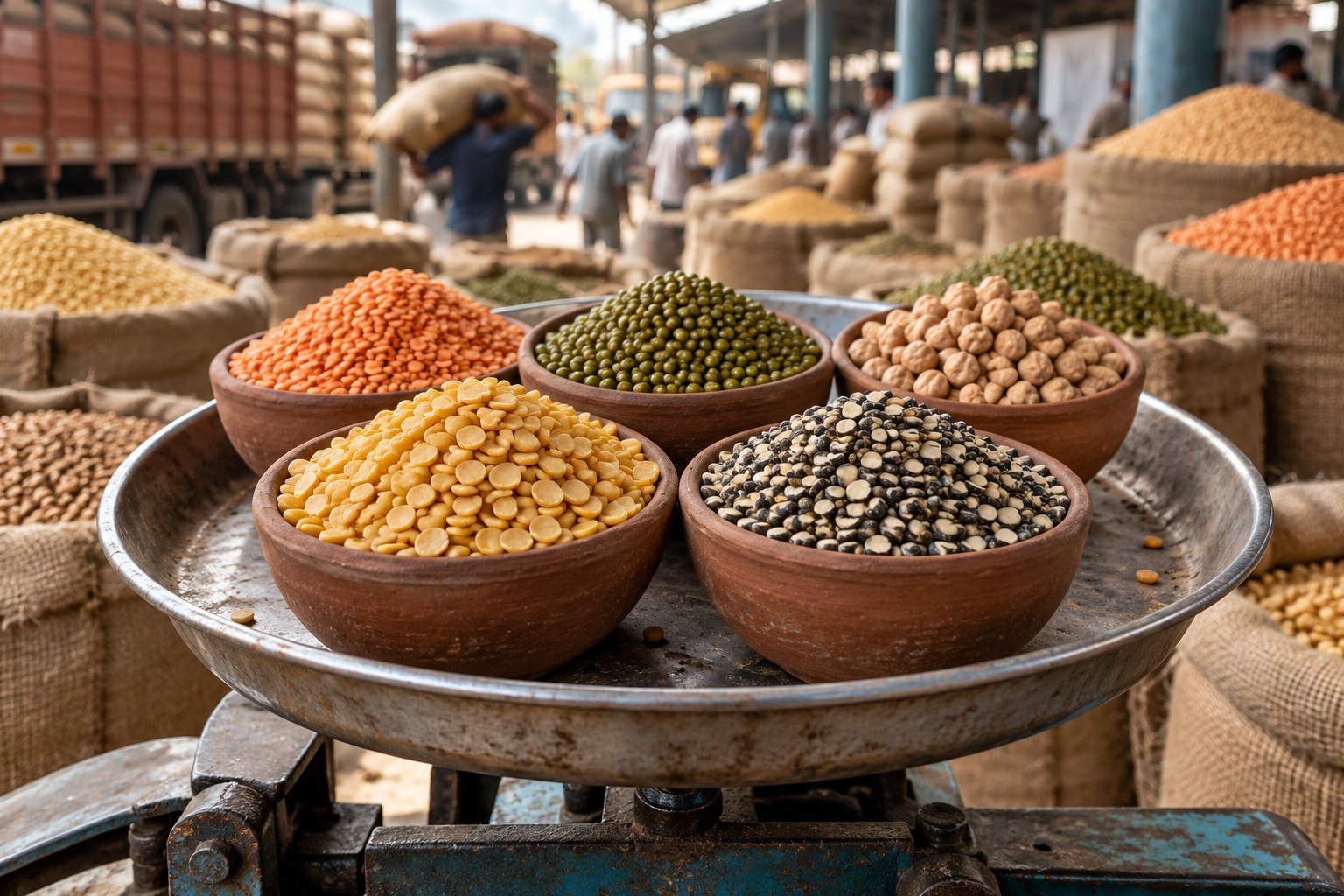
The Price Stabilisation Fund (PSF), set up in 2014-15 and run by the Department of Consumer Affairs, holds a dynamic buffer of tur, urad, moong, masur and chana, released in calibrated amounts to steady retail prices. States are now seeking tur and chana from it as prices rise, and the Centre wants the buffer kept for market intervention.
Syllabus: GS3 · Agriculture & Irrigation; GS3 · MSP, Subsidies & Food Security; Prelims · Economy & Social Development
Why this matters for UPSC
GS3 agriculture: MSP, buffer stocks and food security. Prelims can ask which department runs the Price Stabilisation Fund and how it differs from the Price Support Scheme under PM-AASHA; Mains can ask how buffer stocks stabilise prices.
In short
The Price Stabilisation Fund lets the Centre buy, hold and release pulses and onion to curb price swings, a consumer-side tool beside MSP procurement for farmers.
The buffer works only if kept for price spikes and refilled from rising domestic output, with clear rules on when States may draw on it.
Why it matters
Pulses are central to Indian diets, so a jump in dal prices hits poorer homes first: a family buying a few kilograms of tur dal a month pays noticeably more when the price climbs by a sixth in a year. A stock held by the government and sold into the market when prices spike can cool those prices without waiting for the next harvest. The same stock, bought from farmers, also gives growers a buyer. The open question is who the stock is for: States want it for their own welfare schemes, while the Centre wants to keep it for moments when the whole market needs calming.
Prelims pointers
- PSF 2015 design: interest-free advances to States and central agencies; State-level revolving funds shared 50:50 by Centre and State (75:25 for North-Eastern States); SFAC managed the central corpus.
- Earlier PSF: a 2003 fund under the Ministry of Commerce supported growers of tea, coffee, rubber and tobacco; it ended in 2013.
- PM-AASHA components since September 2024: Price Support Scheme, Price Stabilisation Fund, Price Deficit Payment Scheme and Market Intervention Scheme.
- PSS ceiling: procurement of notified pulses, oilseeds and copra at MSP is limited to 25% of national production from 2024-25; tur, urad and masur were exempt in 2024-25.
- Price Deficit Payment Scheme: an option for notified oilseeds, covering up to 40% of a State's production; the Centre bears the MSP gap up to 15% of MSP.
- Market Intervention Scheme: for perishable horticultural crops, covering 25% of production, with an option of paying the price difference into farmers' accounts.
- Mission for Aatmanirbharta in Pulses (2025-26 to 2030-31): 100% procurement of tur, urad and masoor from farmers at MSP for the next four years (from 2025).
Practise a UPSC-style question
With reference to the Price Stabilisation Fund (PSF) in India, consider the following statements:
1. It is administered by the Department of Consumer Affairs.
2. Under it, pulses are bought for the buffer at MSP whenever market prices fall below MSP.
3. Its pulses buffer covers tur, urad, moong, masur and chana.
Which of the statements given above is/are correct?
- (a) 1 and 2 only
- (b) 2 and 3 only
- (c) 1 and 3 only
- (d) 1, 2 and 3
Show the answer
Answer: (c) 1 and 3 only
Answer: (c) 1 and 3 only. The PSF is a consumer-side fund; MSP buying belongs to the Price Support Scheme.
Statement 1: correct. The PSF moved from the agriculture ministry to the Department of Consumer Affairs on 1 April 2016.
Statement 2: incorrect. Under the PSF the department buys at market price when prices rule above MSP; buying at MSP when prices fall below it is the Price Support Scheme.
Statement 3: correct. The department keeps a dynamic buffer of tur, urad, moong, masur and gram (chana), besides onion.
Eliminate: Statement 2 is the surest: MSP buying is the PSS, not the PSF. Out: (a), (b), (d).
Trap: Swapped attribution. The Price Support Scheme's MSP trigger is pinned on the Price Stabilisation Fund.
Remember: PSF buys at market price when prices are high; PSS buys at MSP when prices are low.
More Explainers
- State Legislative Councils: Articles 168-172 and the graduates' and teachers' seats Polity
- Whales and dolphins in Indian waters: legal protection, IUCN status and strandings Environment
- The Aligarh Movement, AMU and the Article 30 minority test Polity
- Environmental clearance by States: SEIAA, SEAC and the EIA Notification, 2006 Environment
- Software vulnerabilities: CVE, CVSS, coordinated disclosure and CERT-In's role Sci-Tech
- Drug trafficking law in India: NDPS Act, PIT-NDPS, NCB and NCORD National
- Choosing the UN Secretary-General: Article 97, UNSC veto and straw polls World & IR
- UN Convention against Torture, and why India has not ratified it Polity
- NavIC: why India's navigation constellation cannot give a standalone position Sci-Tech
- International Energy Agency: membership, 90-day oil stocks and India's status World & IR
- PM Surya Ghar: Muft Bijli Yojana and the rooftop solar subsidy Economy
- HFSS foods: FSSAI's draft limits and front-of-pack warning labels National