
The Kargil War of 1999 and India's higher defence reforms
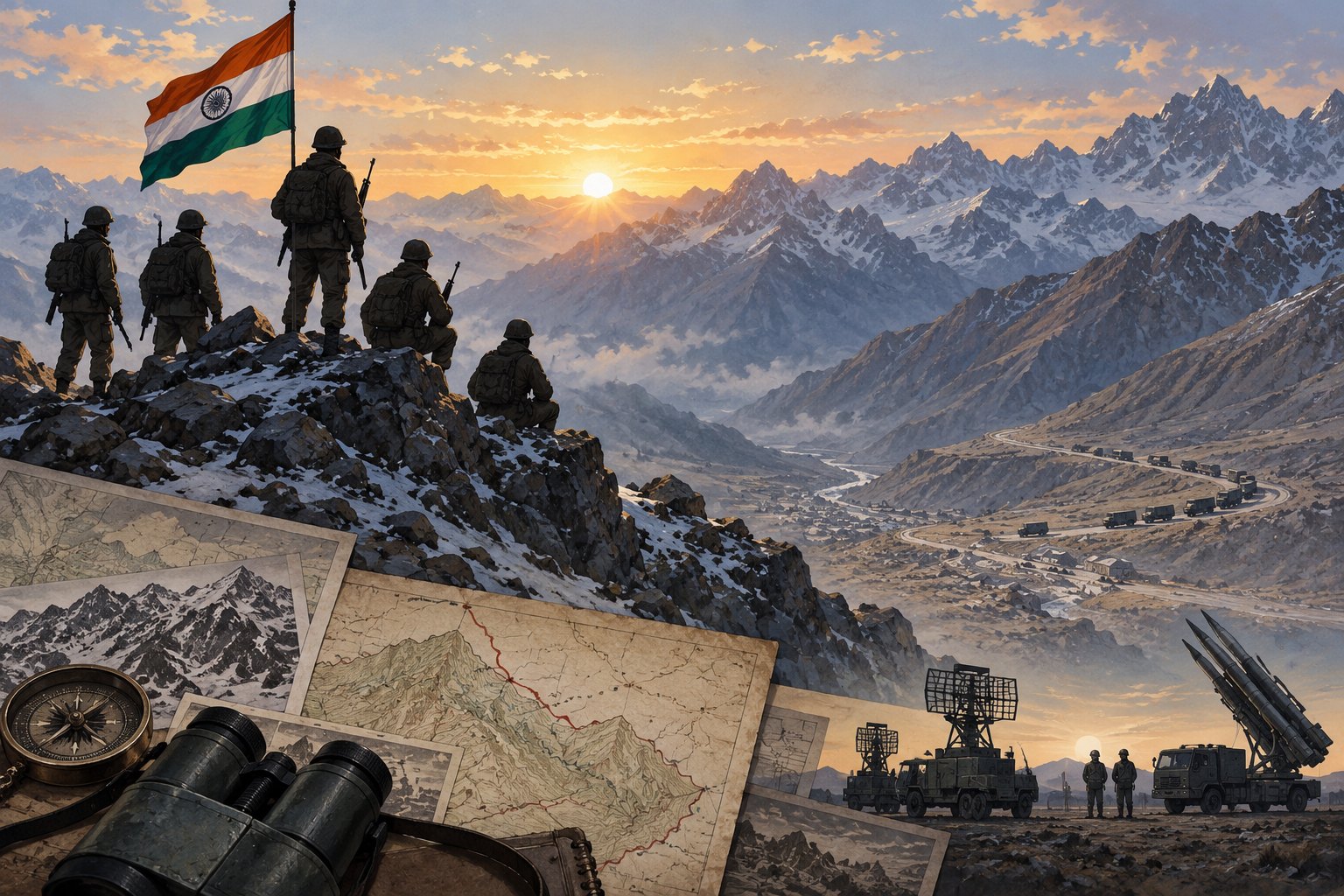
In the Kargil War of May–July 1999, Pakistani forces crossed the Line of Control to seize heights above the Srinagar–Leh highway, and India evicted them through Operation Vijay without crossing it. The Kargil Review Committee set off reforms that eventually produced the Chief of Defence Staff in 2020. The 27th Kargil Vijay Diwas fell on 26 July 2026.
Syllabus: Prelims · Current Affairs & IR; GS2 · India & its Neighbourhood; GS3 · Border Security & Organised Crime
In short
The Kargil War (May–July 1999) began when Pakistani forces crossed the Line of Control to seize Kargil's heights; the gaps it exposed set off India's higher defence reforms.
Kargil was won by courage and restraint; its reforms finish only when intelligence is fused and the three Services plan and fight as one.
Why it matters
For a soldier on a ridge above Dras, or a driver hauling supplies to Leh, Kargil decided whether the Srinagar–Leh highway, a lifeline to Ladakh, stayed open. The war showed the cost of intelligence agencies and the three Services working apart: local residents, not surveillance, first raised the alarm. The reforms since then aim to make the Army, Navy and Air Force plan, buy and fight as one, with the CDS as a single military voice to the government. India's refusal to cross the LoC in 1999 also won it diplomatic support, a lesson in pairing force with legitimacy.
Prelims pointers
- Chief of Defence Staff: four-star officer; Permanent Chairman of the Chiefs of Staff Committee; Principal Military Adviser to the Raksha Mantri on tri-Service matters; commands none of the Service Chiefs.
- Department of Military Affairs: created in 2020 within the Ministry of Defence; the CDS is its Secretary; it promotes jointness in doctrine, planning and procurement.
- Andaman & Nicobar Command: created on 8 October 2001 for the islands, with Army, Navy, Air Force and Coast Guard under one command.
- Strategic Forces Command: the Cabinet Committee on Security approved its Commander-in-Chief on 4 January 2003, while reviewing India's nuclear doctrine.
- Line of Control: the ceasefire line of December 1971, set as the LoC under the Simla Agreement of 1972; it ends at grid point NJ 9842, short of Siachen.
- Zoji La: pass on the Srinagar–Leh highway linking Sonamarg in the Kashmir valley with Dras in Ladakh.
- Wartime gallantry awards, highest first: Param Vir Chakra, Maha Vir Chakra, Vir Chakra; the Ashoka Chakra series honours gallantry other than in the face of the enemy.
- Lahore Declaration (February 1999): signed by the Prime Ministers of India and Pakistan, committing both to settle disputes, including Jammu and Kashmir, peacefully.
Practise a UPSC-style question
With reference to the Kargil War of 1999, consider the following pairs:
(Operation : Force that conducted it)
1. Operation Vijay : Indian Army
2. Operation Safed Sagar : Indian Navy
3. Operation Talwar : Indian Air Force
How many of the above pairs are correctly matched?
- (a) Only one
- (b) Only two
- (c) All three
- (d) None
Show the answer
Answer: (a) Only one
1 is correct: Operation Vijay was the Indian Army's operation to evict the intruders. 2 is incorrect: Operation Safed Sagar was the Indian Air Force's campaign, begun on 26 May 1999. 3 is incorrect: Operation Talwar was the Indian Navy's deployment in the Arabian Sea. Only one pair is correct.
More Explainers
- State Legislative Councils: Articles 168-172 and the graduates' and teachers' seats Polity
- Whales and dolphins in Indian waters: legal protection, IUCN status and strandings Environment
- The Aligarh Movement, AMU and the Article 30 minority test Polity
- Environmental clearance by States: SEIAA, SEAC and the EIA Notification, 2006 Environment
- Software vulnerabilities: CVE, CVSS, coordinated disclosure and CERT-In's role Sci-Tech
- Drug trafficking law in India: NDPS Act, PIT-NDPS, NCB and NCORD National
- Choosing the UN Secretary-General: Article 97, UNSC veto and straw polls World & IR
- UN Convention against Torture, and why India has not ratified it Polity
- NavIC: why India's navigation constellation cannot give a standalone position Sci-Tech
- International Energy Agency: membership, 90-day oil stocks and India's status World & IR
- PM Surya Ghar: Muft Bijli Yojana and the rooftop solar subsidy Economy
- HFSS foods: FSSAI's draft limits and front-of-pack warning labels National