
Strait of Hormuz, maritime chokepoints and transit passage under UNCLOS
Why in news: The Singapore-flagged GFS Pride sank after being struck in the strait on 13 October 2026; Iran's Guard says a mine, Singapore a projectile.
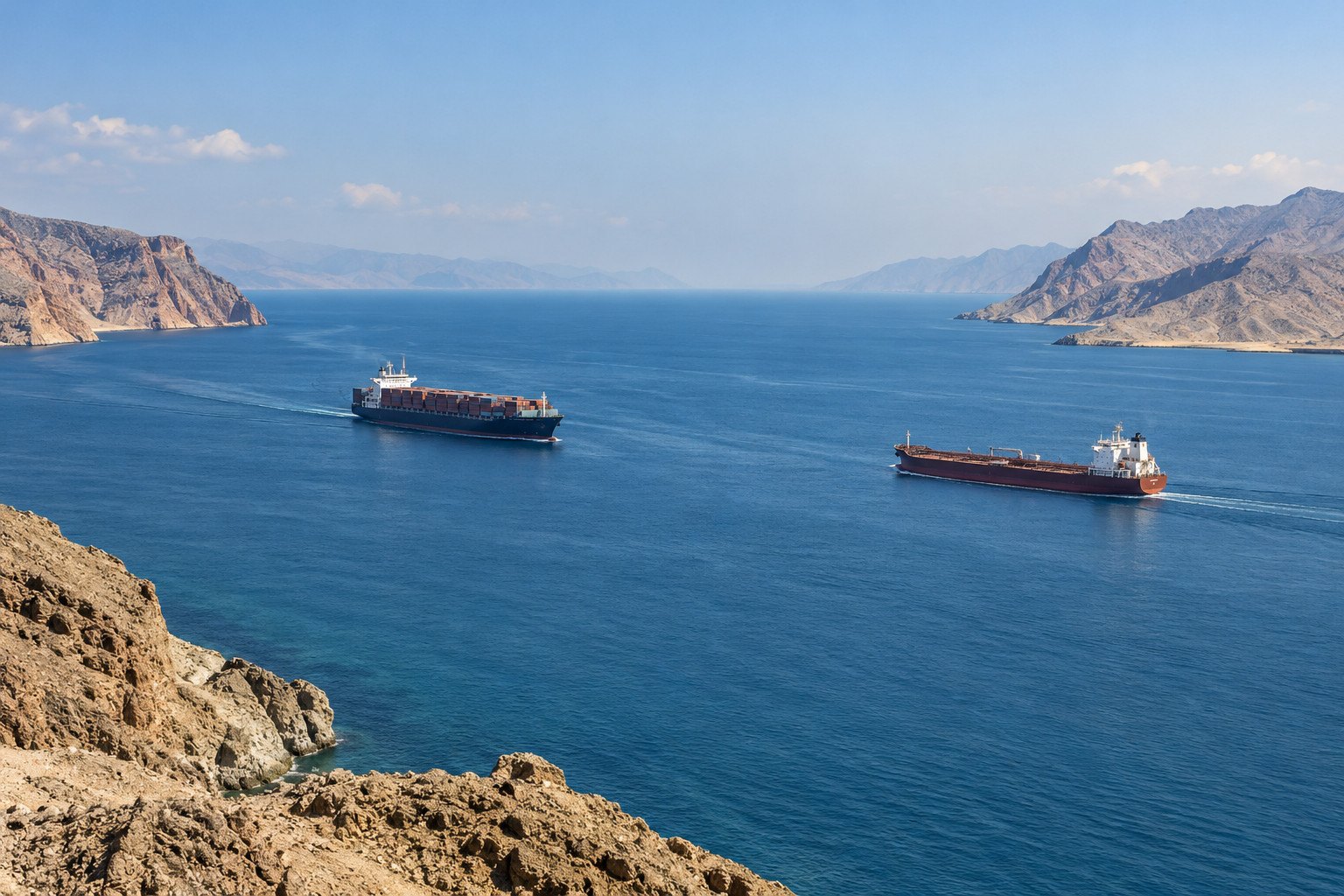
The Strait of Hormuz, between Iran and Oman's Musandam governorate, links the Persian Gulf with the Gulf of Oman and carried about a fifth of world oil consumption in 2024. UNCLOS gives all ships a right of transit passage through it that cannot be suspended. Ships hit there on 10-14 October 2026 have again tested that right.
Syllabus: Prelims · Geography; GS3 · Infrastructure; GS2 · Foreign Policies & the Diaspora
Why this matters for UPSC
GS1 geography and GS2 international relations: Prelims asks which countries border Hormuz, which seas chokepoints link and what transit passage under UNCLOS allows; Mains asks how chokepoints shape India's energy security.
In short
The Strait of Hormuz, between Iran and Oman, is the narrow outlet of the Persian Gulf and one of the world's most important oil chokepoints, governed by transit passage under UNCLOS.
Hormuz shows that India's energy security rests on freedom of navigation; India must defend transit passage while widening reserves and supply routes.
Why it matters
Petrol, diesel and cooking gas prices in India move with crude prices, and much of the crude India buys from the Gulf passes through this one narrow strait. When ships there are attacked or traffic slows, cargoes are delayed, insurance and freight costs rise, and the extra cost reaches fuel pumps and factories. Indian seafarers, who crew many ships in the Gulf, face direct danger, which is why the shipping regulator has asked recruiters to keep them out of conflict areas. The larger issue is how far a trading nation's energy security depends on the freedom of navigation that international law promises.
Prelims pointers
- UNCLOS Article 3: a State may fix its territorial sea up to 12 nautical miles, measured from baselines.
- UNCLOS Article 36: Part III does not apply where a high-seas or EEZ route of similar convenience runs through the strait.
- UNCLOS Article 40: ships in transit passage, including research and survey ships, may not survey without the bordering States' prior authorisation.
- UNCLOS Article 45: innocent passage applies in straits excluded from transit passage, and it too cannot be suspended there.
- Strait of Malacca: about 1.7 miles wide at its narrowest, in the Phillips Channel of the Singapore Strait, per the US EIA.
- Indian Strategic Petroleum Reserves: Visakhapatnam 1.33 MMT, Mangaluru 1.5 MMT, Padur 2.5 MMT; Phase II approved at Chandikhol (4 MMT) and Padur (2.5 MMT).
- Iran's Goreh-Jask pipeline ends at Jask on the Gulf of Oman, and the UAE's pipeline at Fujairah, both outside the strait.
Practise a UPSC-style question
With reference to the Strait of Hormuz, consider the following statements:
1. It connects the Persian Gulf with the Gulf of Oman.
2. Oman's Musandam governorate lies on its southern side.
3. Its northern shore belongs to Iraq.
Which of the statements given above is/are correct?
- (a) 1 and 2 only
- (b) 2 and 3 only
- (c) 1 and 3 only
- (d) 1, 2 and 3
Show the answer
Answer: (a) 1 and 2 only
Answer: (a) 1 and 2 only. Hormuz lies between Iran and Oman and joins the Persian Gulf to the Gulf of Oman.
Statement 1: correct. The strait links the Persian Gulf with the Gulf of Oman and, beyond it, the Arabian Sea, per the US EIA.
Statement 2: correct. Oman's Musandam governorate, in the extreme north of the country, faces the Strait of Hormuz.
Statement 3: incorrect. Iran forms the northern shore of the strait, opposite Oman; Iraq does not border it.
Eliminate: Statement 3 is wrong because the strait lies between Iran and Oman. Out: (b), (c), (d).
Trap: Look-alike names. Iran and Iraq are neighbours on the Gulf, and their similar names invite a swap.
Remember: Hormuz = Iran (north) and Oman's Musandam (south); Persian Gulf to Gulf of Oman.
More Explainers
- State Legislative Councils: Articles 168-172 and the graduates' and teachers' seats Polity
- Whales and dolphins in Indian waters: legal protection, IUCN status and strandings Environment
- The Aligarh Movement, AMU and the Article 30 minority test Polity
- Environmental clearance by States: SEIAA, SEAC and the EIA Notification, 2006 Environment
- Software vulnerabilities: CVE, CVSS, coordinated disclosure and CERT-In's role Sci-Tech
- Drug trafficking law in India: NDPS Act, PIT-NDPS, NCB and NCORD National
- Choosing the UN Secretary-General: Article 97, UNSC veto and straw polls World & IR
- UN Convention against Torture, and why India has not ratified it Polity
- NavIC: why India's navigation constellation cannot give a standalone position Sci-Tech
- International Energy Agency: membership, 90-day oil stocks and India's status World & IR
- PM Surya Ghar: Muft Bijli Yojana and the rooftop solar subsidy Economy
- HFSS foods: FSSAI's draft limits and front-of-pack warning labels National