
Stock limits under the Essential Commodities Act: a tool against hoarding
Why in news: From 15 October 2026, sugar dealers may hold stock for no more than 15 days and, outside Kolkata and Assam, 1,000 quintals, the government said.
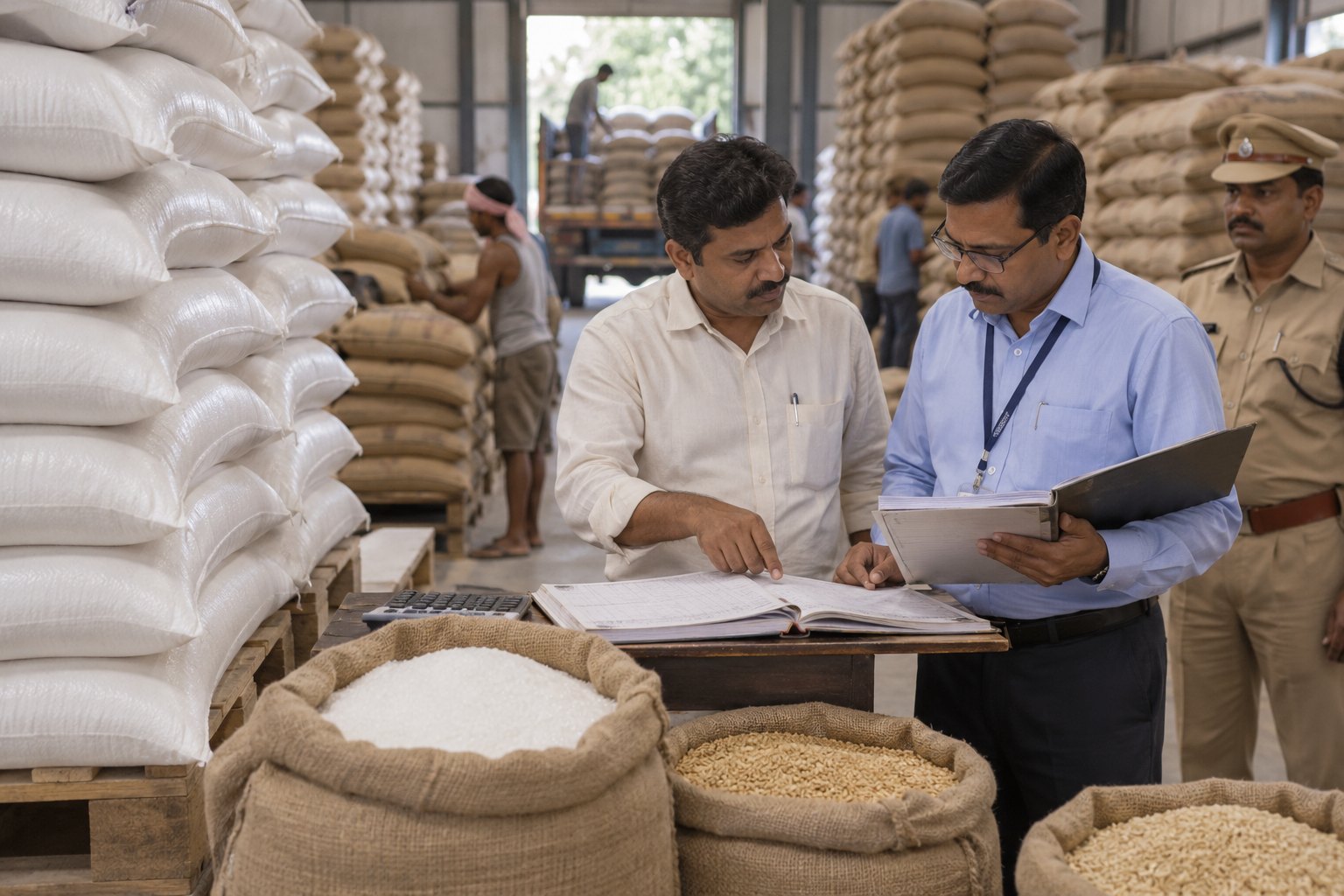
A stock limit caps how much of an essential commodity a trader may hold, and sometimes for how long, so supplies keep moving. The Centre sets such limits by order under section 3 of the Essential Commodities Act, 1955. From 15 October 2026, sugar dealers may hold stock for 15 days at most and, outside Kolkata and Assam, 1,000 quintals.
Syllabus: GS3 · Agriculture & Irrigation; GS3 · MSP, Subsidies & Food Security; GS2 · Government Policies
In short
A stock limit, ordered under section 3 of the Essential Commodities Act, 1955, caps how much of an essential commodity a trader may hold, and sometimes for how long.
Stock limits should stay short, predictable emergency tools, so curbing hoarding neither starves private storage nor squeezes mills that pay cane farmers.
Why it matters
A family buying sugar for festival sweets pays more when dealers hold back stock betting on higher prices. Capping how much a dealer may hold, and for how long, keeps sugar moving from mills to shops, so a fall in mill prices reaches the shelf: the government says ex-mill prices are about 28% lower and retail prices 15% below their August peak. Kolkata and Assam get a higher cap because Kolkata supplies eastern India and the North-East, where transport is harder. The larger issue is balance: tight, frequent limits can squeeze traders and discourage storage, while cane farmers' dues depend on mills selling sugar at fair prices.
Prelims pointers
- Essential Commodities Act, 1955, section 3: the Centre may by order regulate or prohibit the production, supply, distribution and trade of an essential commodity.
- Essential Commodities Act, section 2A: an essential commodity is one in the Act's Schedule; the Centre may add or remove items by notification in the public interest.
- Farm Laws Repeal Act, 2021: repealed the Essential Commodities (Amendment) Act, 2020 and omitted section 3(1A), which had tied stock limits to price triggers.
- Agricultural marketing is a State subject: Agricultural Produce Market Committees are regulated under each State's APMC Act.
- Prevention of Black Marketing and Maintenance of Supplies of Essential Commodities Act, 1980: allows preventive detention to stop hoarding and black marketing.
- Fair and Remunerative Price (FRP): the minimum cane price, fixed under the Sugarcane (Control) Order, 1966 and approved by the Cabinet Committee on Economic Affairs.
- Sugar (Control) Order, 2025: formulated after a review of the Sugar (Control) Order, 1966; the 2026 sugar stock limits are made under it, read with section 3.
- Removal of Licensing Requirements, Stock Limits and Movement Restrictions on Specified Foodstuffs Order, 2016: the order used for stock limits on wheat and pulses.
Practise a UPSC-style question
With reference to the Essential Commodities Act, 1955, consider the following statements:
1. The Central Government may direct that its power to make orders under section 3 be exercised by State Governments.
2. Wholesale markets for agricultural produce in the States are set up and regulated under this Act.
Which of the statements given above is/are correct?
- (a) 1 only
- (b) 2 only
- (c) Both 1 and 2
- (d) Neither 1 nor 2
Show the answer
Answer: (a) 1 only
1 is correct: section 5 lets the Centre delegate its order-making power under section 3 to State Governments or officers. 2 is incorrect: wholesale agricultural markets are set up and regulated under the States' Agricultural Produce Market Committee (APMC) Acts.
More Explainers
- State Legislative Councils: Articles 168-172 and the graduates' and teachers' seats Polity
- Whales and dolphins in Indian waters: legal protection, IUCN status and strandings Environment
- The Aligarh Movement, AMU and the Article 30 minority test Polity
- Environmental clearance by States: SEIAA, SEAC and the EIA Notification, 2006 Environment
- Software vulnerabilities: CVE, CVSS, coordinated disclosure and CERT-In's role Sci-Tech
- Drug trafficking law in India: NDPS Act, PIT-NDPS, NCB and NCORD National
- Choosing the UN Secretary-General: Article 97, UNSC veto and straw polls World & IR
- UN Convention against Torture, and why India has not ratified it Polity
- NavIC: why India's navigation constellation cannot give a standalone position Sci-Tech
- International Energy Agency: membership, 90-day oil stocks and India's status World & IR
- PM Surya Ghar: Muft Bijli Yojana and the rooftop solar subsidy Economy
- HFSS foods: FSSAI's draft limits and front-of-pack warning labels National