
Siang Upper Multipurpose Project and China's Yarlung Tsangpo dam
Why in news: In October 2026, protests in Upper Siang district against the project's pre-feasibility report surveys escalated.
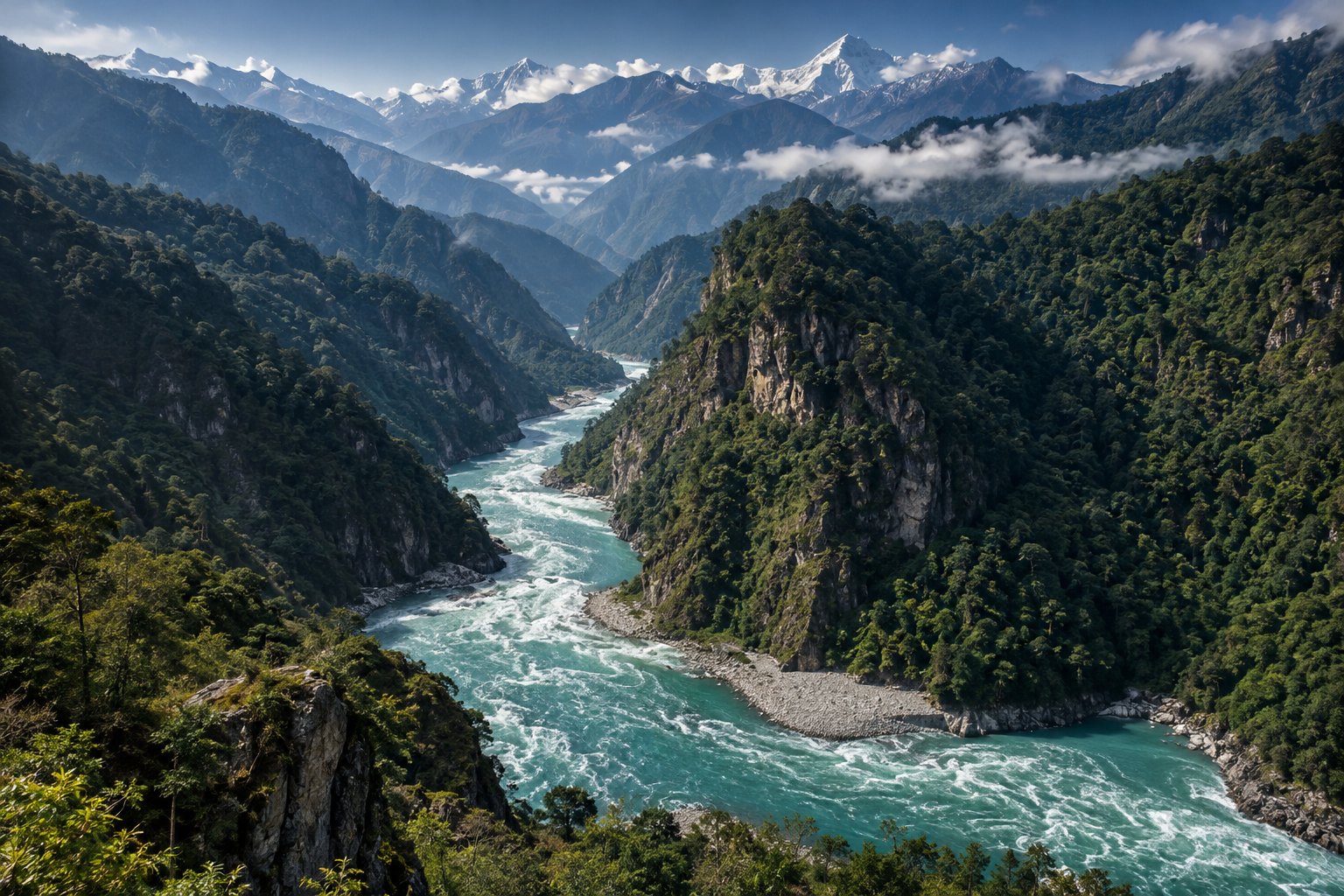
The Brahmaputra rises in Tibet as the Yarlung Tsangpo, on whose lower reaches China has announced a mega dam, and enters Arunachal Pradesh as the Siang. On the Siang, India proposes the Siang Upper Multipurpose Project, estimated at 11,000 MW or more. Its pre-feasibility surveys face sustained protests from Adi communities in Upper Siang district.
Syllabus: Prelims · Geography; GS3 · Infrastructure; GS3 · Disaster Management
Why this matters for UPSC
GS2 (India and its neighbourhood) and Prelims geography: Prelims asks the Brahmaputra's course and names, the rivers India shares with China and the Expert Level Mechanism; GS2 and GS3 Mains, upstream dams, river data and large hydropower in Arunachal Pradesh.
In short
The Brahmaputra rises in Tibet as the Yarlung Tsangpo, where China has announced a mega dam; India, the lower riparian, weighs data, diplomacy and its own Siang project.
India needs binding data access through diplomacy and a Siang decision built on Adi consent; neither alone secures a river it does not control.
Why it matters
A farmer on the Brahmaputra's floodplain in Assam lives by the river's monsoon rise, and an early warning depends on knowing how much water is coming down from Tibet. Since China stopped sharing hydrological data, Indian agencies have less notice of floods and less information for planning dams and bridges. Upstream, a Chinese mega dam could change how the river behaves before it reaches India, which is why India has asked for transparency and consultation. At home, the Siang Upper Multipurpose Project weighs a very large power project against Adi villages and farmland that could be submerged in a seismic zone. The larger issue is water security on a river India shares, but does not control at its source.
Prelims pointers
- Brahmaputra's names: Yarlung Tsangpo in Tibet, Siang in Arunachal Pradesh, Brahmaputra after the Dibang and Lohit join, Jamuna in Bangladesh.
- Expert Level Mechanism (ELM): India-China forum on trans-border rivers, set up in 2006; covers data sharing and other river cooperation.
- India-China hydrological data MoUs covered two rivers rising in Tibet: the Brahmaputra and the Sutlej.
- The Sutlej rises in Tibet and enters India in Himachal Pradesh through Shipki La; it is an eastern river under the Indus Waters Treaty, 1960.
- The Lohit and the Siang both enter India from Tibet in Arunachal Pradesh.
- Lower riparian state: a country downstream on a shared river; India is lower riparian to China on the Brahmaputra and the Sutlej.
- Siang Upper Multipurpose Project (SUMP): proposed on the Siang river in Arunachal Pradesh, at 11,000 MW or more.
Practise a UPSC-style question
With reference to the Brahmaputra river, consider the following statements:
1. In the Tibet Autonomous Region of China, it is known as the Yarlung Tsangpo.
2. It enters India in Sikkim, where it is known as the Siang.
3. After entering Bangladesh, its main channel is known as the Jamuna.
Which of the statements given above is/are correct?
- (a) 1 and 2 only
- (b) 2 and 3 only
- (c) 1 and 3 only
- (d) 1, 2 and 3
Show the answer
Answer: (c) 1 and 3 only
1 is correct: the Yarlung Tsangpo is the Brahmaputra's upper stretch in Tibet. 2 is incorrect: it enters India in Arunachal Pradesh, not Sikkim, as the Siang. 3 is correct: in Bangladesh its main channel is called the Jamuna.
More Explainers
- State Legislative Councils: Articles 168-172 and the graduates' and teachers' seats Polity
- Whales and dolphins in Indian waters: legal protection, IUCN status and strandings Environment
- The Aligarh Movement, AMU and the Article 30 minority test Polity
- Environmental clearance by States: SEIAA, SEAC and the EIA Notification, 2006 Environment
- Software vulnerabilities: CVE, CVSS, coordinated disclosure and CERT-In's role Sci-Tech
- Drug trafficking law in India: NDPS Act, PIT-NDPS, NCB and NCORD National
- Choosing the UN Secretary-General: Article 97, UNSC veto and straw polls World & IR
- UN Convention against Torture, and why India has not ratified it Polity
- NavIC: why India's navigation constellation cannot give a standalone position Sci-Tech
- International Energy Agency: membership, 90-day oil stocks and India's status World & IR
- PM Surya Ghar: Muft Bijli Yojana and the rooftop solar subsidy Economy
- HFSS foods: FSSAI's draft limits and front-of-pack warning labels National