
Satellite spectrum: administrative assignment under the Telecommunications Act, 2023
Why in news: On 8 October 2026, the Ministry of Communications said security assessment of all three satellite licensees was under way, before any may seek spectrum.
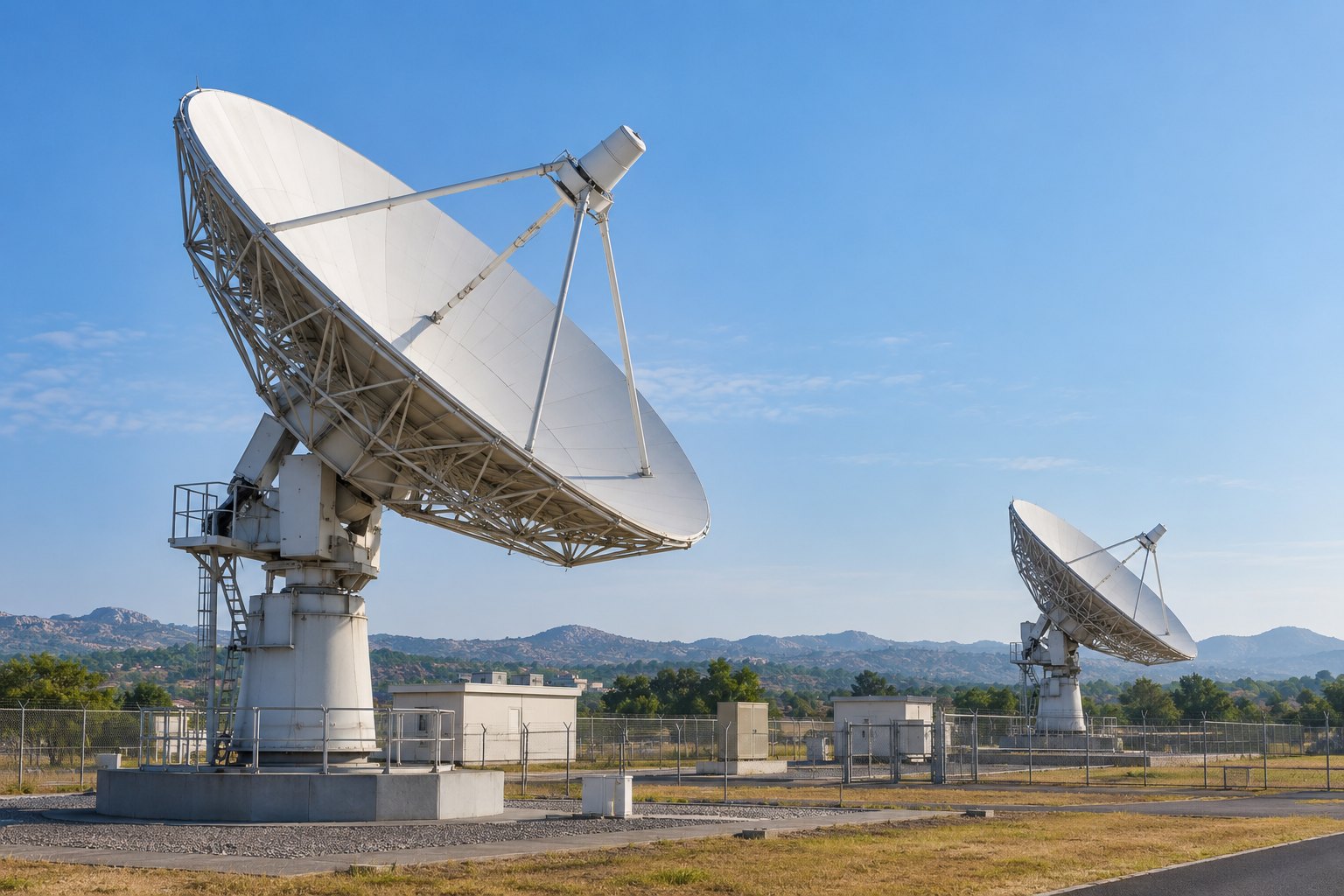
Under the Telecommunications Act, 2023, spectrum is auctioned by default, but satellite services listed in its First Schedule, such as GMPCS, VSAT and DTH, get spectrum through an administrative process, with pricing proposed in TRAI's recommendations of 9 May 2025. On 8 October 2026, the Ministry of Communications said three satellite licensees must clear security assessment before seeking spectrum.
Syllabus: GS2 · Statutory & Regulatory Bodies; GS3 · Infrastructure; GS2 · Government Policies
Why this matters for UPSC
GS III infrastructure and space technology, GS II regulatory bodies: Prelims can ask what Section 4 and the First Schedule of the Telecommunications Act, 2023 provide; Mains, whether spectrum should be auctioned or assigned administratively.
In short
Satellite spectrum is the radio frequency range satellites use to reach users and gateways; under the Telecommunications Act, 2023, First Schedule satellite services get it administratively, without auction.
Administrative assignment suits shared satellite bands, but only transparent pricing and time-bound security clearance can keep it fair to rivals and the exchequer.
Why it matters
Satellite internet can reach a fishing village, a Himalayan border post or an island where laying fibre or raising towers does not pay. Whether such service arrives, and what it costs, depends on how the satellite operator gets its spectrum. An auction makes an operator pay a large sum before earning anything; an administrative assignment with a revenue-linked charge lowers that entry cost but leaves the Government to set the price. The choice also decides whether mobile companies, which bought their spectrum at auction, compete on equal terms with satellite firms. Behind this lies a larger question for public policy: how a State should hand out a scarce natural resource fairly, earn a fair return for the public, and keep national security checks without letting them become delays.
Prelims pointers
- Section 4(1), Telecommunications Act, 2023: the Central Government owns spectrum on behalf of the people and may notify a National Frequency Allocation Plan.
- The First Schedule lists 16 uses assigned administratively, among them defence, public broadcasting, Community Radio Stations, in-flight and maritime connectivity, and satellite services.
- The Act repealed the Indian Telegraph Act, 1885 and the Indian Wireless Telegraphy Act, 1933; the Universal Service Obligation Fund became the Digital Bharat Nidhi.
- TRAI, set up under the Telecom Regulatory Authority of India Act, 1997, makes recommendations that are not binding on the Central Government.
- TRAI's 2025 bands: NGSO fixed-satellite, Ku, Ka and Q/V; mobile-satellite, L and S for user links and C, Ku, Ka and Q/V for feeder links.
- GSO means geostationary orbit; NGSO means non-geostationary orbit, which includes low- and medium-earth-orbit constellations offering lower-latency broadband.
- ITU, the UN specialised agency for information and communication technologies, allocates global radio spectrum and satellite orbits; its Radio Regulations govern interference.
- IN-SPACe, the Indian National Space Promotion and Authorisation Centre, gives space-sector approval; DoT grants the telecom licence and assigns spectrum.
Practise a UPSC-style question
With reference to the Telecommunications Act, 2023, consider the following statements:
1. The Act makes the Telecom Regulatory Authority of India the owner of spectrum on behalf of the people.
2. A notification amending the Act's First Schedule for spectrum assignment must be laid before each House of Parliament.
Which of the statements given above is/are correct?
- (a) 1 only
- (b) 2 only
- (c) Both 1 and 2
- (d) Neither 1 nor 2
Show the answer
Answer: (b) 2 only
1 is incorrect: Section 4(1) makes the Central Government, not TRAI, the owner of spectrum on behalf of the people. 2 is correct: Section 4(5)(b) requires such a notification to be laid before each House of Parliament.
More Explainers
- State Legislative Councils: Articles 168-172 and the graduates' and teachers' seats Polity
- Whales and dolphins in Indian waters: legal protection, IUCN status and strandings Environment
- The Aligarh Movement, AMU and the Article 30 minority test Polity
- Environmental clearance by States: SEIAA, SEAC and the EIA Notification, 2006 Environment
- Software vulnerabilities: CVE, CVSS, coordinated disclosure and CERT-In's role Sci-Tech
- Drug trafficking law in India: NDPS Act, PIT-NDPS, NCB and NCORD National
- Choosing the UN Secretary-General: Article 97, UNSC veto and straw polls World & IR
- UN Convention against Torture, and why India has not ratified it Polity
- NavIC: why India's navigation constellation cannot give a standalone position Sci-Tech
- International Energy Agency: membership, 90-day oil stocks and India's status World & IR
- PM Surya Ghar: Muft Bijli Yojana and the rooftop solar subsidy Economy
- HFSS foods: FSSAI's draft limits and front-of-pack warning labels National