
Production Linked Incentive scheme and the National Manufacturing Mission
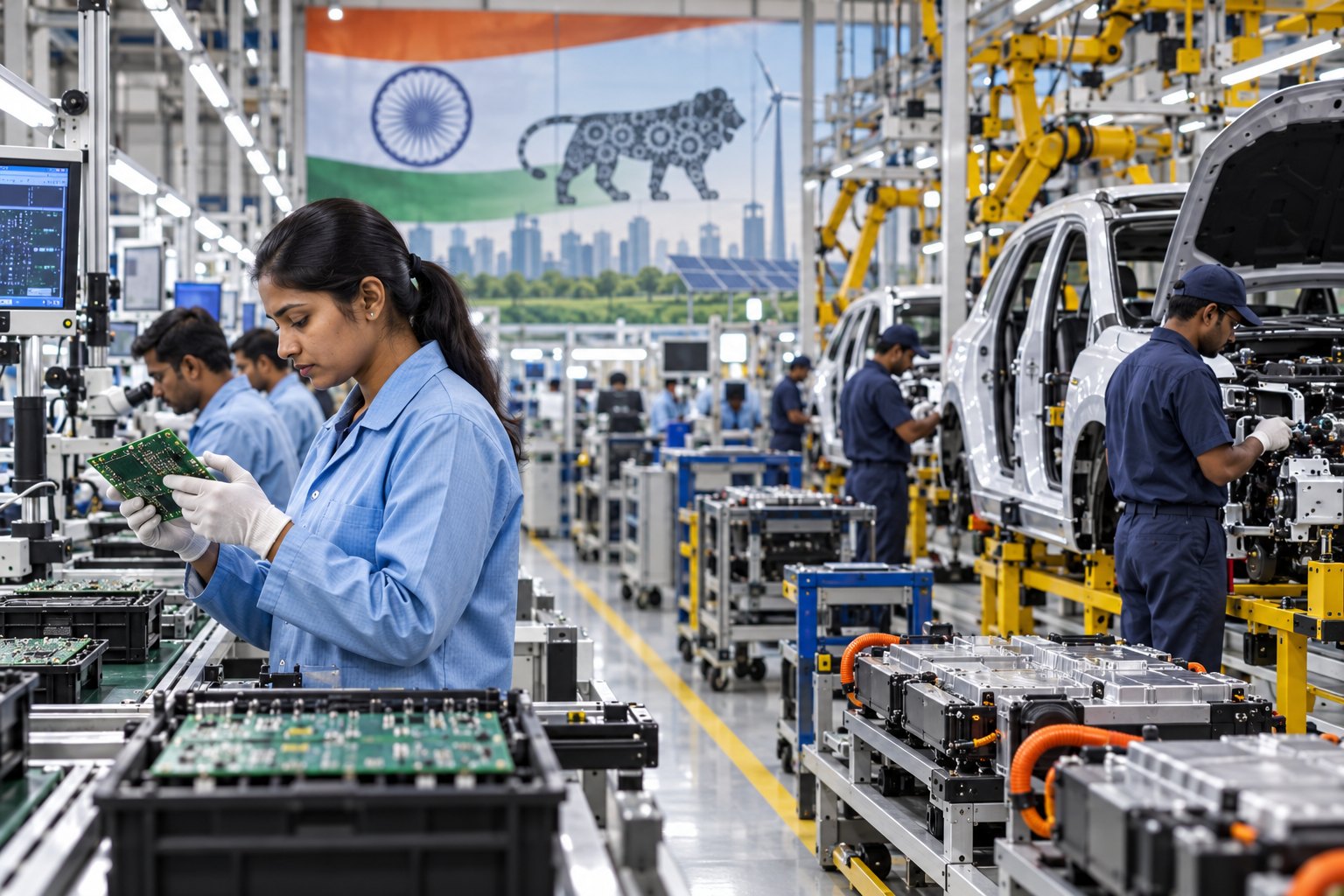
The Production Linked Incentive (PLI) scheme, begun in 2020, pays firms in 14 sectors a share of incremental sales, from a ₹1.97 lakh crore outlay. The National Manufacturing Mission, announced in the Union Budget 2025-26, is meant to align ministries and States behind manufacturing, stressing clean technology. A September 2025 PIB review called both central to India's factory push.
Syllabus: GS3 · Indian Economy & Growth; GS3 · Liberalisation & Industry; GS3 · Infrastructure
In short
The Production Linked Incentive (PLI) scheme, begun in 2020, pays manufacturers a share of incremental sales in 14 sectors; the National Manufacturing Mission aims to coordinate the wider push.
PLI has built scale in phones and drugs by official count; the Mission must now deepen components and skills so factories outlast incentives.
Why it matters
For a young worker on a phone assembly line, PLI is a reason the factory exists in India at all: the incentive is earned only when output and sales here rise, so the government pays for production that actually happens. For the country, the bet is that factories can absorb workers leaving farms, cut imports of electronics, drug inputs and solar equipment, and lift exports. The larger issue is India's long struggle to raise manufacturing's share of GDP. PLI hands cash to selected firms; the National Manufacturing Mission is meant to fix the wider conditions, such as the cost of doing business, skills, technology and quality, that decide whether factories stay once incentives end.
Prelims pointers
- PLI's 14 sectors: mobiles and components, bulk-drug inputs, medical devices, autos, pharma, specialty steel, telecom, IT hardware, white goods, food, textiles, solar PV, ACC batteries, drones.
- Implementing ministries: MeitY (mobiles, IT hardware), Heavy Industries (autos, ACC batteries), MNRE (solar PV), Department of Pharmaceuticals (drugs, devices), Textiles, Steel, Civil Aviation (drones), DPIIT (white goods).
- PLI incentives are linked to incremental sales of goods made in India, whether sold at home or exported.
- National Manufacturing Mission (Budget 2025-26): focus areas include ease and cost of doing business, a future-ready workforce, MSMEs, availability of technology and quality products.
- Index of Industrial Production: compiled monthly by the National Statistics Office, MoSPI; measures the volume of mining, manufacturing and electricity output; manufacturing carries the largest weight.
- Purchasing Managers' Index: survey-based; above 50 signals expansion over the previous month, below 50 contraction; India's manufacturing PMI is HSBC's, compiled by S&P Global.
- PM MITRA parks: Ministry of Textiles; seven parks on the '5F' idea, farm to fibre to factory to fashion to foreign.
- National Logistics Policy, 2022: works with the PM GatiShakti National Master Plan; implemented through the Comprehensive Logistics Action Plan (CLAP).
Practise a UPSC-style question
With reference to the Production Linked Incentive (PLI) scheme, consider the following statements:
1. The incentive is calculated on a company's incremental sales of eligible goods over a base year.
2. It began in 2020 with mobile phones and electronic components, bulk-drug inputs and medical devices.
3. Its incentive is paid as a refund of the GST collected on the goods produced.
Which of the statements given above is/are correct?
- (a) 1 and 2 only
- (b) 2 and 3 only
- (c) 1 and 3 only
- (d) 1, 2 and 3
Show the answer
Answer: (a) 1 and 2 only
1 is correct: PLI pays a percentage of incremental sales measured against a base year. 2 is correct: the first PLI schemes of April 2020 covered mobile phones and specified electronic components, key starting materials and APIs for bulk drugs, and medical devices. 3 is incorrect: the incentive is a payment linked to incremental sales, not a refund of GST.
More Explainers
- State Legislative Councils: Articles 168-172 and the graduates' and teachers' seats Polity
- Whales and dolphins in Indian waters: legal protection, IUCN status and strandings Environment
- The Aligarh Movement, AMU and the Article 30 minority test Polity
- Environmental clearance by States: SEIAA, SEAC and the EIA Notification, 2006 Environment
- Software vulnerabilities: CVE, CVSS, coordinated disclosure and CERT-In's role Sci-Tech
- Drug trafficking law in India: NDPS Act, PIT-NDPS, NCB and NCORD National
- Choosing the UN Secretary-General: Article 97, UNSC veto and straw polls World & IR
- UN Convention against Torture, and why India has not ratified it Polity
- NavIC: why India's navigation constellation cannot give a standalone position Sci-Tech
- International Energy Agency: membership, 90-day oil stocks and India's status World & IR
- PM Surya Ghar: Muft Bijli Yojana and the rooftop solar subsidy Economy
- HFSS foods: FSSAI's draft limits and front-of-pack warning labels National