
Prime Minister Dhan-Dhaanya Krishi Yojana: a district-led farm scheme
Why in news: All 100 PMDDKY districts have District Action Plans in place as the scheme completes one year, the government said on 10 October 2026.
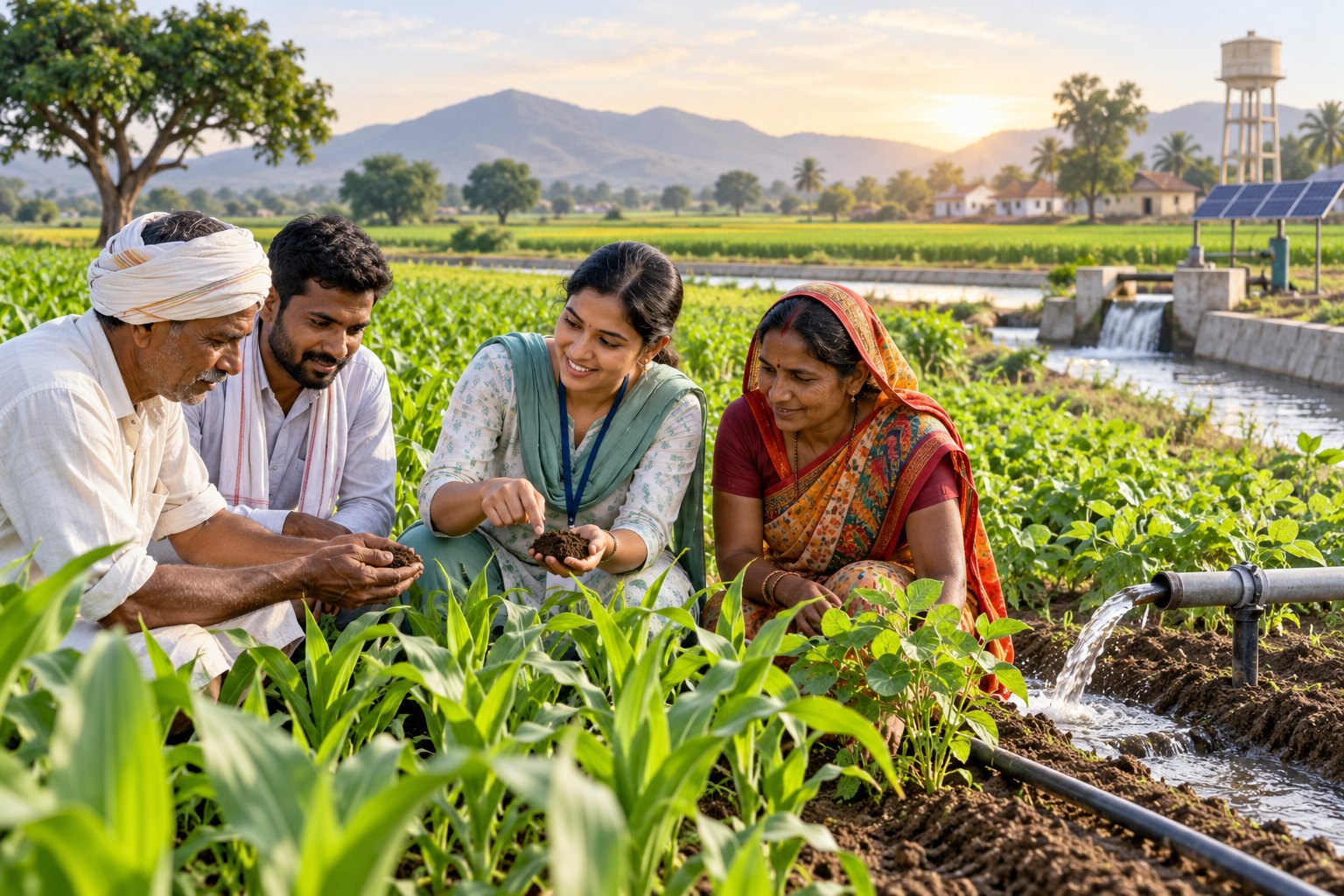
The Prime Minister Dhan-Dhaanya Krishi Yojana (PMDDKY) is a six-year scheme, from 2025-26, to lift farming in 100 lagging districts chosen for low productivity, low cropping intensity and low credit disbursement. It works by converging 36 Central schemes of 11 Ministries and Departments through district plans. The scheme completed its first year on 11 October 2026.
Syllabus: GS3 · Inclusive Growth; GS3 · Agriculture & Irrigation; Prelims · Economy & Social Development
In short
The Prime Minister Dhan-Dhaanya Krishi Yojana (PMDDKY) is a six-year Central scheme from 2025-26 that aims to lift farming in 100 lagging districts through district-level convergence.
PMDDKY will be judged on yield, credit and income, not dashboard scores; timely State funding of district plans decides whether convergence works.
Why it matters
Take a smallholder in a district where one rainfed crop a year is the norm and bank credit rarely reaches the village. PMDDKY's promise is that irrigation, storage, seed, credit and extension schemes reach that district together, under one plan, instead of separately and unevenly. A second crop on the same field raises cropping intensity and income without any new land. The larger issue is an old one: India's farm schemes are many but scattered across ministries, and the weakest districts often draw the least from them. PMDDKY tests whether district planning, convergence and public monitoring can narrow the gap between India's best and worst farm districts, the method the Aspirational Districts Programme used for overall development since 2018.
Prelims pointers
- PMDDKY: announced in the Union Budget 2025-26; Cabinet approval July 2025; six years from 2025-26; steered by the Ministry of Agriculture and Farmers Welfare.
- Six objective areas tracked: productivity; crop diversification and sustainable practices; post-harvest storage; irrigation; short- and long-term credit; governance and service delivery.
- District Action Plan: written by the District Dhan Dhaanya Krishi Yojana Samiti (head: District Collector), then built into State departments' annual action plans for approval and funds.
- National Executive Committee: headed by the Union Minister for Agriculture and Farmers Welfare. National Monitoring Committee: headed by the Secretary, Department of Agriculture and Farmers Welfare.
- Cropping intensity = gross cropped area divided by net sown area, multiplied by 100; a field cropped twice in a year counts twice in gross cropped area.
- Aspirational Districts Programme (2018): district ranking on development indicators; PMDDKY applies that approach to agriculture and allied sectors.
- Agriculture is a State subject (Entry 14, State List, Seventh Schedule), so PMDDKY works through State departments and district administrations.
Practise a UPSC-style question
With reference to the Agriculture Census in India, consider the following statements:
1. It is the main source of data on the number and size of operational holdings.
2. It is conducted by the National Statistical Office under the Ministry of Statistics and Programme Implementation.
3. It is conducted every five years.
Which of the statements given above is/are correct?
- (a) 1 and 2 only
- (b) 2 and 3 only
- (c) 1 and 3 only
- (d) 1, 2 and 3
Show the answer
Answer: (c) 1 and 3 only
1 is correct: the Agriculture Census is the main source of data on the number, size and class-wise distribution of operational holdings, the land a cultivator farms as one unit, owned or leased in; PMDDKY allots districts by each State's share of net cropped area and operational holdings. 2 is incorrect: the census is conducted by the Ministry of Agriculture and Farmers Welfare with the States and Union Territories, not by the National Statistical Office. 3 is correct: it is held every five years; the 11th round has 2021-22 as its reference year.
In the news
More Explainers
- State Legislative Councils: Articles 168-172 and the graduates' and teachers' seats Polity
- Whales and dolphins in Indian waters: legal protection, IUCN status and strandings Environment
- The Aligarh Movement, AMU and the Article 30 minority test Polity
- Environmental clearance by States: SEIAA, SEAC and the EIA Notification, 2006 Environment
- Software vulnerabilities: CVE, CVSS, coordinated disclosure and CERT-In's role Sci-Tech
- Drug trafficking law in India: NDPS Act, PIT-NDPS, NCB and NCORD National
- Choosing the UN Secretary-General: Article 97, UNSC veto and straw polls World & IR
- UN Convention against Torture, and why India has not ratified it Polity
- NavIC: why India's navigation constellation cannot give a standalone position Sci-Tech
- International Energy Agency: membership, 90-day oil stocks and India's status World & IR
- PM Surya Ghar: Muft Bijli Yojana and the rooftop solar subsidy Economy
- HFSS foods: FSSAI's draft limits and front-of-pack warning labels National