
Prasar Bharati and PBSHABD: the public broadcaster's free news feed
Why in news: PBSHABD, Prasar Bharati's free news feed, now serves 3,600 media organisations, with a PBSHABD 2.0 planned, the government said on 24 September 2026.
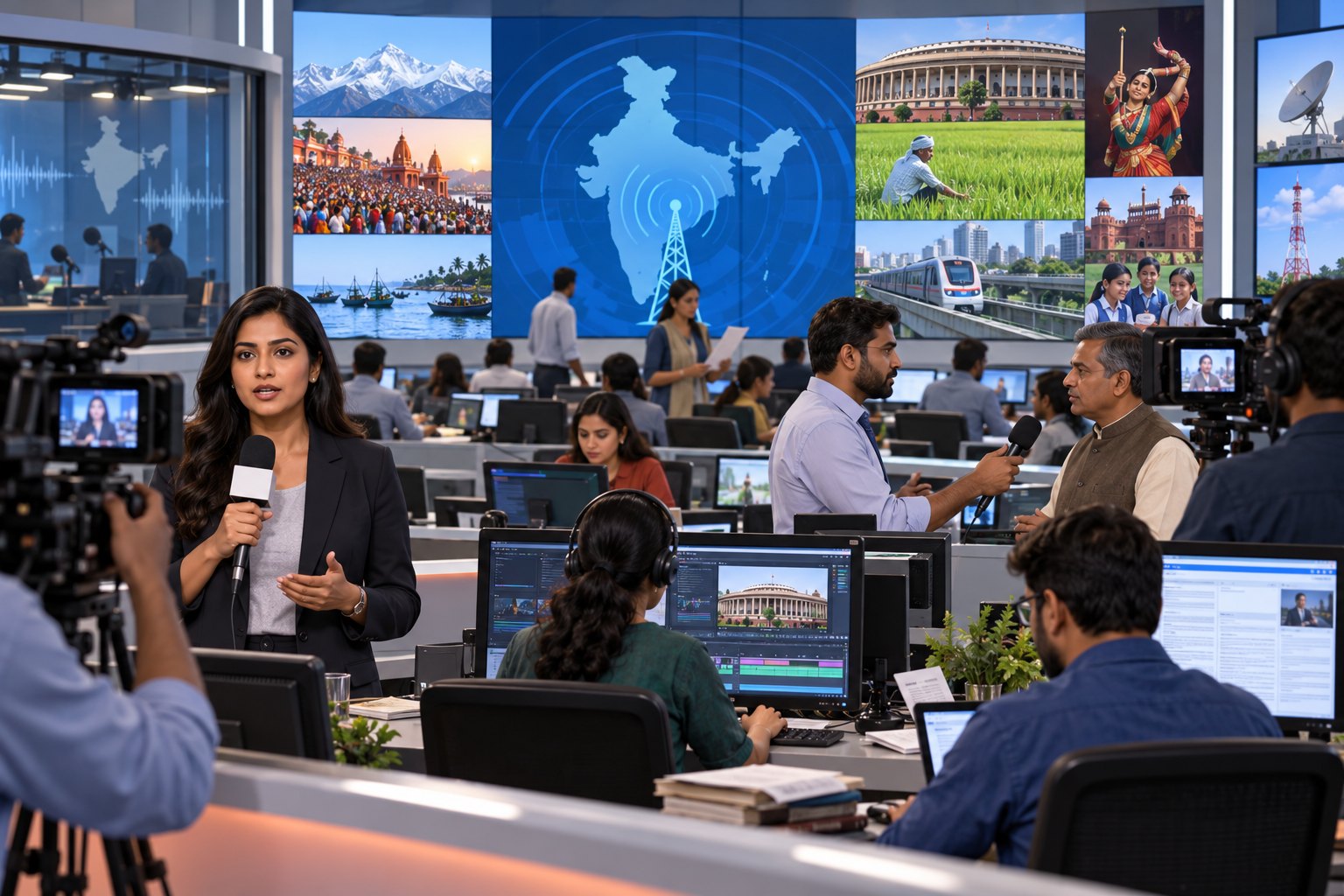
Prasar Bharati, the autonomous public broadcaster created by the Prasar Bharati Act, 1990, runs Akashvani and Doordarshan. Its PBSHABD service, launched in March 2024, gives registered media outlets free news in five formats and 15 Indian languages. About 3,600 outlets now use it, free until March 2027, the government said on 24 September 2026.
Syllabus: GS2 · Statutory & Regulatory Bodies; GS2 · Governance & e-Governance; GS3 · Cyber Security & Money Laundering
In short
Prasar Bharati, the public service broadcaster created by the Prasar Bharati Act, 1990, shares its news free with other outlets through PBSHABD, testing its autonomy and media plurality.
PBSHABD widens access to verified news; disclosing its source and securing Prasar Bharati's independence would keep that reach from narrowing India's media voices.
Why it matters
Consider a district newspaper with no reporter in Delhi or abroad. Through PBSHABD it can carry verified national and international stories, with video and photographs, at no cost and under its own masthead, cutting both expense and turnaround time. Readers in small towns get wider coverage, and outlets get copy that has passed editorial checks against fake and morphed content. The larger issue is media plurality: when thousands of outlets run the same uncredited copy from a publicly funded broadcaster, the autonomy promised by the 1990 Act and the citizen's right to receive information from many voices both matter.
Prelims pointers
- Prasar Bharati: statutory autonomous corporation under the Prasar Bharati Act, 1990; constituents Akashvani and Doordarshan; administrative ministry: Ministry of Information and Broadcasting.
- Appointment: the President appoints Prasar Bharati's Chairman on a committee's binding recommendation: Chairman of the Rajya Sabha (head), Chairman of the Press Council of India, a presidential nominee.
- Section 12 of the Act: Prasar Bharati must safeguard the citizen's right to be informed freely, truthfully and objectively on matters of public interest.
- Supreme Court, 1995 (Cricket Association of Bengal case): airwaves are public property, to be used for the public good and regulated by a public authority.
- Article 19(1)(a): freedom of speech and expression includes freedom of the press and the right to receive information; limits only on Article 19(2) grounds.
- Press Council of India: statutory body under the Press Council Act, 1978, for standards of newspapers and news agencies; it does not regulate broadcasters.
- Press Information Bureau: the Ministry of Information and Broadcasting's agency that releases government information to the media; it is not part of Prasar Bharati.
- PBSHABD: Prasar Bharati – Shared Audio-Visuals for Broadcast and Dissemination; launched March 2024; free for registered print, broadcast and digital outlets.
Practise a UPSC-style question
With reference to Prasar Bharati, consider the following statements:
1. It is a statutory body created by an Act of Parliament.
2. Akashvani and Doordarshan are the two constituents through which it works.
3. Its administrative ministry is the Ministry of Electronics and Information Technology.
Which of the statements given above is/are correct?
- (a) 1 and 2 only
- (b) 2 and 3 only
- (c) 1 and 3 only
- (d) 1, 2 and 3
Show the answer
Answer: (a) 1 and 2 only
1 is correct: Prasar Bharati was created by the Prasar Bharati Act, 1990 and came into existence in 1997. 2 is correct: Akashvani (All India Radio) and Doordarshan are its two constituents. 3 is incorrect: its administrative ministry is the Ministry of Information and Broadcasting, which also launched PBSHABD.
More Explainers
- State Legislative Councils: Articles 168-172 and the graduates' and teachers' seats Polity
- Whales and dolphins in Indian waters: legal protection, IUCN status and strandings Environment
- The Aligarh Movement, AMU and the Article 30 minority test Polity
- Environmental clearance by States: SEIAA, SEAC and the EIA Notification, 2006 Environment
- Software vulnerabilities: CVE, CVSS, coordinated disclosure and CERT-In's role Sci-Tech
- Drug trafficking law in India: NDPS Act, PIT-NDPS, NCB and NCORD National
- Choosing the UN Secretary-General: Article 97, UNSC veto and straw polls World & IR
- UN Convention against Torture, and why India has not ratified it Polity
- NavIC: why India's navigation constellation cannot give a standalone position Sci-Tech
- International Energy Agency: membership, 90-day oil stocks and India's status World & IR
- PM Surya Ghar: Muft Bijli Yojana and the rooftop solar subsidy Economy
- HFSS foods: FSSAI's draft limits and front-of-pack warning labels National