
PPV&FR Act, 2001: plant breeders' rights and farmers' seed rights
Why in news: Cheruvayal Raman, the Wayanad rice conserver who received the Plant Genome Saviour Farmer Recognition (2013) and Padma Shri (2023), died on 14 October 2026.
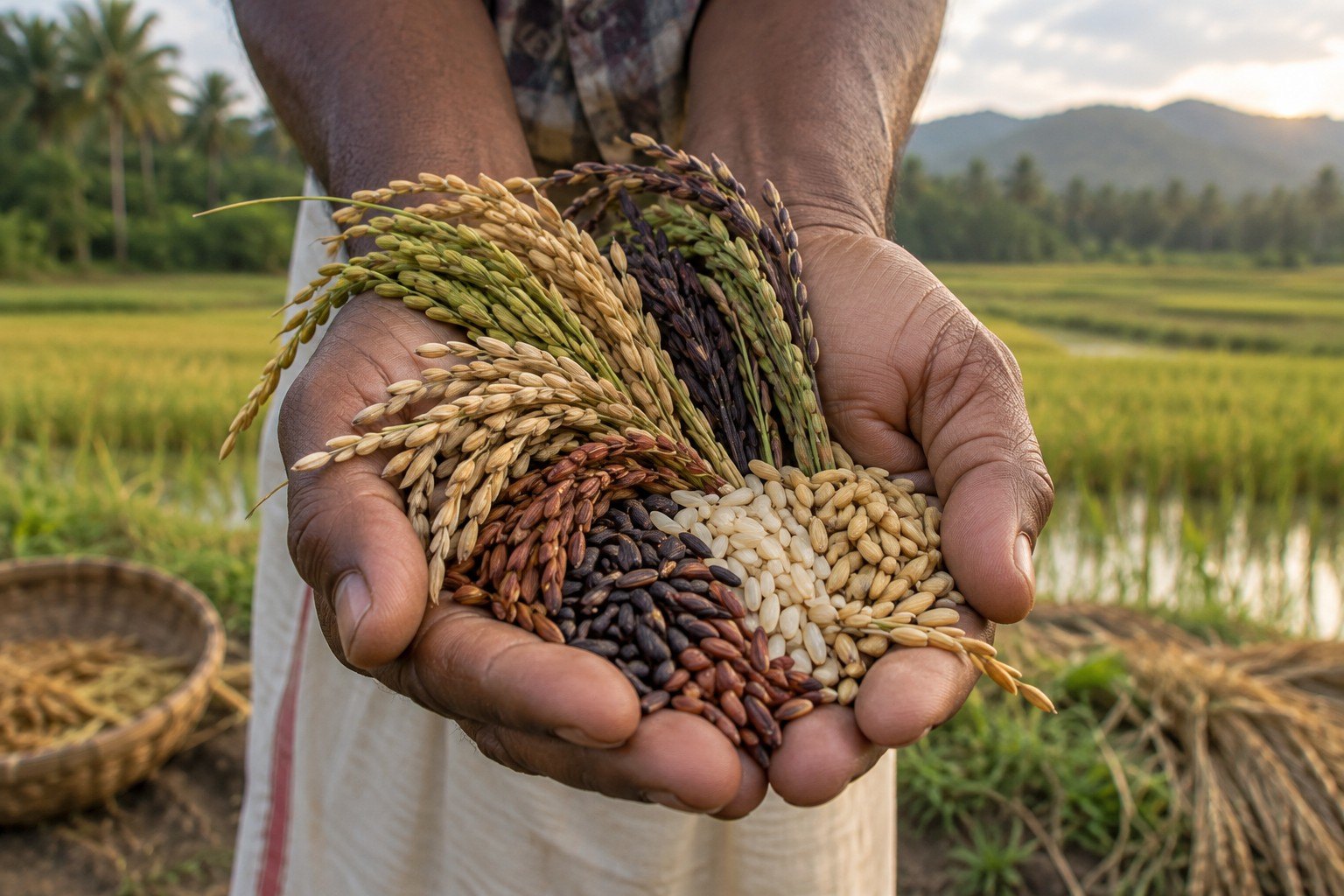
The Protection of Plant Varieties and Farmers' Rights Act, 2001 is India's sui generis law under the TRIPS Agreement. It gives breeders exclusive rights over registered varieties, lets farmers save, share and sell unbranded seed, and rewards conservers from the National Gene Fund. Cheruvayal Raman, a Wayanad rice conserver honoured under it in 2013, died on 14 October 2026.
Syllabus: GS3 · Agriculture & Irrigation; Prelims · Environment & Ecology; GS3 · IT, Space, Biotech & IPR
Why this matters for UPSC
GS3 agriculture and IPR: Prelims asks what the PPV&FR Act, 2001 registers, its DUS tests, section 39 farmers' rights and the National Gene Fund; Mains asks how India balances breeders' rights under TRIPS with farmers' seed freedom.
In short
The Protection of Plant Varieties and Farmers' Rights Act, 2001 is India's sui generis answer to Article 27(3)(b) of the TRIPS Agreement, guarding breeders and farmers together.
India's sui generis bargain works only if farmers save and sell seed without fear of suits, and conservers earn steady support.
Why it matters
A paddy farmer who keeps back seed from a crop of a protected variety can sow it next season, swap it with a neighbour or sell it in the village, as before the law, so long as it is not packed and labelled as that variety. A seed company, in turn, gets years in which no rival may sell its registered variety, meant to repay the cost of breeding it. Where one right ends and the other begins decides whether a farmer selling seed from his own field is within his rights or open to a suit. For tribal and village families who keep old rice landraces alive, the law also offers honour and cash, but only when their seed has passed its genes into a registrable variety.
Prelims pointers
- Authority (section 3): a Chairperson and fifteen members, including nominees of farmers', tribal and women's organisations, the seed industry and an agricultural university.
- Novelty (section 15): no sale in India more than one year before filing; abroad, four years, or six for trees and vines.
- Term (section 24): six years, nine for trees and vines; renewable to a total of 15 years, or 18 for trees and vines.
- Section 39(1)(iv): a farmer may save, use, sow, resow, exchange, share or sell farm produce, including protected seed, as before the Act; branded seed excepted.
- National Gene Fund (section 45) receives benefit sharing, the royalty part of annual fees, community compensation under section 41 and outside contributions.
- Section 18: every application needs an affidavit that the variety holds no gene involving terminator technology; section 40 demands disclosure of tribal or rural families' material.
- Appeals (section 56): the Tribunals Reforms Act, 2021 omitted the Plant Varieties Protection Appellate Tribunal; orders of the Authority or Registrar now go to the High Court.
- Benefit sharing (section 26): Indian claimants only, filed within six months of the variety's advertisement; the Authority sees no overlap with the Biological Diversity Act, 2002.
Practise a UPSC-style question
With reference to the Protection of Plant Varieties and Farmers' Rights Act, 2001, consider the following statements:
1. It was enacted to give effect, among other things, to Article 27(3)(b) of the TRIPS Agreement on plant varieties.
2. The Central Government notifies the genera and species whose new varieties may be registered under it.
3. The authority it sets up consists of a Chairperson and ten members.
Which of the statements given above is/are correct?
- (a) 1 and 2 only
- (b) 2 and 3 only
- (c) 1 and 3 only
- (d) 1, 2 and 3
Show the answer
Answer: (a) 1 and 2 only
Answer: (a) 1 and 2 only. The Authority has fifteen members besides its Chairperson, so statement 3 fails.
Statement 1: correct. The Act's preamble says India, having ratified TRIPS, must give effect to Article 27(3)(b) on protecting plant varieties.
Statement 2: correct. Under section 29(2), the Central Government notifies the genera and species whose varieties, other than extant and farmers' varieties, can be registered.
Statement 3: incorrect. Section 3 gives the Protection of Plant Varieties and Farmers' Rights Authority a Chairperson and fifteen members, not ten.
Eliminate: Judge statement 3 first: section 3 provides fifteen members besides the Chairperson, so statement 3 is incorrect. Out: (b), (c), (d).
Trap: Near-miss figure. The member count is cut from fifteen to ten, a round number that feels familiar.
Remember: PPV&FR Authority: a Chairperson and 15 members, established on 11 November 2005.
More Explainers
- State Legislative Councils: Articles 168-172 and the graduates' and teachers' seats Polity
- Whales and dolphins in Indian waters: legal protection, IUCN status and strandings Environment
- The Aligarh Movement, AMU and the Article 30 minority test Polity
- Environmental clearance by States: SEIAA, SEAC and the EIA Notification, 2006 Environment
- Software vulnerabilities: CVE, CVSS, coordinated disclosure and CERT-In's role Sci-Tech
- Drug trafficking law in India: NDPS Act, PIT-NDPS, NCB and NCORD National
- Choosing the UN Secretary-General: Article 97, UNSC veto and straw polls World & IR
- UN Convention against Torture, and why India has not ratified it Polity
- NavIC: why India's navigation constellation cannot give a standalone position Sci-Tech
- International Energy Agency: membership, 90-day oil stocks and India's status World & IR
- PM Surya Ghar: Muft Bijli Yojana and the rooftop solar subsidy Economy
- HFSS foods: FSSAI's draft limits and front-of-pack warning labels National