
Pattanam and Muziris: India's ancient port trade with Rome
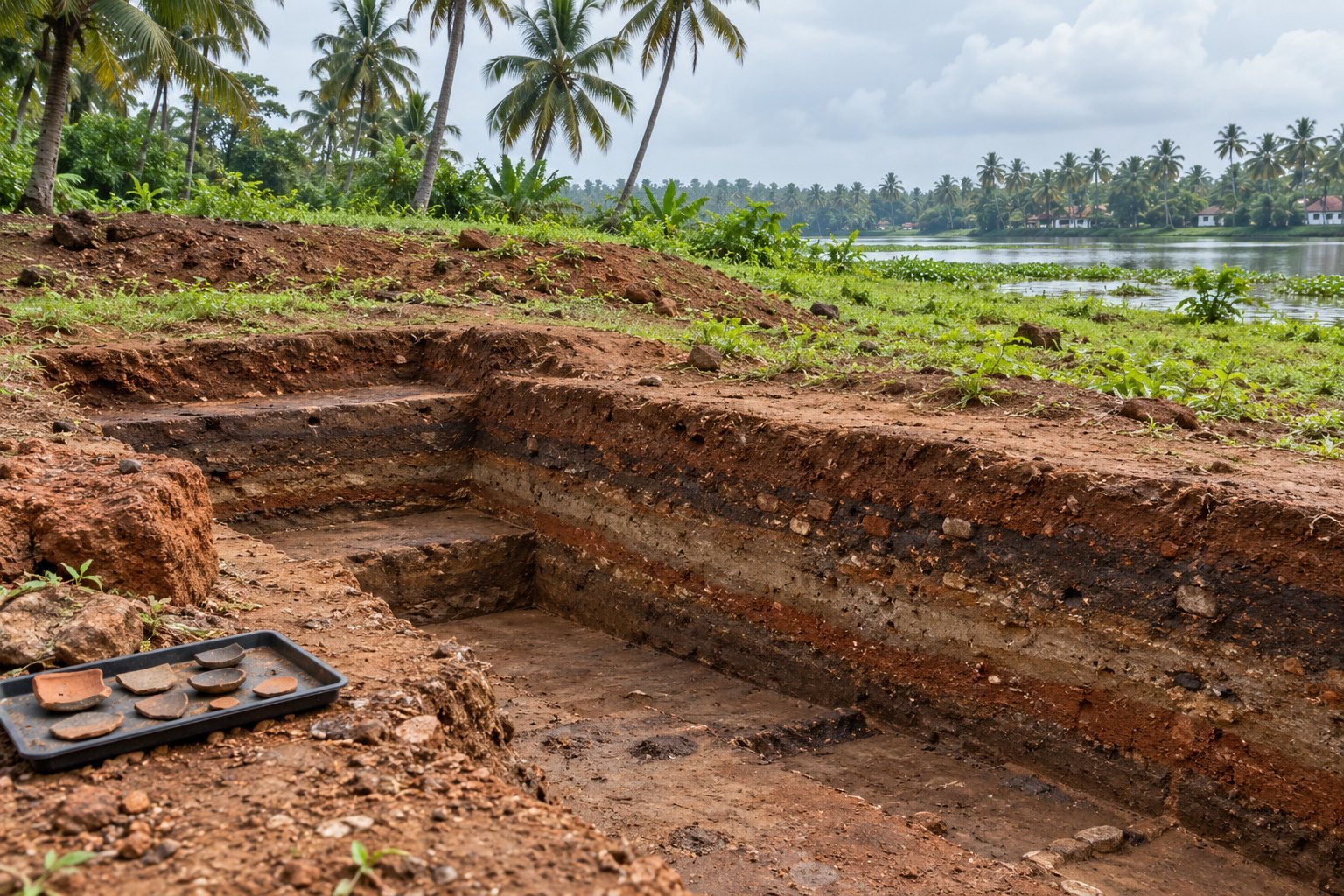
Pattanam, a village on the Periyar delta in Kerala's Ernakulam district, holds an early historic port settlement that excavations since 2007 link to Muziris, the Chera port known from Sangam poems and Greco-Roman texts for its pepper trade. Whether Pattanam was Muziris itself is still debated, and its digs have faced ASI licence disputes since 2015.
Syllabus: GS1 · Art & Culture; Prelims · Current Affairs & IR; Prelims · History & Culture
Why this matters for UPSC
GS1 art and culture and ancient history: Prelims asks about Muziris, the Periplus, Arikamedu, Sangam literature and Project Mausam; Mains, about India's Indian Ocean trade and how archaeology is protected.
In short
Pattanam, a village on the Periyar delta in Kerala's Ernakulam district, holds an early historic port settlement that excavations link to Muziris, the Chera port of the pepper trade.
Pattanam turns Muziris from a name in poems into dug-up evidence; steady, licensed and published excavation must now settle its identity and decline.
Why it matters
Most of what students read about ancient trade comes from foreign writers. Pattanam lets the soil answer back: a jar, a bead or a canoe can be dated and traced, and it shows a Kerala village trading with Rome, Egypt and West Asia two thousand years ago. That changes how the early Chera kingdom is seen, from a remote coast to a busy junction of the ocean world. It also matters to the people living on the mound today, whose houses sit on the record. How India protects such a site, and keeps digging it with care, decides whether this history is studied or lost.
Prelims pointers
- Periplus of the Erythraean Sea: places Muziris and Tyndis in one kingdom and Nelkynda, about 500 stades away, in the Pandya kingdom.
- Periplus sailing advice: ships bound for Limyrike from Egypt set out around July, the month Epeiph.
- Arikamedu: the major glass-bead making centre of South India, on the east coast near Pondicherry; likely source of Pattanam's glass beads.
- Rouletted Ware: a fine pottery found in large amounts at Pattanam, probably made in the Bengal-Gangetic region.
- Project Mausam: Ministry of Culture project with the ASI and IGNCA; launched by India at the 38th World Heritage Session, Doha, Qatar, in June 2014.
- Indian Ocean wind system: the southwest monsoon blows from May to September, the northeast from November to March, per IGNCA.
- Muziris Heritage Project region: between North Paravur in Ernakulam district and Kodungallur in Thrissur district, Kerala.
- Cheras: early Chera coins, found at Pattanam, carry an elephant on the obverse.
Practise a UPSC-style question
With reference to the Greco-Roman sources on the ancient port of Muziris, consider the following statements:
1. The Periplus of the Erythraean Sea is an anonymous Greek navigator's account of the 1st century CE that names Muziris.
2. The Muziris Papyrus records an agreement about a cargo shipped from Muziris to Alexandria in Egypt.
3. The Tabula Peutingeriana, a late Roman map, shows Muziris together with a Temple of Augustus.
Which of the statements given above is/are correct?
- (a) 1 and 2 only
- (b) 2 and 3 only
- (c) 1 and 3 only
- (d) 1, 2 and 3
Show the answer
Answer: (d) 1, 2 and 3
Answer: (d) 1, 2 and 3. All three sources are correctly described.
Statement 1: correct. The Periplus is an anonymous navigator's account in Greek of the 1st century CE; it calls Muziris and Nelkynda the active ports of Limyrike.
Statement 2: correct. The Muziris Papyrus, of the 2nd century CE and now in Vienna, is an agreement on a cargo from Muziris bound for Alexandria.
Statement 3: correct. The Tabula Peutingeriana, dated to the 5th century CE, marks Muziris and a Temple of Augustus on its eastern edge.
Eliminate: Statement 3 holds, since the map's Temple of Augustus is its best-known Muziris detail. Out: (a).
Eliminate: Statement 1 holds; the Periplus is the standard 1st-century Greek guide to these ports. Out: (b).
Eliminate: Statement 2 holds; the papyrus links Muziris with Alexandria. Out: (c).
Trap: Sounds right. Three obscure-sounding Latin and Greek names tempt a student to doubt one of them, though each is described exactly.
Remember: Periplus 1st c. CE, Muziris Papyrus 2nd c. CE, Tabula Peutingeriana 5th c. CE.
More Explainers
- State Legislative Councils: Articles 168-172 and the graduates' and teachers' seats Polity
- Whales and dolphins in Indian waters: legal protection, IUCN status and strandings Environment
- The Aligarh Movement, AMU and the Article 30 minority test Polity
- Environmental clearance by States: SEIAA, SEAC and the EIA Notification, 2006 Environment
- Software vulnerabilities: CVE, CVSS, coordinated disclosure and CERT-In's role Sci-Tech
- Drug trafficking law in India: NDPS Act, PIT-NDPS, NCB and NCORD National
- Choosing the UN Secretary-General: Article 97, UNSC veto and straw polls World & IR
- UN Convention against Torture, and why India has not ratified it Polity
- NavIC: why India's navigation constellation cannot give a standalone position Sci-Tech
- International Energy Agency: membership, 90-day oil stocks and India's status World & IR
- PM Surya Ghar: Muft Bijli Yojana and the rooftop solar subsidy Economy
- HFSS foods: FSSAI's draft limits and front-of-pack warning labels National