
National Food Security Act, 2013: entitlements, PMGKAY, ONORC and fortification
Why in news: The FAO marked World Food Day on 16 October 2026 under the theme 'Innovate today. Nourish tomorrow.'
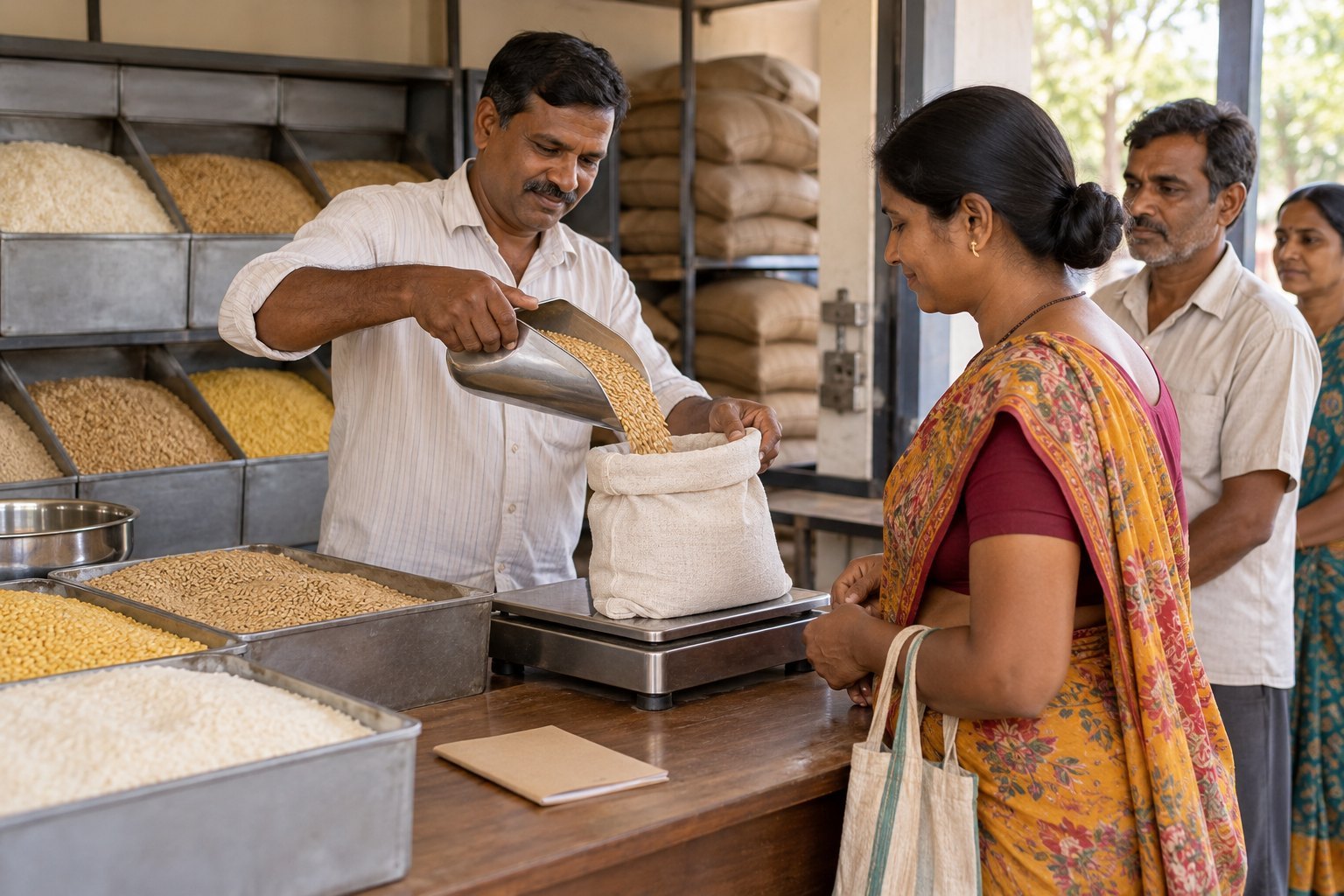
The National Food Security Act, 2013 gives up to 75% of rural and 50% of urban Indians a legal right to grain: 35 kg a month per Antyodaya household and 5 kg per person for priority households, free since 2023 under the Pradhan Mantri Garib Kalyan Anna Yojana. The FAO marked World Food Day on 16 October 2026.
Syllabus: GS3 · MSP, Subsidies & Food Security; Prelims · Economy & Social Development; GS2 · Welfare of Vulnerable Sections
Why this matters for UPSC
GS3 Mains asks about the Public Distribution System and food security, GS2 about welfare schemes for the vulnerable; Prelims can ask NFSA entitlements, Section 13, PMGKAY, One Nation One Ration Card and rice fortification.
In short
The National Food Security Act, 2013 turns subsidised grain from welfare into a legal entitlement for about two-thirds of Indians, delivered through the Targeted Public Distribution System.
The NFSA has secured grain as a right; its next test is nutrition, through fortification that survives storage and entitlements that track household size.
Why it matters
For a daily-wage family of five in a priority household, the Act means 25 kg of rice or wheat every month at no cost, so the money saved can go on pulses, school fees or medicine. A migrant worker who moves to another State can draw the same ration there through One Nation One Ration Card and keeps the family's food secure. If the grain or a child's meal does not arrive, the family is owed an allowance, and the ration card names the eldest woman as head of the household. The larger question is whether a guarantee of cereals can become a guarantee of nutrition, which is what the now-paused fortification of rice set out to do.
Prelims pointers
- Section 13, NFSA: if no woman is 18 or above, the eldest male heads the household until a female member turns 18.
- Section 16: a State Food Commission has a Chairperson, five Members and a Member-Secretary, with at least two women and one SC and one ST member.
- Section 33: the State Food Commission may fine a public servant up to Rs 5,000 for not giving relief the District Grievance Redressal Officer recommended.
- Schedule I: Rs 3/2/1 per kg for rice, wheat and coarse grains for three years; later prices may not exceed the minimum support price.
- Fortified rice: kernels carrying iron, folic acid and vitamin B12, made to FSSAI standards, are blended with ordinary rice at 1% by weight.
- Sections 28 and 29: periodic social audits of fair price shops, and Vigilance Committees at State, district, block and fair price shop levels.
- Sections 4 and 5: free meals through the anganwadi for mothers and children aged six months to six years; a free mid-day meal for ages six to fourteen.
Practise a UPSC-style question
With reference to the National Food Security Act, 2013, consider the following statements:
1. The eldest woman aged 18 years or above in an eligible household is the head of the household for issue of ration cards.
2. The food security allowance for non-supply of entitled foodgrains is paid by the Central Government.
3. Pregnant women and lactating mothers are entitled to a maternity benefit of not less than Rs 6,000.
Which of the statements given above is/are correct?
- (a) 1 and 2 only
- (b) 2 and 3 only
- (c) 1 and 3 only
- (d) 1, 2 and 3
Show the answer
Answer: (c) 1 and 3 only
Answer: (c) 1 and 3 only. The Act makes the eldest woman the head and grants maternity benefit; the allowance is the State's duty.
Statement 1: correct. Section 13 makes the eldest woman of 18 or above the head of the household for ration cards.
Statement 2: incorrect. Section 8 makes the concerned State Government pay the food security allowance, in a time and manner the Centre prescribes.
Statement 3: correct. Section 4(b) entitles pregnant women and lactating mothers to a maternity benefit of not less than Rs 6,000.
Eliminate: Statement 2 is incorrect because the allowance comes from the State Government. Out: (a), (b), (d).
Trap: Swapped attribution. The Centre allocates grain, so it seems natural that it pays the allowance, but the Act places that duty on the State.
Remember: NFSA allowance: Centre prescribes the rules, State Government pays.
More Explainers
- State Legislative Councils: Articles 168-172 and the graduates' and teachers' seats Polity
- Whales and dolphins in Indian waters: legal protection, IUCN status and strandings Environment
- The Aligarh Movement, AMU and the Article 30 minority test Polity
- Environmental clearance by States: SEIAA, SEAC and the EIA Notification, 2006 Environment
- Software vulnerabilities: CVE, CVSS, coordinated disclosure and CERT-In's role Sci-Tech
- Drug trafficking law in India: NDPS Act, PIT-NDPS, NCB and NCORD National
- Choosing the UN Secretary-General: Article 97, UNSC veto and straw polls World & IR
- UN Convention against Torture, and why India has not ratified it Polity
- NavIC: why India's navigation constellation cannot give a standalone position Sci-Tech
- International Energy Agency: membership, 90-day oil stocks and India's status World & IR
- PM Surya Ghar: Muft Bijli Yojana and the rooftop solar subsidy Economy
- HFSS foods: FSSAI's draft limits and front-of-pack warning labels National