
Mysuru Dasara: Karnataka's Nada Habba and the Jamboo Savari
Why in news: Abhinava Gavisiddeshwara Swami of Gavi Mutt, Koppal, inaugurated Mysuru Dasara 2026 on Chamundi Hills on 11 October; the Jamboo Savari is on 21 October.
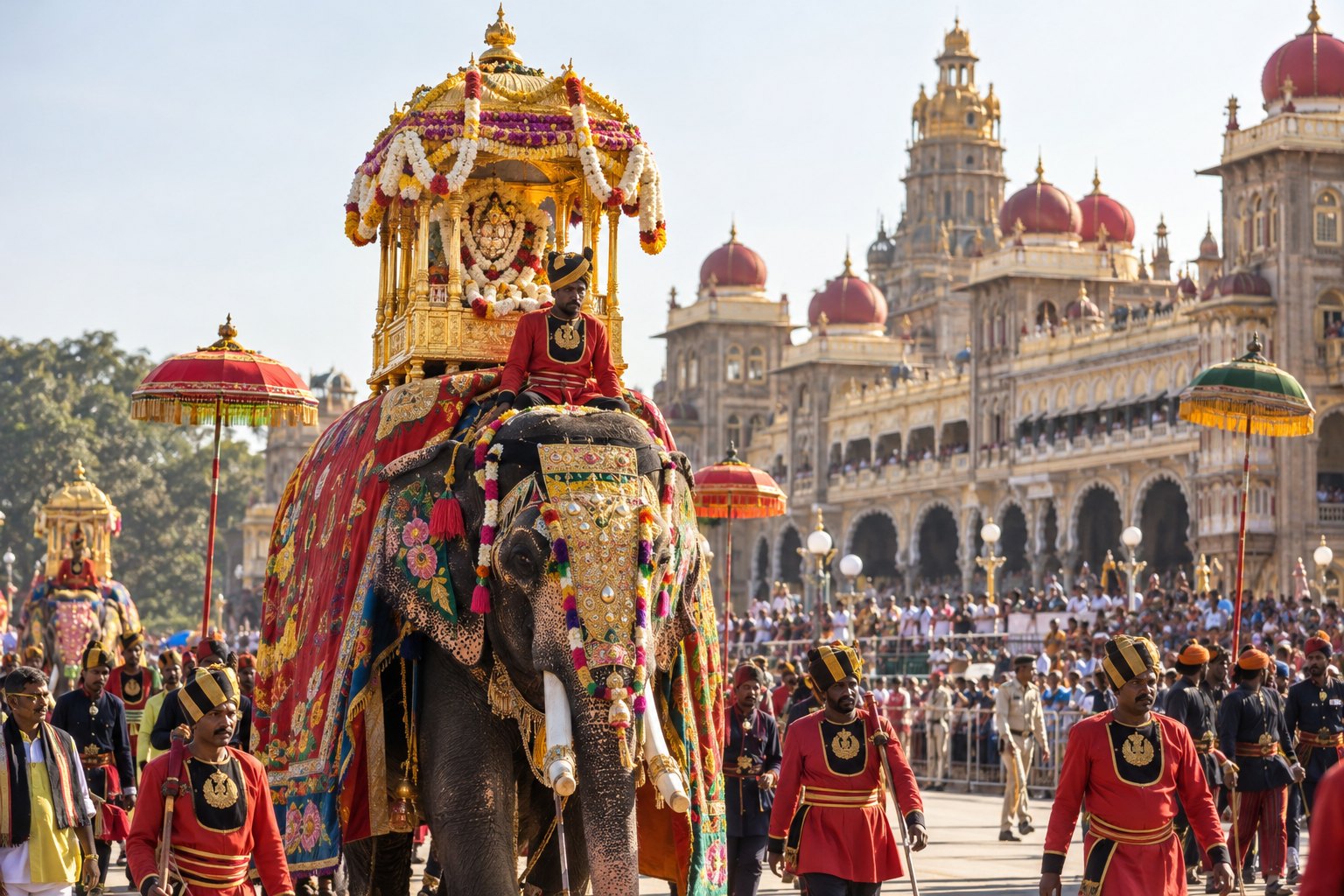
Mysuru Dasara is Karnataka's state festival, the Nada Habba. Raja Wadiyar I first held it at Srirangapatna in 1610, continuing the Vijayanagara rulers' Mahanavami celebrations at Hampi. It ends on Vijayadashami with the Jamboo Savari, an elephant procession carrying Goddess Chamundeshwari in a golden howdah. The 2026 festival opened on Chamundi Hills on 11 October.
Syllabus: GS1 · Art & Culture; Prelims · Current Affairs & IR; Prelims · History & Culture
In short
Mysuru Dasara, Karnataka's state festival or Nada Habba, carries Vijayanagara's royal Mahanavami celebration, through the Wadiyars, into a State-run civic festival ending in the Jamboo Savari.
Mysuru Dasara shows how state patronage can keep a 1610 court ritual alive; its ritual core must not drown in spectacle.
Why it matters
For a student, Mysuru Dasara is one thread through medieval and modern history: the court festival of Vijayanagara at Hampi, the Wadiyars who inherited it, the years under Tipu Sultan, the return of the dynasty in 1799 and the princely state's accession to India. It also shows how a royal ceremony became a public one. The king once rode in the howdah; today the goddess does, the State Government runs the programme, and folk troupes and tableaux from every district of Karnataka join the procession. The festival draws devotees and tourists from across India and abroad, so the district administration and police must manage large crowds, as they did by restricting entry to Chamundi Hills during the inauguration.
Prelims pointers
- Vijayanagara empire: founded in 1336 by Harihara and Bukka of the Sangama dynasty; its capital Hampi stood on the Tungabhadra river.
- Mahanavami Dibba: the great platform at Hampi linked to the royal Mahanavami festival; Hampi is a UNESCO World Heritage Site.
- Battle of Talikota, 1565: the Deccan Sultanates defeated Vijayanagara; feudatories such as the Wadiyars of Mysuru later ruled on their own.
- Fourth Anglo-Mysore War, 1799: Tipu Sultan died at Srirangapatna; the British restored the Wadiyars under a subsidiary alliance, with Lord Wellesley as Governor-General.
- Foreign accounts: the Portuguese traveller Domingo Paes described the Mahanavami festival at Vijayanagara; Abdur Razzaq, an envoy of the ruler of Persia, visited the city in the fifteenth century.
- Ayudha Puja: worship of weapons, tools and vehicles on Mahanavami, the ninth day; Vijayadashami is the tenth day.
- Chamundeshwari: presiding deity of Mysuru; her temple stands on Chamundi Hills above the city.
- Kambala, a traditional buffalo race, and the folk forms Pooja Kunitha and Veeragaase are Karnataka traditions seen in the Dasara programme.
Practise a UPSC-style question
With reference to Mysuru Dasara, consider the following statements:
1. Raja Wadiyar I first celebrated the festival at Hampi in 1610.
2. The celebrations moved to Mysuru in 1799, after the fall of Tipu Sultan.
Which of the statements given above is/are correct?
- (a) 1 only
- (b) 2 only
- (c) Both 1 and 2
- (d) Neither 1 nor 2
Show the answer
Answer: (b) 2 only
1 is incorrect: Raja Wadiyar I first celebrated Dasara at Srirangapatna in 1610; Hampi was the capital of the Vijayanagara empire, whose Mahanavami festival the Wadiyars continued. 2 is correct: the festival shifted to Mysuru in 1799, when the Wadiyars returned to the throne after Tipu Sultan was killed in the Fourth Anglo-Mysore War.
More Explainers
- State Legislative Councils: Articles 168-172 and the graduates' and teachers' seats Polity
- Whales and dolphins in Indian waters: legal protection, IUCN status and strandings Environment
- The Aligarh Movement, AMU and the Article 30 minority test Polity
- Environmental clearance by States: SEIAA, SEAC and the EIA Notification, 2006 Environment
- Software vulnerabilities: CVE, CVSS, coordinated disclosure and CERT-In's role Sci-Tech
- Drug trafficking law in India: NDPS Act, PIT-NDPS, NCB and NCORD National
- Choosing the UN Secretary-General: Article 97, UNSC veto and straw polls World & IR
- UN Convention against Torture, and why India has not ratified it Polity
- NavIC: why India's navigation constellation cannot give a standalone position Sci-Tech
- International Energy Agency: membership, 90-day oil stocks and India's status World & IR
- PM Surya Ghar: Muft Bijli Yojana and the rooftop solar subsidy Economy
- HFSS foods: FSSAI's draft limits and front-of-pack warning labels National