
Multi-Lane Free Flow tolling: how barrier-less highway tolls work
Why in news: NHAI rolled out barrier-less Multi-Lane Free Flow tolling at the Paranur toll plaza in Tamil Nadu, the government said on 1 October 2026.
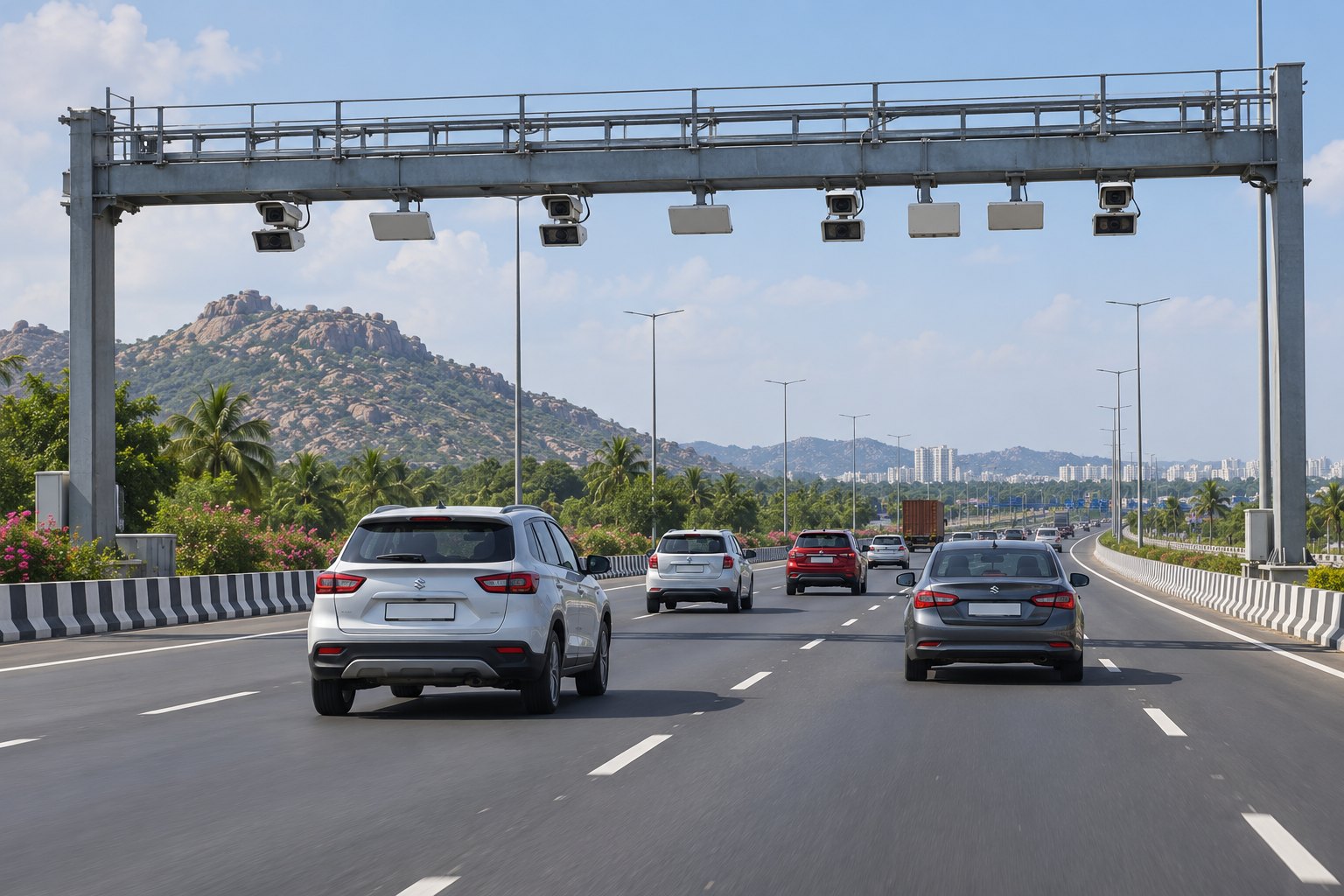
Multi-Lane Free Flow (MLFF) tolling collects highway tolls with no barrier: gantry readers detect a vehicle's FASTag while Automatic Number Plate Recognition cameras log its number plate. A vehicle without a working FASTag or enough balance gets an electronic notice. NHAI brought MLFF to the Paranur toll plaza in Tamil Nadu on 1 October 2026.
Syllabus: GS3 · Infrastructure; GS3 · Science & Technology; GS2 · Governance & e-Governance
In short
Multi-Lane Free Flow (MLFF) tolling removes the toll booth and boom barrier: overhead FASTag readers and number-plate cameras charge moving vehicles, so collection rests on accurate reads.
MLFF's time and fuel savings last only if reads stay accurate, wrong bills are easily contested and camera data stays confined to tolling.
Why it matters
A truck driver or a family on a highway trip no longer brakes, queues and pulls away at a toll booth: MLFF lets traffic pass at speed, which NHAI says saves fuel and time, cuts congestion and emissions and lowers the cost of running toll plazas. The catch is enforcement. With no barrier to stop a vehicle, collection rests on the FASTag and on cameras reading a clean High Security Registration Plate, so a dirty, tampered or fake plate becomes a way to dodge the toll. A wrong read can bill the wrong owner, which is why the rules allow 72 hours to contest an e-notice. The cameras also build a record of vehicle movements, which raises questions of data protection.
Prelims pointers
- FASTag: a passive RFID tag with no battery, powered by the reader's radio signal and read only at short range as the vehicle passes.
- NETC programme: the National Payments Corporation of India runs its switch and settlement; Indian Highways Management Company Limited, promoted by NHAI, implements it on National Highways.
- ANPR: cameras read number plates by optical character recognition; High Security Registration Plates are fitted on vehicles manufactured on or after 1 April 2019.
- GNSS tolling: an on-board unit fixes position from satellites such as GPS and NavIC, and the fee is computed from distance travelled on a geo-fenced highway.
- NHAI: a statutory body under the National Highways Authority of India Act, 1988, working under the Ministry of Road Transport and Highways.
- National Highways Fee (Determination of Rates and Collection) Rules, 2008 are made under the National Highways Act, 1956; the toll is a user fee for using a highway section.
- NavIC (Navigation with Indian Constellation) is ISRO's regional satellite navigation system; GPS belongs to the United States.
- NH-44 runs from Srinagar to Kanyakumari and is India's longest National Highway; NH-48 runs from Delhi to Chennai through Jaipur, Ahmedabad, Mumbai and Bengaluru.
Practise a UPSC-style question
With reference to FASTag, consider the following statements:
1. It is a passive Radio Frequency Identification tag powered by the radio signal of the reader.
2. It fixes the toll by tracking the vehicle's position through NavIC satellites.
Which of the statements given above is/are correct?
- (a) 1 only
- (b) 2 only
- (c) Both 1 and 2
- (d) Neither 1 nor 2
Show the answer
Answer: (a) 1 only
1 is correct: a passive RFID tag has no battery and is energised by the reader's radio waves, so it is read only at short range. 2 is incorrect: position tracking by satellites such as NavIC is the method of GNSS-based tolling with an on-board unit, not FASTag.
More Explainers
- State Legislative Councils: Articles 168-172 and the graduates' and teachers' seats Polity
- Whales and dolphins in Indian waters: legal protection, IUCN status and strandings Environment
- The Aligarh Movement, AMU and the Article 30 minority test Polity
- Environmental clearance by States: SEIAA, SEAC and the EIA Notification, 2006 Environment
- Software vulnerabilities: CVE, CVSS, coordinated disclosure and CERT-In's role Sci-Tech
- Drug trafficking law in India: NDPS Act, PIT-NDPS, NCB and NCORD National
- Choosing the UN Secretary-General: Article 97, UNSC veto and straw polls World & IR
- UN Convention against Torture, and why India has not ratified it Polity
- NavIC: why India's navigation constellation cannot give a standalone position Sci-Tech
- International Energy Agency: membership, 90-day oil stocks and India's status World & IR
- PM Surya Ghar: Muft Bijli Yojana and the rooftop solar subsidy Economy
- HFSS foods: FSSAI's draft limits and front-of-pack warning labels National