
Mission for Aatmanirbharta in Pulses: self-reliance in tur, urad and masoor
Why in news: The Mission for Aatmanirbharta in Pulses completed its first year, with 528 of 1,000 planned dal mills allocated, the government said on 11 October 2026.
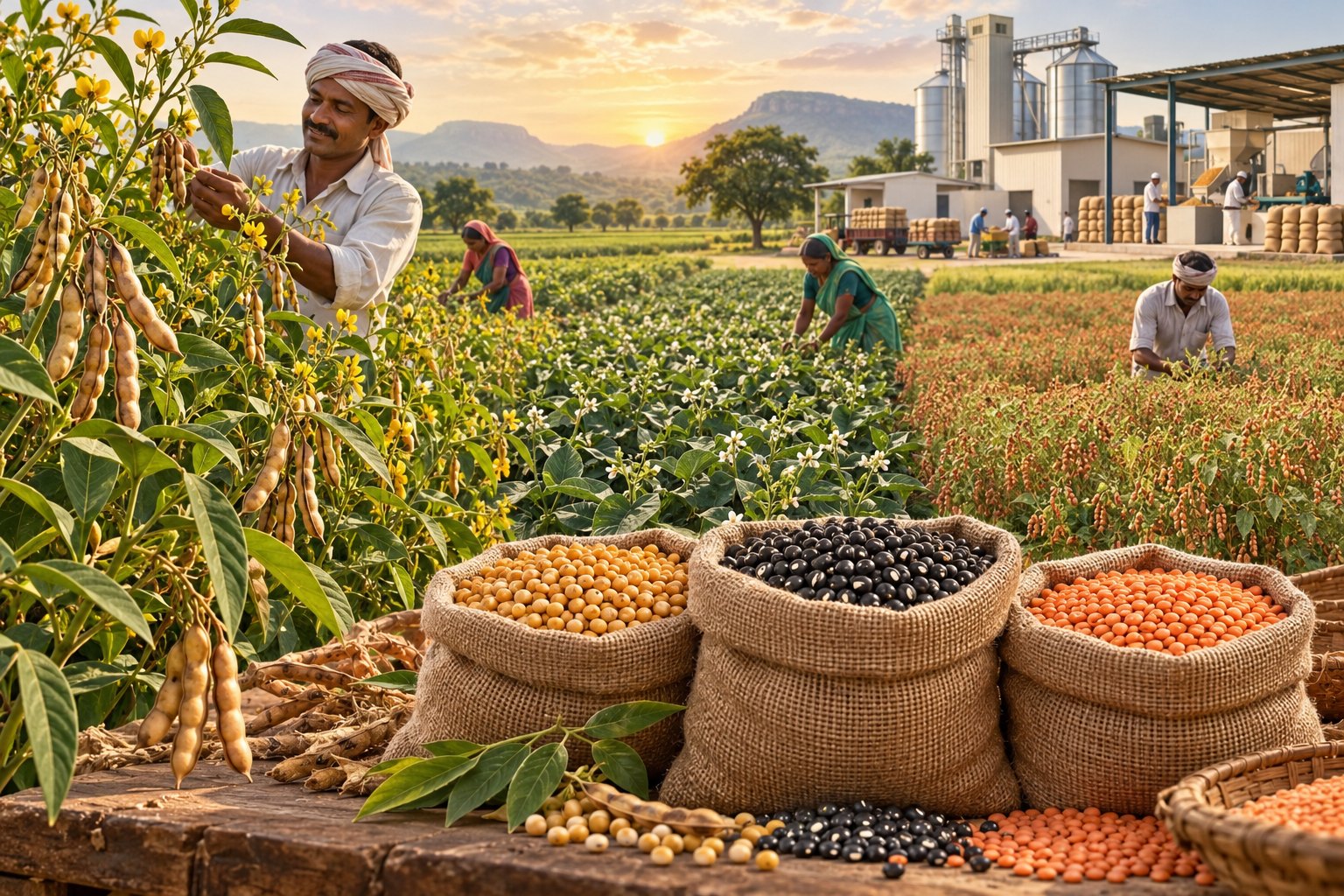
The Mission for Aatmanirbharta in Pulses is a six-year plan, from 2025-26 to 2030-31 with ₹11,440 crore, to make India self-sufficient in pulses. Run by the Ministry of Agriculture and Farmers Welfare, it targets tur, urad and masoor through better seed, more area, dal mills and assured MSP procurement. It completed its first year on 11 October 2026.
Syllabus: GS3 · Agriculture & Irrigation; GS3 · MSP, Subsidies & Food Security; Prelims · Economy & Social Development
In short
The Mission for Aatmanirbharta in Pulses (2025-26 to 2030-31, ₹11,440 crore) is the Agriculture Ministry's plan to cut pulse imports by growing more tur, urad and masoor.
Assured prices can pull land into pulses; self-reliance now rests on lifting rainfed yields and keeping procurement affordable.
Why it matters
For a farmer in Madhya Pradesh or Maharashtra, two leading pulse-growing States, the biggest risk in sowing tur or urad is a price crash at harvest. A standing offer from NAFED and NCCF to buy a registered farmer's crop at MSP for four years removes much of that risk, so more land can shift to pulses. For households, pulses are an affordable source of protein, at 20-25% protein, more than double wheat's. Each tonne grown at home instead of imported saves foreign exchange and cushions prices against poor harvests abroad. Pulses also fix nitrogen, so the next crop needs less fertiliser.
Prelims pointers
- Mission for Aatmanirbharta in Pulses: Ministry of Agriculture and Farmers Welfare; announced in Union Budget 2025-26; 2025-26 to 2030-31; crops tur, urad and masoor.
- NAFED (National Agricultural Cooperative Marketing Federation of India) and NCCF (National Cooperative Consumers' Federation of India): the Mission's procurement agencies for tur, urad and masoor.
- Commission for Agricultural Costs and Prices (CACP): attached office of the agriculture ministry, set up in 1965; recommends MSPs, which the Cabinet Committee on Economic Affairs approves.
- Since 2018-19, MSPs are fixed at least 1.5 times the all-India weighted average cost of production.
- PM-AASHA (2018): MSP support for pulses, oilseeds and copra; its Price Support Scheme buys at MSP, its Price Deficiency Payment Scheme pays the gap to market price.
- Seasons: tur (arhar) is a kharif pulse; masoor (lentil) and chana (gram) are rabi pulses; urad is grown mainly in kharif.
- Pulses are legumes: Rhizobium bacteria in their root nodules fix atmospheric nitrogen, enriching the soil for the next crop.
- SATHI (Seed Authentication, Traceability and Holistic Inventory) portal: tracks seed from production through certification to sale.
Practise a UPSC-style question
With reference to the Mission for Aatmanirbharta in Pulses, consider the following statements:
1. It is a mission of the Ministry of Agriculture and Farmers Welfare.
2. Under it, the Food Corporation of India is the agency designated to procure tur, urad and masoor at MSP.
Which of the statements given above is/are correct?
- (a) 1 only
- (b) 2 only
- (c) Both 1 and 2
- (d) Neither 1 nor 2
Show the answer
Answer: (a) 1 only
1 is correct: the Mission is run by the Ministry of Agriculture and Farmers Welfare. 2 is incorrect: the procuring agencies are NAFED and NCCF, two national cooperatives, which may buy all the tur, urad and masoor offered by registered farmers from 2025-26 to 2028-29.
More Explainers
- State Legislative Councils: Articles 168-172 and the graduates' and teachers' seats Polity
- Whales and dolphins in Indian waters: legal protection, IUCN status and strandings Environment
- The Aligarh Movement, AMU and the Article 30 minority test Polity
- Environmental clearance by States: SEIAA, SEAC and the EIA Notification, 2006 Environment
- Software vulnerabilities: CVE, CVSS, coordinated disclosure and CERT-In's role Sci-Tech
- Drug trafficking law in India: NDPS Act, PIT-NDPS, NCB and NCORD National
- Choosing the UN Secretary-General: Article 97, UNSC veto and straw polls World & IR
- UN Convention against Torture, and why India has not ratified it Polity
- NavIC: why India's navigation constellation cannot give a standalone position Sci-Tech
- International Energy Agency: membership, 90-day oil stocks and India's status World & IR
- PM Surya Ghar: Muft Bijli Yojana and the rooftop solar subsidy Economy
- HFSS foods: FSSAI's draft limits and front-of-pack warning labels National