
Lighthouses and the DGLL: India's marine aids to navigation
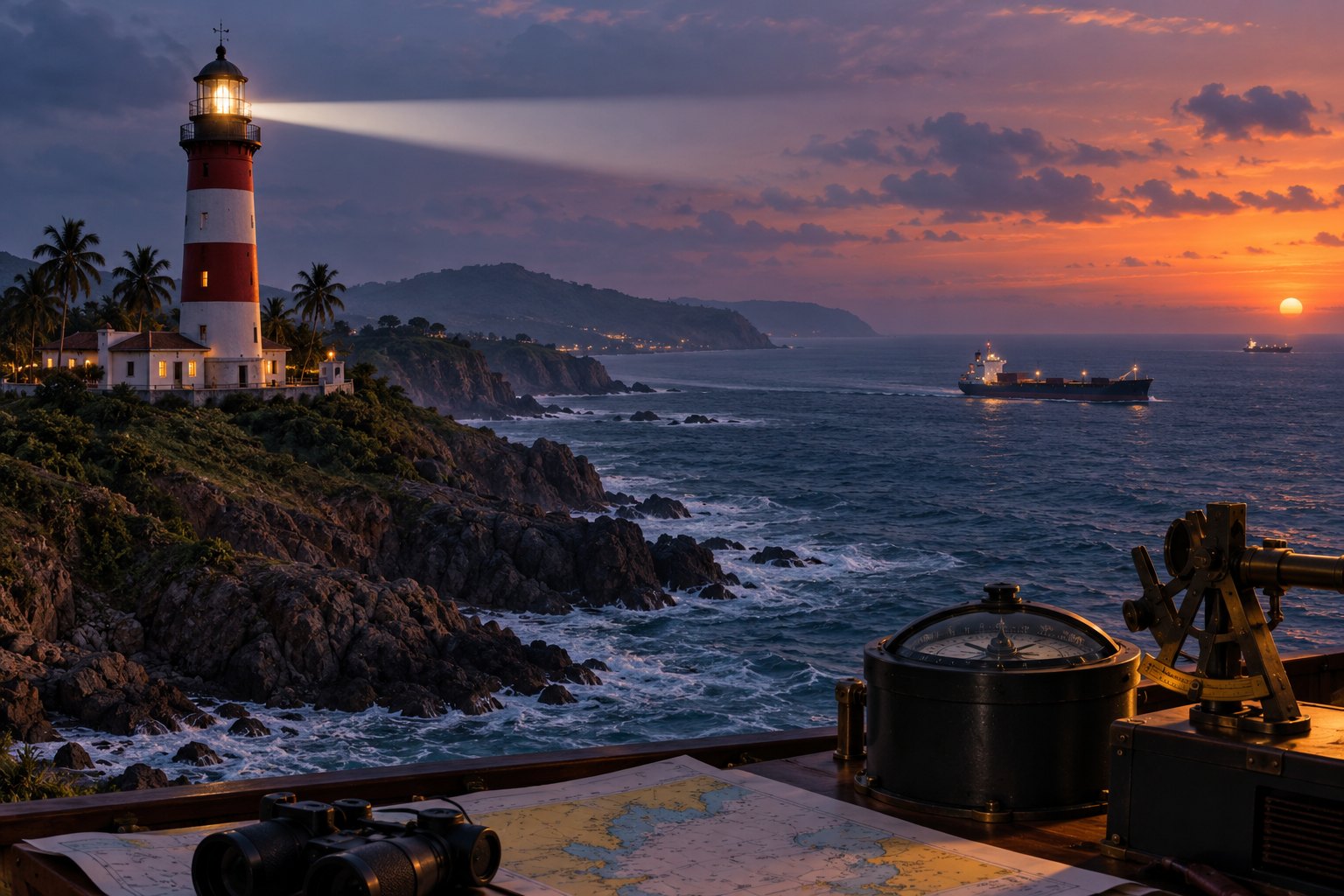
Lighthouses are aids to navigation that guide ships past dangerous coasts. India's are run by the Directorate General of Lighthouses and Lightships (DGLL), under the Ministry of Ports, Shipping and Waterways, and governed by the Marine Aids to Navigation Act, 2021. Four lighthouses being built on the Brahmaputra will be India's first on an inland waterway.
Syllabus: GS1 · Art & Culture; Prelims · Geography; GS3 · Infrastructure
In short
Lighthouses, aids to navigation marking dangerous coasts, are run in India by the Directorate General of Lighthouses and Lightships; they now double as heritage sites.
India's lighthouses can serve heritage, tourism and inland transport, provided upkeep and security of the light and AIS stay their first duty.
Why it matters
A fishing crew returning to harbour at night, or a cargo vessel heading up the Brahmaputra to Pandu, needs to know exactly where the rocks, shoals and channel lie. Lighthouses and AIS stations give that fix, and a failure costs lives and cargo. AIS data also shows the shore which vessels are at sea, which helps traffic management and coastal awareness. On the river, lights with weather sensors can make night and bad-weather navigation on National Waterway-2 safer, supporting cheaper water transport for the Northeast. The heritage side, through museums and heritage lighthouses, keeps the story of ports from Lothal to Mahabalipuram in public view.
Prelims pointers
- DGLL: the body under the Ministry of Ports, Shipping and Waterways that builds and runs India's lighthouses, lightships and other marine aids to navigation.
- Marine Aids to Navigation Act, 2021: replaced the Lighthouse Act, 1927; covers vessel traffic services, operator training and certification, wreck marking and developing lighthouses for culture and tourism.
- SOLAS: the International Convention for the Safety of Life at Sea, an International Maritime Organization treaty; its first version (1914) followed the sinking of the Titanic.
- AIS: VHF system broadcasting a ship's identity, position, course and speed; SOLAS requires it on passenger ships and on ships of 300 gross tonnage upward on international voyages.
- Lothal: Harappan site in Gujarat, near the Gulf of Khambhat between the Sabarmati and its tributary the Bhogavo, known for its brick dockyard.
- Mahabalipuram (Mamallapuram): Pallava port on Tamil Nadu's Coromandel Coast; its Group of Monuments is a UNESCO World Heritage Site.
- National Waterway-2: the Sadiya-Dhubri stretch of the Brahmaputra in Assam, developed by the Inland Waterways Authority of India, set up under an Act of 1985.
- Fort Aguada: 17th-century Portuguese fort in Goa with a historic lighthouse; host of the first Indian Lighthouse Festival in 2023.
Practise a UPSC-style question
With reference to the Marine Aids to Navigation Act, 2021, consider the following statements:
1. It replaced the Indian Ports Act, 1908 as the law governing lighthouses in India.
2. It allows the Central Government to designate an aid to navigation under its control as a heritage lighthouse.
Which of the statements given above is/are correct?
- (a) 1 only
- (b) 2 only
- (c) Both 1 and 2
- (d) Neither 1 nor 2
Show the answer
Answer: (b) 2 only
1 is incorrect: the 2021 Act replaced the Lighthouse Act, 1927. 2 is correct: the Act lets the Centre designate an aid to navigation under its control as a heritage lighthouse, to be developed for educational, cultural and tourism purposes.
More Explainers
- State Legislative Councils: Articles 168-172 and the graduates' and teachers' seats Polity
- Whales and dolphins in Indian waters: legal protection, IUCN status and strandings Environment
- The Aligarh Movement, AMU and the Article 30 minority test Polity
- Environmental clearance by States: SEIAA, SEAC and the EIA Notification, 2006 Environment
- Software vulnerabilities: CVE, CVSS, coordinated disclosure and CERT-In's role Sci-Tech
- Drug trafficking law in India: NDPS Act, PIT-NDPS, NCB and NCORD National
- Choosing the UN Secretary-General: Article 97, UNSC veto and straw polls World & IR
- UN Convention against Torture, and why India has not ratified it Polity
- NavIC: why India's navigation constellation cannot give a standalone position Sci-Tech
- International Energy Agency: membership, 90-day oil stocks and India's status World & IR
- PM Surya Ghar: Muft Bijli Yojana and the rooftop solar subsidy Economy
- HFSS foods: FSSAI's draft limits and front-of-pack warning labels National