
Lethal autonomous weapons systems and meaningful human control
Why in news: On 20 October 2026, UNIDIR's Director warned at UN Headquarters that AI is on track to crowd out human decision-making in warfare.
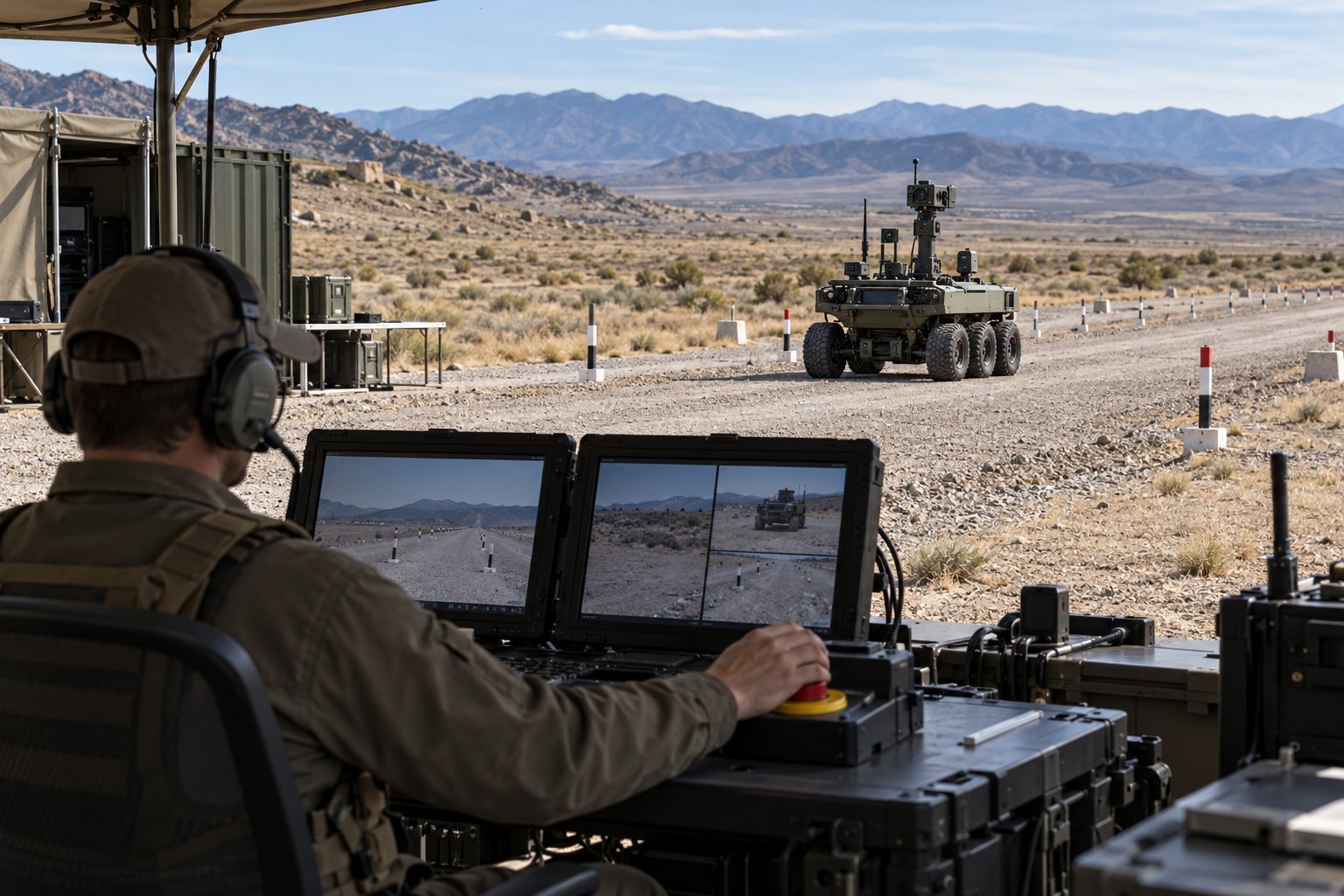
Lethal autonomous weapons systems (LAWS) select and strike targets without further human input once activated, and no agreed definition of them exists. States discuss them in a Group of Governmental Experts under the Convention on Certain Conventional Weapons (CCW). UNIDIR's Director warned on 20 October 2026 that military AI is crowding out human decision-making.
Syllabus: GS4 · Ethics in Public Administration; GS3 · IT, Space, Biotech & IPR; GS2 · Groupings & Agreements
Why this matters for UPSC
GS2 international institutions and GS3 robotics and AI: Prelims can ask about the CCW and its Protocols, the GGE and UNIDIR; Mains, about meaningful human control and India's stand on LAWS.
In short
Lethal autonomous weapons systems pick and strike targets without further human input after activation; their regulation turns on keeping meaningful human control under international humanitarian law.
Agreed definitions and meaningful human control over every attack must anchor any LAWS instrument, balancing military necessity with humanity within the CCW's consensus framework.
Why it matters
Whether a machine or a person decides to kill decides who answers for a wrong strike. A soldier can hesitate, spot a surrender or call off an attack when children appear; a sensor matching a pattern cannot. As targeting speeds up, commanders get less time to check what the machine proposes, so mistakes can spread into wider wars nobody chose. Civilians near any front line carry most of that risk. Easier-to-use tools also let armed groups copy what armies do. For India, with long and contested borders, the rules agreed now will shape how its own forces may use these systems and how far rivals' systems are restrained.
Prelims pointers
- The CCW's full title covers weapons deemed excessively injurious or having indiscriminate effects; it was amended on 21 December 2001.
- A 2001 amendment to Article 1 of the CCW, in force from 2004, extends the Convention to non-international armed conflicts.
- Under Article 8(2)(a) of the CCW, any High Contracting Party may propose additional protocols on weapons not yet covered.
- Amended Protocol II of the CCW is the only legally binding instrument that covers improvised explosive devices.
- Protocol V of the CCW, adopted in 2003, was the first multilateral agreement on unexploded and abandoned ordnance.
- CCW States parties hold a Review Conference every five years; the Sixth was held in December 2021.
- UNIDIR is governed by the Advisory Board on Disarmament Matters, and the UN Secretary-General appoints its Director.
Practise a UPSC-style question
With reference to the Convention on Certain Conventional Weapons (CCW), consider the following statements:
1. The framework convention allows its parties to negotiate and adopt new protocols on other weapons.
2. Protocol III of the CCW prohibits laser weapons specifically designed to cause permanent blindness.
3. An amendment to Article 1 extends the Convention and its Protocols to non-international armed conflicts.
Which of the statements given above is/are correct?
- (a) 1 and 2 only
- (b) 2 and 3 only
- (c) 1 and 3 only
- (d) 1, 2 and 3
Show the answer
Answer: (c) 1 and 3 only
Answer: (c) 1 and 3 only. Blinding lasers fall under Protocol IV, not Protocol III.
Statement 1: correct. Under Article 8(2)(a) any High Contracting Party may propose protocols on weapons not yet covered.
Statement 2: incorrect. Protocol IV (1995) bans blinding laser weapons; Protocol III covers incendiary weapons.
Statement 3: correct. The amendment to Article 1, decided in 2001 and in force from 2004, covers non-international armed conflicts.
Eliminate: Statement 2 swaps Protocol IV for Protocol III, so it is wrong. Out: (a), (b), (d).
Trap: Look-alike names. The five CCW Protocols are numbered, and the question pins a real ban on a neighbouring Protocol.
Remember: CCW Protocols: I fragments, II mines, III incendiary, IV blinding lasers, V explosive remnants of war.
More Explainers
- State Legislative Councils: Articles 168-172 and the graduates' and teachers' seats Polity
- Whales and dolphins in Indian waters: legal protection, IUCN status and strandings Environment
- The Aligarh Movement, AMU and the Article 30 minority test Polity
- Environmental clearance by States: SEIAA, SEAC and the EIA Notification, 2006 Environment
- Software vulnerabilities: CVE, CVSS, coordinated disclosure and CERT-In's role Sci-Tech
- Drug trafficking law in India: NDPS Act, PIT-NDPS, NCB and NCORD National
- Choosing the UN Secretary-General: Article 97, UNSC veto and straw polls World & IR
- UN Convention against Torture, and why India has not ratified it Polity
- NavIC: why India's navigation constellation cannot give a standalone position Sci-Tech
- International Energy Agency: membership, 90-day oil stocks and India's status World & IR
- PM Surya Ghar: Muft Bijli Yojana and the rooftop solar subsidy Economy
- HFSS foods: FSSAI's draft limits and front-of-pack warning labels National