
Left-Wing Extremism and the 2015 National Policy and Action Plan
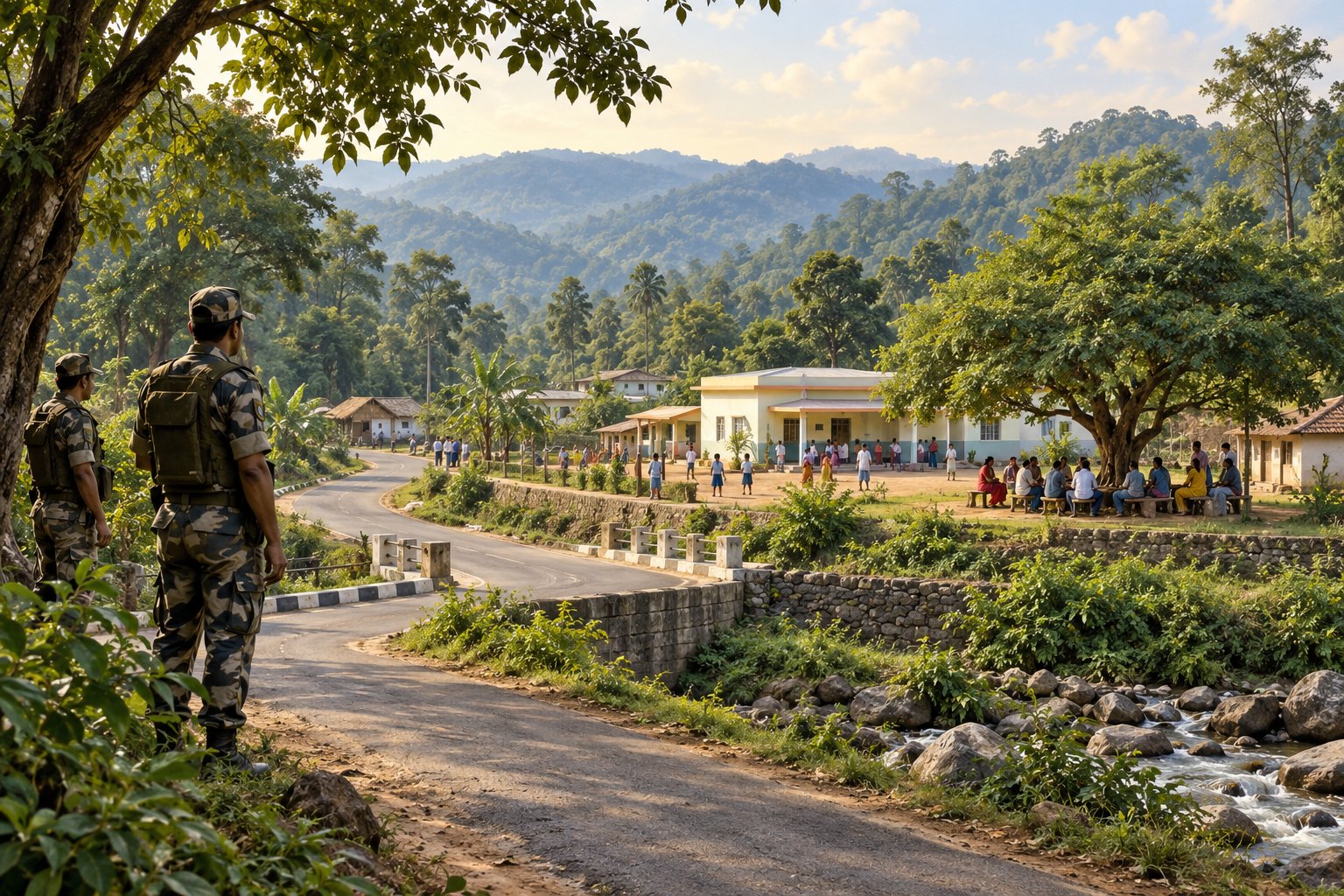
Left-Wing Extremism, the Maoist armed movement that grew from the 1967 Naxalbari uprising, has been tackled since 2015 under a National Policy and Action Plan that combines security operations, development schemes and rehabilitation of surrendered cadres. The government says India became effectively free of it on 31 March 2026, though 38 districts remain in special categories for continued support.
Syllabus: Prelims · Current Affairs & IR; GS2 · Welfare of Vulnerable Sections; GS3 · Development & Extremism
In short
Left-Wing Extremism is the Maoist armed movement born at Naxalbari in 1967; the 2015 National Policy and Action Plan meets it with security, development and rehabilitation together.
The 2015 plan's gains will last only if Legacy and Thrust Districts keep support until tribal rights make the State's presence permanent.
Why it matters
For a tribal family in Bastar, the end of armed conflict means a road to the market, a mobile signal, a bank branch and a school that stays open. By the government's count, Naxal-related incidents fell from 870 in 2014 to 33 in 2026 up to 29 July, and deaths from 310 to 11. The larger issue is the link between development deficits and extremism: violence spread where the State was absent and land and forest grievances went unheard. Whether the gains last depends on consolidation in the 38 districts still under watch, and on tribal rights under the Forest Rights Act, 2006 and the PESA Act, 1996 being delivered.
Prelims pointers
- Naxalbari (Darjeeling district, West Bengal): its 1967 uprising named Naxalism. CPI (Maoist): formed in 2004 by merging the People's War Group and the Maoist Communist Centre of India.
- Aspirational Districts Programme (NITI Aayog, 2018): converges welfare schemes in lagging districts to improve health, education, financial inclusion and connectivity.
- Seventh Schedule, State List: 'public order' and 'police' are State subjects; the Centre helps with Central Armed Police Forces, funds and coordination by the Ministry of Home Affairs.
- National Policy and Action Plan (2015): security, development and protection of community rights; funded through the SRE, SIS and SCA schemes of the Ministry of Home Affairs.
- Road Connectivity Project for LWE Affected Areas: Ministry of Rural Development, a vertical under PMGSY; the earlier Road Requirement Plan-I: Ministry of Road Transport and Highways.
- CoBRA (Commando Battalion for Resolute Action): the CRPF's jungle-warfare unit; District Reserve Guard: a Chhattisgarh Police unit drawn from local youth.
- Ministry of Tribal Affairs: Eklavya Model Residential Schools, PM-JANMAN (for Particularly Vulnerable Tribal Groups) and the Dharti Aaba Janjatiya Gram Utkarsh Abhiyan.
- Fifth Schedule: Scheduled Areas; PESA Act, 1996 extends panchayats to them with strong Gram Sabhas; Forest Rights Act, 2006 recognises forest dwellers' rights.
Practise a UPSC-style question
With reference to Left-Wing Extremism (LWE) in India, consider the following statements:
1. The movement takes its popular name from a 1967 uprising at Naxalbari in West Bengal.
2. The Communist Party of India (Maoist) was formed in 2004 through a merger of armed groups.
3. 'Police' and 'public order' are entries in the Union List of the Seventh Schedule.
Which of the statements given above is/are correct?
- (a) 1 and 2 only
- (b) 2 and 3 only
- (c) 1 and 3 only
- (d) 1, 2 and 3
Show the answer
Answer: (a) 1 and 2 only
1 is correct: the 1967 peasant uprising at Naxalbari, in Darjeeling district, gave the movement the name Naxalism. 2 is correct: the People's War Group and the Maoist Communist Centre of India merged into CPI (Maoist) in 2004. 3 is incorrect: police and public order are in the State List, which is why States lead and the Centre supports.
More Explainers
- State Legislative Councils: Articles 168-172 and the graduates' and teachers' seats Polity
- Whales and dolphins in Indian waters: legal protection, IUCN status and strandings Environment
- The Aligarh Movement, AMU and the Article 30 minority test Polity
- Environmental clearance by States: SEIAA, SEAC and the EIA Notification, 2006 Environment
- Software vulnerabilities: CVE, CVSS, coordinated disclosure and CERT-In's role Sci-Tech
- Drug trafficking law in India: NDPS Act, PIT-NDPS, NCB and NCORD National
- Choosing the UN Secretary-General: Article 97, UNSC veto and straw polls World & IR
- UN Convention against Torture, and why India has not ratified it Polity
- NavIC: why India's navigation constellation cannot give a standalone position Sci-Tech
- International Energy Agency: membership, 90-day oil stocks and India's status World & IR
- PM Surya Ghar: Muft Bijli Yojana and the rooftop solar subsidy Economy
- HFSS foods: FSSAI's draft limits and front-of-pack warning labels National