
Khadi and Village Industries Commission (KVIC) and what makes khadi
Why in news: KVIC has modernised its Central Sliver Plants at Chitradurga and Kuttur, with Chitradurga running half on solar power, the government said on 9 October 2026.
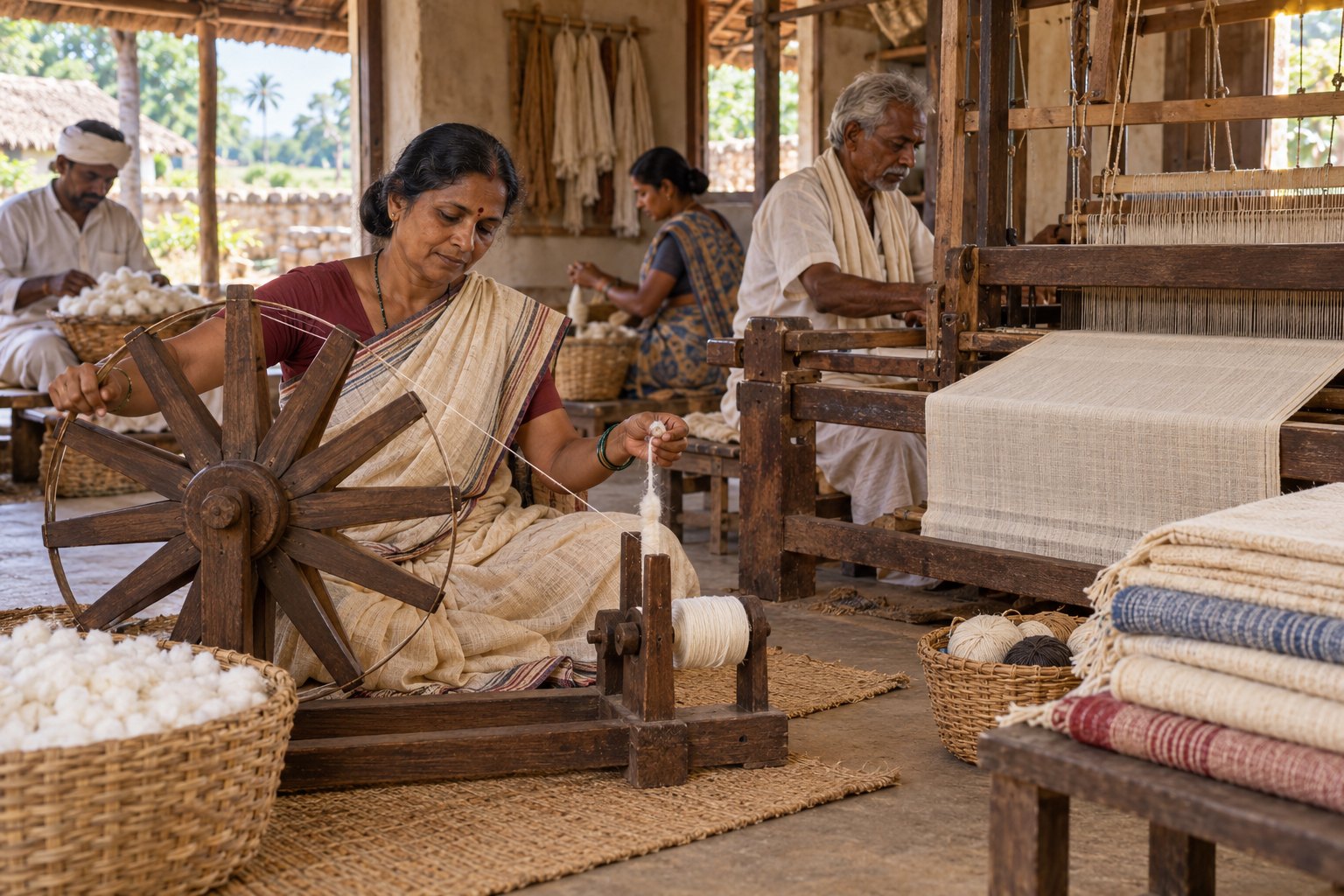
The Khadi and Village Industries Commission (KVIC) is a statutory body under the Ministry of Micro, Small and Medium Enterprises that promotes khadi and village industries in rural areas. Khadi is cloth both hand-spun and hand-woven. New khadi ranges, modernised sliver plants and Ponduru Khadi's GI tag featured in the government's review of 9 October 2026.
Syllabus: GS3 · Indian Economy & Growth; GS3 · Inclusive Growth; Prelims · Economy & Social Development
In short
The Khadi and Village Industries Commission (KVIC), a statutory body under the KVIC Act, 1956 and the Ministry of MSME, promotes hand-spun, hand-woven khadi and rural village industries.
Khadi's future lies in paying spinners enough and selling at a premium, while keeping the hand spinning that sets it apart.
Why it matters
For a woman spinning yarn in a village khadi institution, KVIC is the link to raw sliver, a wage and a buyer. The Ministry says about four in five of roughly half a million khadi artisans are women, so wage rises and wider sales reach rural households directly, without migration. Because khadi is made by hand from natural fibre, with little power or water, it is also low-carbon textile work, and KVIC is exploring naturally coloured cotton varieties with ICAR-CIRCOT to cut chemical dyeing. The larger questions are whether a hand-made, subsidised sector can pay enough to keep young spinners, and how a heritage fabric competes with cheap mill and powerloom cloth without diluting what makes it khadi.
Prelims pointers
- Khadi and Village Industries Commission Act, 1956: created KVIC as a statutory body; KVIC took over the All India Khadi and Village Industries Board's work in April 1957.
- Khadi (KVIC Act definition): cloth woven on handlooms in India from cotton, silk or woollen yarn hand-spun in India, or a mix of these.
- Khadi vs handloom: both are hand-woven; only khadi needs hand-spun yarn. Khadi falls under the Ministry of MSME, handlooms under the Ministry of Textiles.
- National Handloom Day, 7 August (observed since 2015), marks the Swadeshi Movement launched on 7 August 1905.
- Village industry (KVIC Act): a unit in a rural area producing goods or services, with or without power, within a fixed-capital limit per artisan or worker.
- Geographical Indications of Goods (Registration and Protection) Act, 1999: registration valid ten years and renewable; Darjeeling Tea was India's first GI.
- State Khadi and Village Industries Boards implement KVIC-run schemes such as PMEGP at the State level, alongside District Industries Centres.
Practise a UPSC-style question
With reference to the Khadi and Village Industries Commission (KVIC), consider the following statements:
1. It is a statutory body set up under an Act of Parliament passed in 1956.
2. It functions under the administrative control of the Ministry of Textiles.
3. Its headquarters is located in Mumbai.
Which of the statements given above is/are correct?
- (a) 1 and 2 only
- (b) 2 and 3 only
- (c) 1 and 3 only
- (d) 1, 2 and 3
Show the answer
Answer: (c) 1 and 3 only
1 is correct: KVIC was created by the Khadi and Village Industries Commission Act, 1956 and began work in April 1957. 2 is incorrect: KVIC is under the Ministry of Micro, Small and Medium Enterprises; the Ministry of Textiles looks after handlooms. 3 is correct: KVIC's head office is in Mumbai.
More Explainers
- State Legislative Councils: Articles 168-172 and the graduates' and teachers' seats Polity
- Whales and dolphins in Indian waters: legal protection, IUCN status and strandings Environment
- The Aligarh Movement, AMU and the Article 30 minority test Polity
- Environmental clearance by States: SEIAA, SEAC and the EIA Notification, 2006 Environment
- Software vulnerabilities: CVE, CVSS, coordinated disclosure and CERT-In's role Sci-Tech
- Drug trafficking law in India: NDPS Act, PIT-NDPS, NCB and NCORD National
- Choosing the UN Secretary-General: Article 97, UNSC veto and straw polls World & IR
- UN Convention against Torture, and why India has not ratified it Polity
- NavIC: why India's navigation constellation cannot give a standalone position Sci-Tech
- International Energy Agency: membership, 90-day oil stocks and India's status World & IR
- PM Surya Ghar: Muft Bijli Yojana and the rooftop solar subsidy Economy
- HFSS foods: FSSAI's draft limits and front-of-pack warning labels National