
Inverted duty structure in GST: the textile value chain
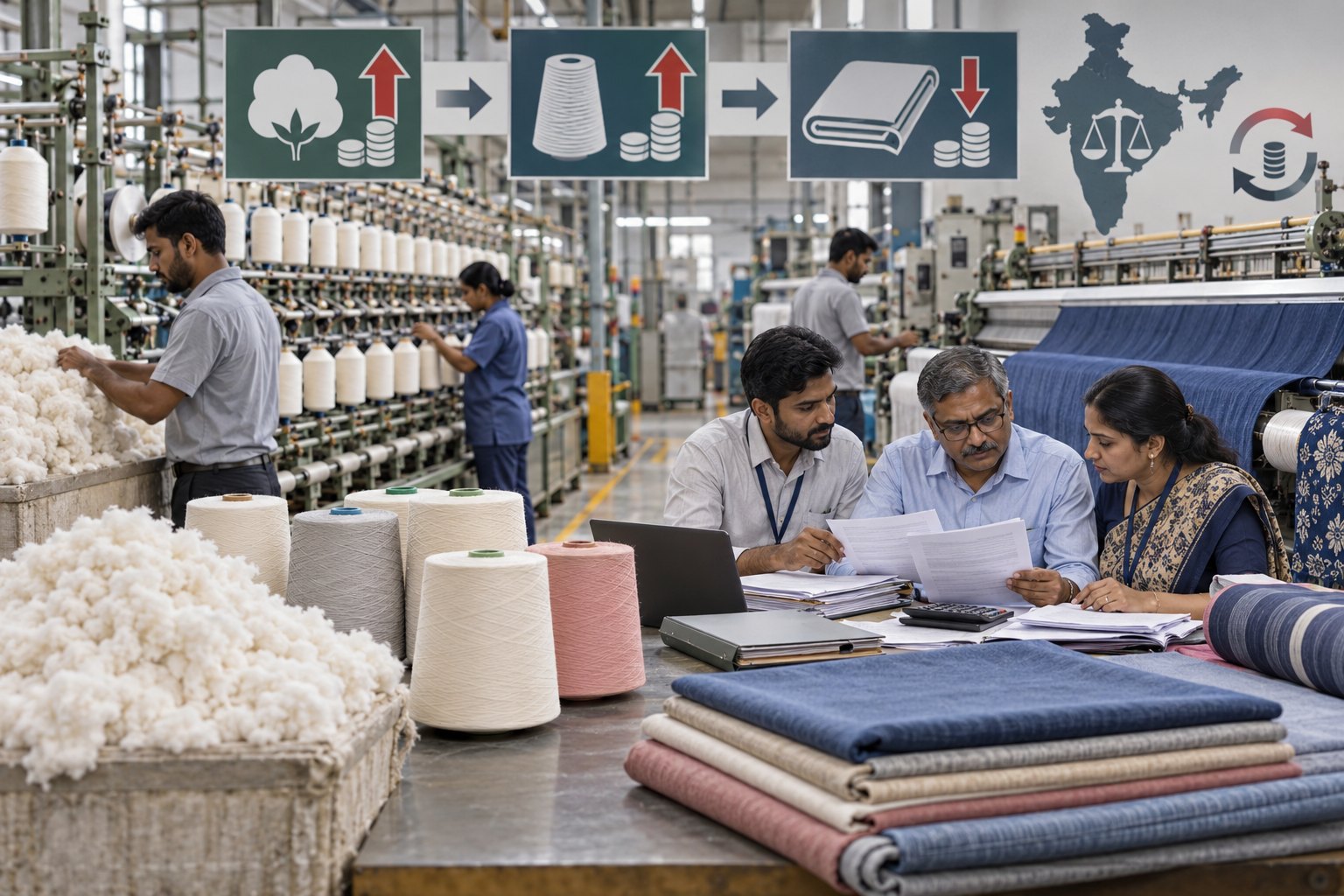
An inverted duty structure arises when inputs carry a higher GST rate than the finished product, so manufacturers pile up unused input tax credit. India's man-made fibre chain was the textbook case, with fibre taxed at 18%, yarn at 12% and fabric at 5%. The GST rate cuts effective 22 September 2025 brought fibre and yarn to 5%.
Syllabus: GS3 · Indian Economy & Growth; GS3 · Government Budgeting; Prelims · Economy & Social Development
In short
An inverted duty structure arises when inputs bear a higher GST rate than the finished good, so input tax credit piles up and locks a manufacturer's working capital.
Equal textile rates freed working capital at a revenue cost; the GST Council should now clear inversions elsewhere and review the ₹2,500 garment line.
Why it matters
Take a small powerloom unit in Surat that buys polyester yarn and sells fabric. Under the old rates it paid 12% on yarn but collected only 5% on fabric, so part of every sale sat with the government as credit until a refund came through: money that could have bought more yarn or paid wages. Equal 5% rates free that cash. A shopper buying a Rs 2,000 shirt now pays 5% GST instead of 12%, though a Rs 3,000 jacket attracts 18%, up from 12%. The larger issue is GST's promise of seamless credit, which inverted rates break in other sectors too.
Prelims pointers
- Inverted duty structure: GST on inputs is higher than on output; unused input tax credit accumulates and is refundable under Section 54(3) of the CGST Act, 2017.
- GST Council: constitutional body under Article 279A, chaired by the Union Finance Minister; decisions need three-fourths of weighted votes (Centre one-third, States two-thirds).
- GST came into force on 1 July 2017 through the Constitution (101st Amendment) Act, 2016.
- RoSCTL (Ministry of Textiles) rebates embedded State and Central levies on apparel and made-up exports; other textile exports use RoDTEP, whose rates apply from 1 January 2021.
- PM MITRA parks: developed by special purpose vehicles owned by the Centre and the State, on the 5F idea of Farm to Fibre to Factory to Fashion to Foreign.
- Man-made fibres: polyester, nylon and acrylic are synthetic fibres from petrochemicals; viscose is a regenerated fibre made from wood cellulose.
- National Technical Textiles Mission and SAMARTH, a skilling scheme, belong to the Ministry of Textiles; technical textiles include geotextiles, agrotextiles and medical textiles.
Practise a UPSC-style question
With reference to the inverted duty structure under the Goods and Services Tax (GST), consider the following statements:
1. Refund of input tax credit accumulated for this reason is not permitted under the CGST Act, 2017.
2. It arises when the GST rate on inputs is higher than the GST rate on the output.
3. It locks up a manufacturer's working capital in input tax credit that cannot be used.
Which of the statements given above is/are correct?
- (a) 1 and 2 only
- (b) 2 and 3 only
- (c) 1 and 3 only
- (d) 1, 2 and 3
Show the answer
Answer: (b) 2 and 3 only
1 is incorrect: Section 54(3) of the CGST Act, 2017 allows a refund of unutilised input tax credit that accumulates because inputs are taxed at a higher rate than output. 2 is correct: that rate gap is what defines an inverted duty structure. 3 is correct: the credit sits unused until refunded, which raises the firm's working-capital burden.
More Explainers
- State Legislative Councils: Articles 168-172 and the graduates' and teachers' seats Polity
- Whales and dolphins in Indian waters: legal protection, IUCN status and strandings Environment
- The Aligarh Movement, AMU and the Article 30 minority test Polity
- Environmental clearance by States: SEIAA, SEAC and the EIA Notification, 2006 Environment
- Software vulnerabilities: CVE, CVSS, coordinated disclosure and CERT-In's role Sci-Tech
- Drug trafficking law in India: NDPS Act, PIT-NDPS, NCB and NCORD National
- Choosing the UN Secretary-General: Article 97, UNSC veto and straw polls World & IR
- UN Convention against Torture, and why India has not ratified it Polity
- NavIC: why India's navigation constellation cannot give a standalone position Sci-Tech
- International Energy Agency: membership, 90-day oil stocks and India's status World & IR
- PM Surya Ghar: Muft Bijli Yojana and the rooftop solar subsidy Economy
- HFSS foods: FSSAI's draft limits and front-of-pack warning labels National