
Interlinking of rivers: National Perspective Plan, NWDA and Godavari-Cauvery link
Why in news: On 8 October 2026, Andhra Pradesh's Chief Minister urged the Prime Minister to prioritise the Godavari-Cauvery link; Tamil Nadu wrote in August.
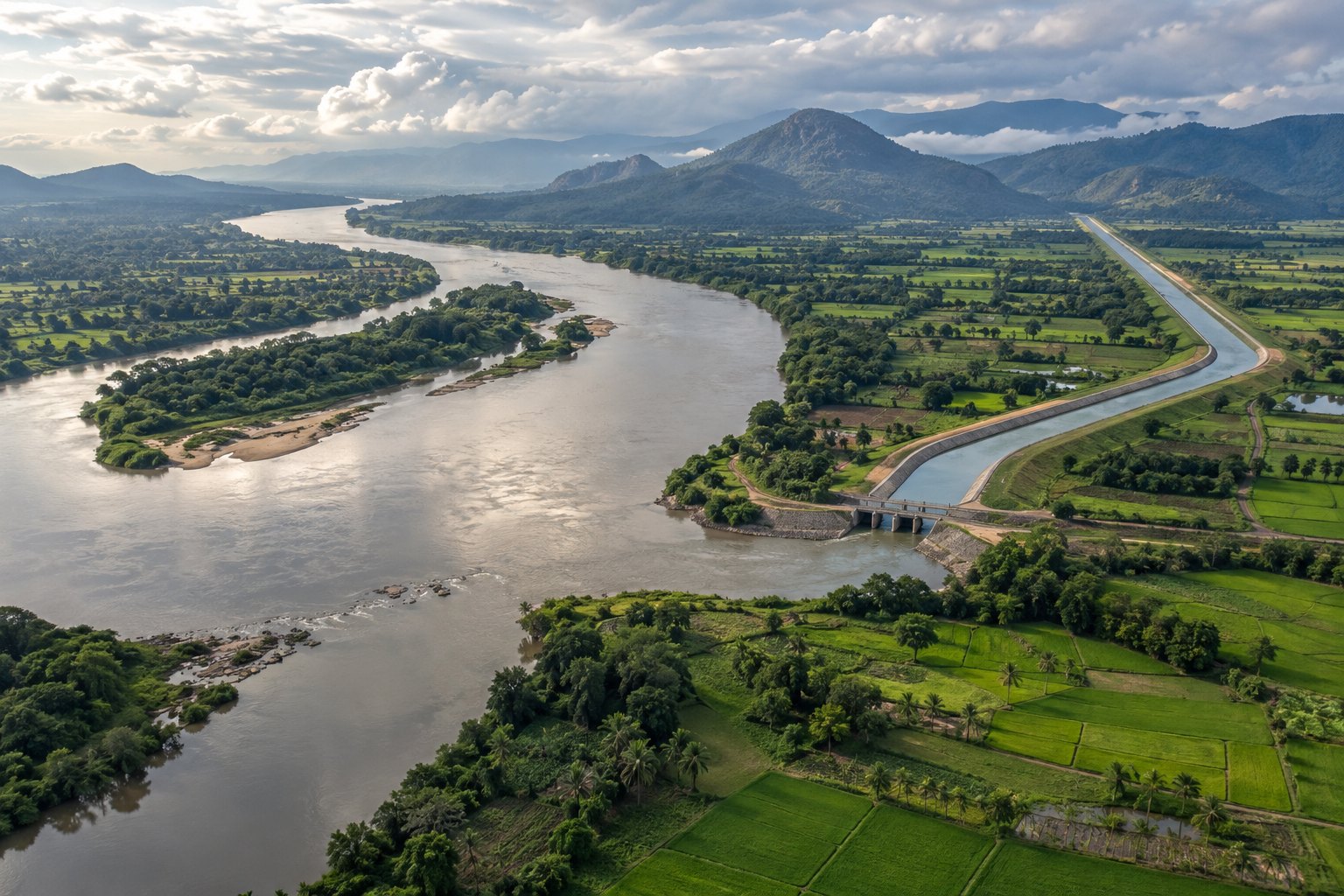
Interlinking of rivers moves water from surplus basins to deficit basins through dams and link canals. Under the National Perspective Plan, the National Water Development Agency has identified 30 links, 16 Peninsular and 14 Himalayan; Ken-Betwa is the first taken up. On 8 October 2026, Andhra Pradesh's Chief Minister urged the Prime Minister to prioritise the Godavari-Cauvery link.
Syllabus: GS2 · Federalism & Local Government; Prelims · Geography; GS3 · Agriculture & Irrigation
Why this matters for UPSC
GS3 (irrigation) and GS2 (federal issues): Prelims asks which links join which rivers and States, the NPP's two components and NWDA's ministry; Mains asks whether inter-basin transfer can end water scarcity without inter-State conflict.
In short
Interlinking of rivers moves water from surplus to deficit basins through dams, barrages and link canals under the 1980 National Perspective Plan, testing ecology and inter-State consent.
River links can relieve drought-prone basins only if States agree on surplus figures and forest, tribal and groundwater costs are settled first.
Why it matters
A farmer in Jhansi in Uttar Pradesh or Ramanathapuram in Tamil Nadu depends on water that falls somewhere else. River links promise to carry it there: per NWDA, Ken-Betwa alone is to irrigate 10.62 lakh hectares a year and supply drinking water to 62 lakh people in Madhya Pradesh and Uttar Pradesh. Tamil Nadu's Chief Minister says the State relies on neighbouring States for over 30 per cent of its water. But a link needs every State on its route to agree on how much surplus a river really has, and it needs forest and wildlife clearances: NWDA's 2022 Ken-Betwa note listed the Daudhan dam's stage-II forest clearance as pending. The larger issue is water security in a federation where rivers cross State lines.
Prelims pointers
- Peninsular Component links include Mahanadi-Godavari, Godavari-Krishna, Krishna-Pennar, Pennar-Cauvery, Ken-Betwa, Damanganga-Pinjal and Par-Tapi-Narmada.
- Himalayan Component links include Kosi-Mechi, Gandak-Ganga, Ghaghra-Yamuna, Sarda-Yamuna, Manas-Sankosh-Tista-Ganga, Farakka-Sundarbans and Subarnarekha-Mahanadi.
- Ken-Betwa Link Project Authority (KBLPA) is the Special Purpose Vehicle implementing Ken-Betwa; its main works are the Daudhan dam and the link canal.
- Ken-Betwa Phase-II comprises the Lower Orr dam, the Kotha Barrage and the Bina Complex Multipurpose Project.
- Pamba-Achankovil-Vaippar link: Kerala and Tamil Nadu; Bedti-Varda link: Karnataka; Damanganga-Pinjal: water supply to Mumbai, Maharashtra.
- Netravati-Hemavati (Karnataka) was not pursued: after Karnataka's Yettinahole project, NWDA found no surplus left in the Netravati basin.
- Entry 17 of the State List covers water, including irrigation and canals, subject to Entry 56 of the Union List.
- Entry 56 of the Union List: regulation and development of inter-State rivers and river valleys to the extent Parliament declares by law.
Practise a UPSC-style question
Consider the following statements about the National Perspective Plan for interlinking of rivers:
1. The Ken-Betwa link is part of the Himalayan Component of the plan.
2. The plan was prepared by the then Ministry of Irrigation, now the Ministry of Jal Shakti.
3. The Manas-Sankosh-Tista-Ganga link is part of the Himalayan Component of the plan.
Which of the statements given above is/are correct?
- (a) 1 and 2 only
- (b) 2 and 3 only
- (c) 1 and 3 only
- (d) 1, 2 and 3
Show the answer
Answer: (b) 2 and 3 only
1 is incorrect: Ken-Betwa, joining two rivers of central India, is in the Peninsular Component. 2 is correct: NWDA records that the then Ministry of Irrigation, now the Ministry of Jal Shakti, prepared the plan. 3 is correct: the Manas-Sankosh-Tista-Ganga link, benefiting Assam, West Bengal and Bihar, is a Himalayan Component link.
More Explainers
- State Legislative Councils: Articles 168-172 and the graduates' and teachers' seats Polity
- Whales and dolphins in Indian waters: legal protection, IUCN status and strandings Environment
- The Aligarh Movement, AMU and the Article 30 minority test Polity
- Environmental clearance by States: SEIAA, SEAC and the EIA Notification, 2006 Environment
- Software vulnerabilities: CVE, CVSS, coordinated disclosure and CERT-In's role Sci-Tech
- Drug trafficking law in India: NDPS Act, PIT-NDPS, NCB and NCORD National
- Choosing the UN Secretary-General: Article 97, UNSC veto and straw polls World & IR
- UN Convention against Torture, and why India has not ratified it Polity
- NavIC: why India's navigation constellation cannot give a standalone position Sci-Tech
- International Energy Agency: membership, 90-day oil stocks and India's status World & IR
- PM Surya Ghar: Muft Bijli Yojana and the rooftop solar subsidy Economy
- HFSS foods: FSSAI's draft limits and front-of-pack warning labels National