
Inland waterways: National Waterways, IWAI and safe river navigation
Why in news: A PIB backgrounder of 16 October 2026 described IWAI's surveys, depth monitoring and digital navigation tools and the Brahmaputra's planned riverine lighthouses.
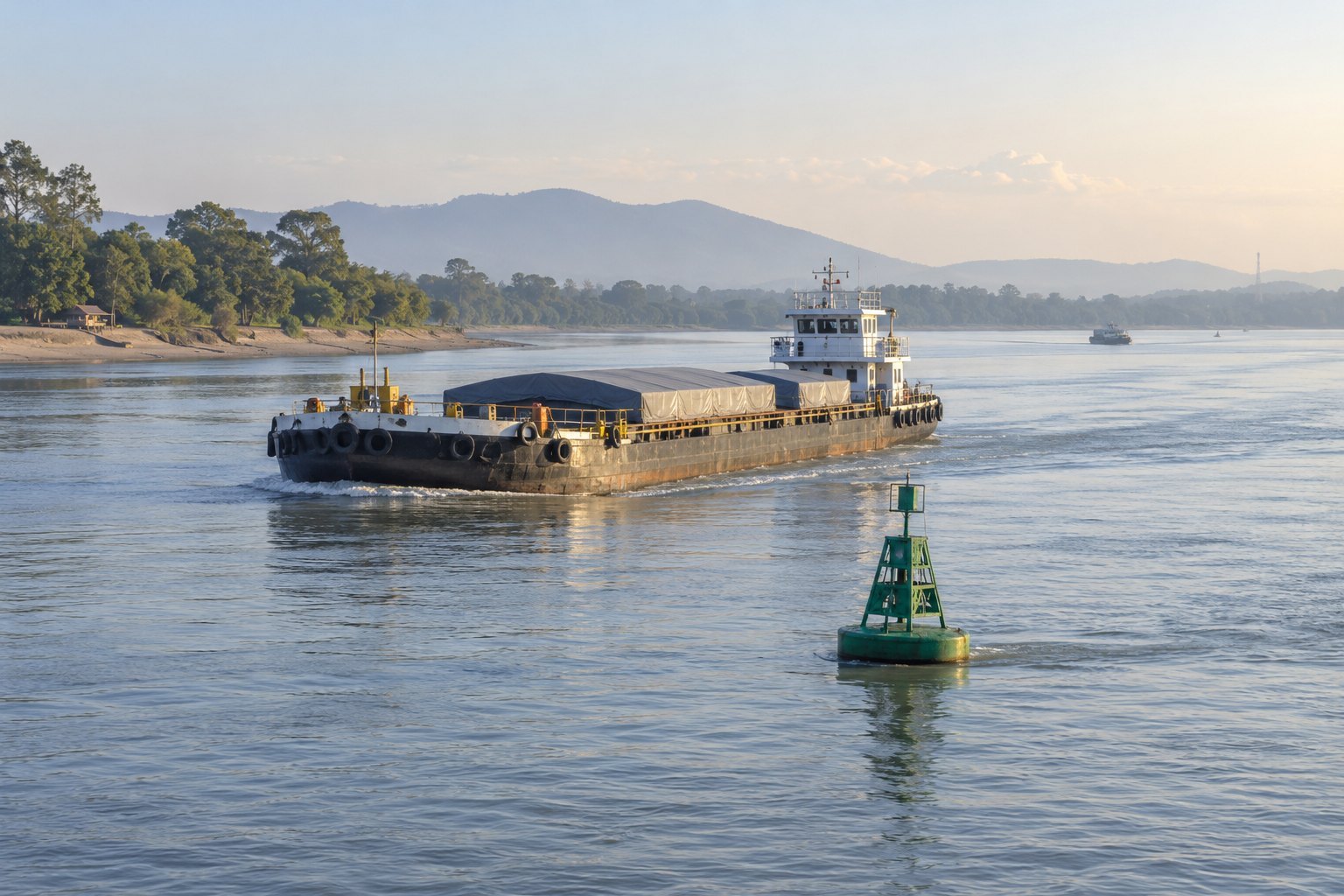
The National Waterways Act, 2016 declares 111 National Waterways, which the Inland Waterways Authority of India (IWAI) keeps navigable through hydrographic surveys, dredging, navigation aids and digital depth data. A PIB backgrounder of 16 October 2026 set out this system, including India's first riverine lighthouses planned on the Brahmaputra.
Syllabus: Prelims · Current Affairs & IR; Prelims · Geography; GS3 · Infrastructure
Why this matters for UPSC
GS3 infrastructure (ports and waterways) and Prelims geography: Prelims can ask which river forms which National Waterway, what Least Available Depth measures and what the IWAI does; GS3 Mains, about inland water transport and logistics costs.
In short
Inland water transport moves freight and passengers on rivers, canals and backwaters; Parliament declares National Waterways by law, and the Inland Waterways Authority of India keeps them navigable.
Waterways will carry more freight only when declared routes become dependable ones: assured depth, marked channels and live data on every operational waterway.
Why it matters
For a tea grower in Assam or a power plant buying coal along the Ganga, a barge beats a truck only if it sails on time and fully loaded. When surveys show where the channel lies and how deep it runs, operators can plan loads and sailing dates instead of waiting at a sandbank. Lights and real-time depth data let vessels move at night too, which cuts transit time. Every full barge also takes many heavy trucks off congested highways and burns less fuel per tonne. The larger issue is India's transport mix: roads carry most freight, and dependable waterways are one way to cut logistics costs for farmers, miners and manufacturers alike.
Prelims pointers
- NW-1 is the Ganga-Bhagirathi-Hooghly river system from Haldia (Sagar) to Prayagraj, 1,620 km, declared a National Waterway in 1986.
- NW-2 is the Brahmaputra between the Bangladesh border and Sadiya in Assam, declared a National Waterway on 1 September 1988.
- NW-3 in Kerala is the West Coast Canal from Kottapuram to Kollam, together with the Champakkara and Udyogamandal canals.
- A waterway Parliament later declares national by law comes under the National Waterways Act, 2016 from the date of that declaration.
- The IWAI's head office is at Noida; its regional offices include Patna, Kolkata, Guwahati, Varanasi, Bhubaneswar, Mumbai and Kochi.
- The Inland Vessels Act, 2021 sets uniform rules for construction, survey, registration and manning of inland vessels; Jalyan and Navic register vessels under it.
- India is a signatory to the International Convention for the Safety of Life at Sea (SOLAS) and follows IALA guidelines on aids to navigation.
- The Maritime Amrit Kaal Vision 2047 aims to raise inland water transport's share of freight from 2% to 5%.
Practise a UPSC-style question
With reference to the National Waterways Act, 2016, consider the following statements:
1. The Act established the Inland Waterways Authority of India to develop and regulate the National Waterways.
2. A waterway that Parliament later declares by law to be a national waterway comes under the Act from that date.
Which of the statements given above is/are correct?
- (a) 1 only
- (b) 2 only
- (c) Both 1 and 2
- (d) Neither 1 nor 2
Show the answer
Answer: (b) 2 only
Answer: (b) 2 only. The 2016 Act declares the waterways; the authority comes from a 1985 law.
Statement 1: incorrect. The IWAI was created under the Inland Waterways Authority of India Act, 1985 and came into existence on 27 October 1986; the 2016 Act declared the 111 National Waterways.
Statement 2: correct. The 2016 Act provides that a waterway Parliament declares national by law is treated as one from that date, and the Act then applies to it.
Eliminate: Statement 1 credits a body working since 1986 to a 2016 law, so it is wrong. Out: (a), (c).
Eliminate: Statement 2 restates the Act's clause for future declarations, so it is right. Out: (d).
Trap: Swapped attribution. The authority and the waterways come from two different laws; the question pins the 1985 body on the 2016 Act.
Remember: IWAI Act, 1985 creates the authority; National Waterways Act, 2016 declares the 111 waterways.
More Explainers
- State Legislative Councils: Articles 168-172 and the graduates' and teachers' seats Polity
- Whales and dolphins in Indian waters: legal protection, IUCN status and strandings Environment
- The Aligarh Movement, AMU and the Article 30 minority test Polity
- Environmental clearance by States: SEIAA, SEAC and the EIA Notification, 2006 Environment
- Software vulnerabilities: CVE, CVSS, coordinated disclosure and CERT-In's role Sci-Tech
- Drug trafficking law in India: NDPS Act, PIT-NDPS, NCB and NCORD National
- Choosing the UN Secretary-General: Article 97, UNSC veto and straw polls World & IR
- UN Convention against Torture, and why India has not ratified it Polity
- NavIC: why India's navigation constellation cannot give a standalone position Sci-Tech
- International Energy Agency: membership, 90-day oil stocks and India's status World & IR
- PM Surya Ghar: Muft Bijli Yojana and the rooftop solar subsidy Economy
- HFSS foods: FSSAI's draft limits and front-of-pack warning labels National