
India's military space: GSAT-7 satellites, Defence Space Agency, Mission Shakti
Why in news: On 15 October 2026 the Ministry of Defence signed a Rs 2,563 crore contract with NewSpace India Limited for the Air Force's GSAT-7C satellite.
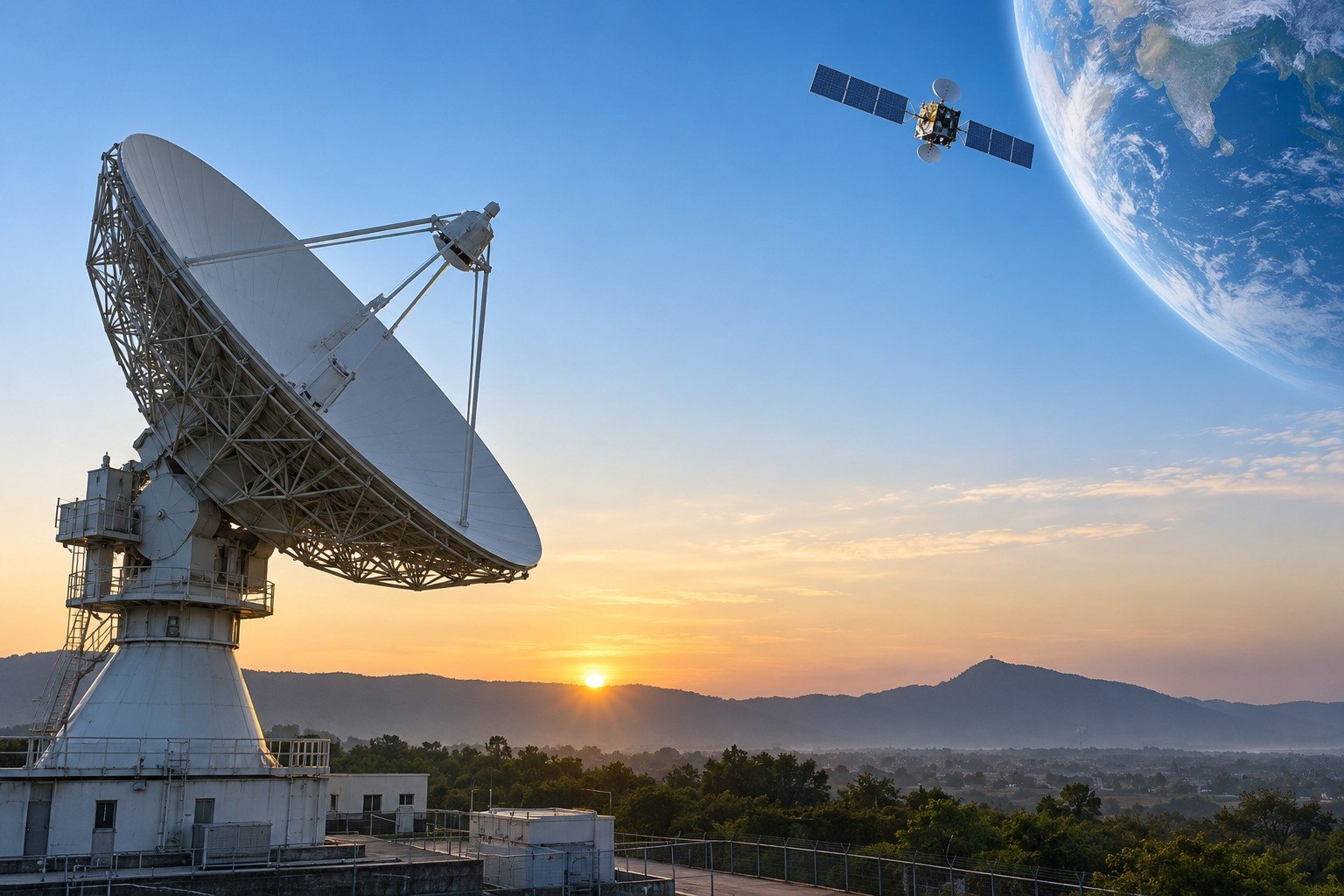
India's military space capability rests on the GSAT-7 series of dedicated communication satellites for the Navy, Army and Air Force, the Defence Space Agency raised in 2018-19, and DRDO's 2019 anti-satellite test, Mission Shakti. On 15 October 2026 the Ministry of Defence signed a Rs 2,563 crore contract with NewSpace India Limited for the Air Force's GSAT-7C.
Syllabus: Prelims · Current Affairs & IR; GS3 · Indian Achievements in S&T; GS3 · IT, Space, Biotech & IPR
Why this matters for UPSC
GS3 security and space technology: Prelims can ask which Service each GSAT-7 satellite is for, where the Defence Space Agency sits and who conducted Mission Shakti; Mains can ask how space assets aid jointness and how to protect them.
In short
India's military space capability is the satellites, agencies and weapons that let its forces communicate beyond line of sight, watch the seas and defend assets in orbit.
Each Service now has, or has ordered, its own satellite; faster acquisition and resilience against disruption will decide that capability's worth in war.
Why it matters
A pilot over the Himalaya or a warship's crew far out in the Indian Ocean often cannot reach headquarters by direct radio across such distances and terrain. A satellite reserved for the forces gives them a secure channel meant to stay open in all circumstances, so orders and reports keep moving. The same dependence is a weakness: if an adversary jams or disables those satellites, ships and aircraft can lose touch at the worst moment. That is why India now war-games the loss of space services and has shown that it can strike a satellite itself. Building these satellites at home also keeps the skills, the orders and the jobs with Indian firms, from large companies to small suppliers.
Prelims pointers
- GSAT-7 series by Service: GSAT-7 'Rukmini' and GSAT-7R (CMS-03), Navy; GSAT-7B, Army; GSAT-7C, Air Force; GSAT-7A, Air Force by the Air Chief's 2018 account.
- Launches: GSAT-7 on Arianespace's Ariane-5 from Kourou, French Guiana (2013); GSAT-7A on GSLV-F11 (2018) and CMS-03 on LVM3-M5 (2025), both from Sriharikota.
- Chief of Defence Staff: commands tri-service cyber and space agencies and sits on the Defence Acquisition Council, but holds no military command over the three Service Chiefs.
- Headquarters Integrated Defence Staff also houses the Defence Cyber Agency, Defence Intelligence Agency and Strategic Forces Command as specialist branches.
- Mission Shakti interceptor: a DRDO ballistic missile defence missile of three stages with two solid rocket boosters, fired from Dr APJ Abdul Kalam Island, Odisha.
- Mission DefSpace challenges fall in five buckets: launch, satellite, communication and payload, ground, and software systems.
- iDEX: launched in April 2018; funded and managed by the Defence Innovation Organisation, a not-for-profit Section 8 company founded by HAL and BEL.
- Indian Space Policy, 2023: NSIL services the space-based needs of government entities and non-government entities on sound commercial principles.
Practise a UPSC-style question
With reference to the GSAT-7 series of satellites, consider the following statements:
1. GSAT-7, named 'Rukmini', was meant chiefly for the Indian Navy's communication at sea.
2. GSAT-7B was contracted to provide High Throughput Services to the Indian Air Force.
3. GSAT-7R, also called CMS-03, was built for the Indian Navy's communication needs.
Which of the statements given above is/are correct?
- (a) 1 and 2 only
- (b) 2 and 3 only
- (c) 1 and 3 only
- (d) 1, 2 and 3
Show the answer
Answer: (c) 1 and 3 only
Answer: (c) 1 and 3 only. GSAT-7 and GSAT-7R serve the Navy; GSAT-7B is the Army's satellite.
Statement 1: correct. The Navy described GSAT-7 'Rukmini' (2013) as its 'over-the-sea use' satellite, giving real-time links to ships, submarines and aircraft.
Statement 2: incorrect. The Ministry of Defence's 2023 contract with NSIL buys GSAT-7B to provide High Throughput Services to the Indian Army.
Statement 3: correct. The Ministry of Defence called GSAT-7R (CMS-03), launched in November 2025, the Navy's most advanced communication satellite.
Eliminate: Judge statement 2 first: GSAT-7B is the Army's satellite, so statement 2 is incorrect. Out: (a), (b), (d).
Trap: Swapped attribution. The satellite and its High Throughput Services are right, but the Service is moved from the Army to the Air Force.
Remember: Navy: GSAT-7 and GSAT-7R; Army: GSAT-7B; Air Force: GSAT-7C.
In the news
More Explainers
- State Legislative Councils: Articles 168-172 and the graduates' and teachers' seats Polity
- Whales and dolphins in Indian waters: legal protection, IUCN status and strandings Environment
- The Aligarh Movement, AMU and the Article 30 minority test Polity
- Environmental clearance by States: SEIAA, SEAC and the EIA Notification, 2006 Environment
- Software vulnerabilities: CVE, CVSS, coordinated disclosure and CERT-In's role Sci-Tech
- Drug trafficking law in India: NDPS Act, PIT-NDPS, NCB and NCORD National
- Choosing the UN Secretary-General: Article 97, UNSC veto and straw polls World & IR
- UN Convention against Torture, and why India has not ratified it Polity
- NavIC: why India's navigation constellation cannot give a standalone position Sci-Tech
- International Energy Agency: membership, 90-day oil stocks and India's status World & IR
- PM Surya Ghar: Muft Bijli Yojana and the rooftop solar subsidy Economy
- HFSS foods: FSSAI's draft limits and front-of-pack warning labels National