
India's connectivity corridors: Chabahar, INSTC, Kaladan and the Trilateral Highway
Why in news: The US conditional sanctions waiver for Chabahar ended on 26 April 2026; on 4 August the MEA said India is in contact with all partners.
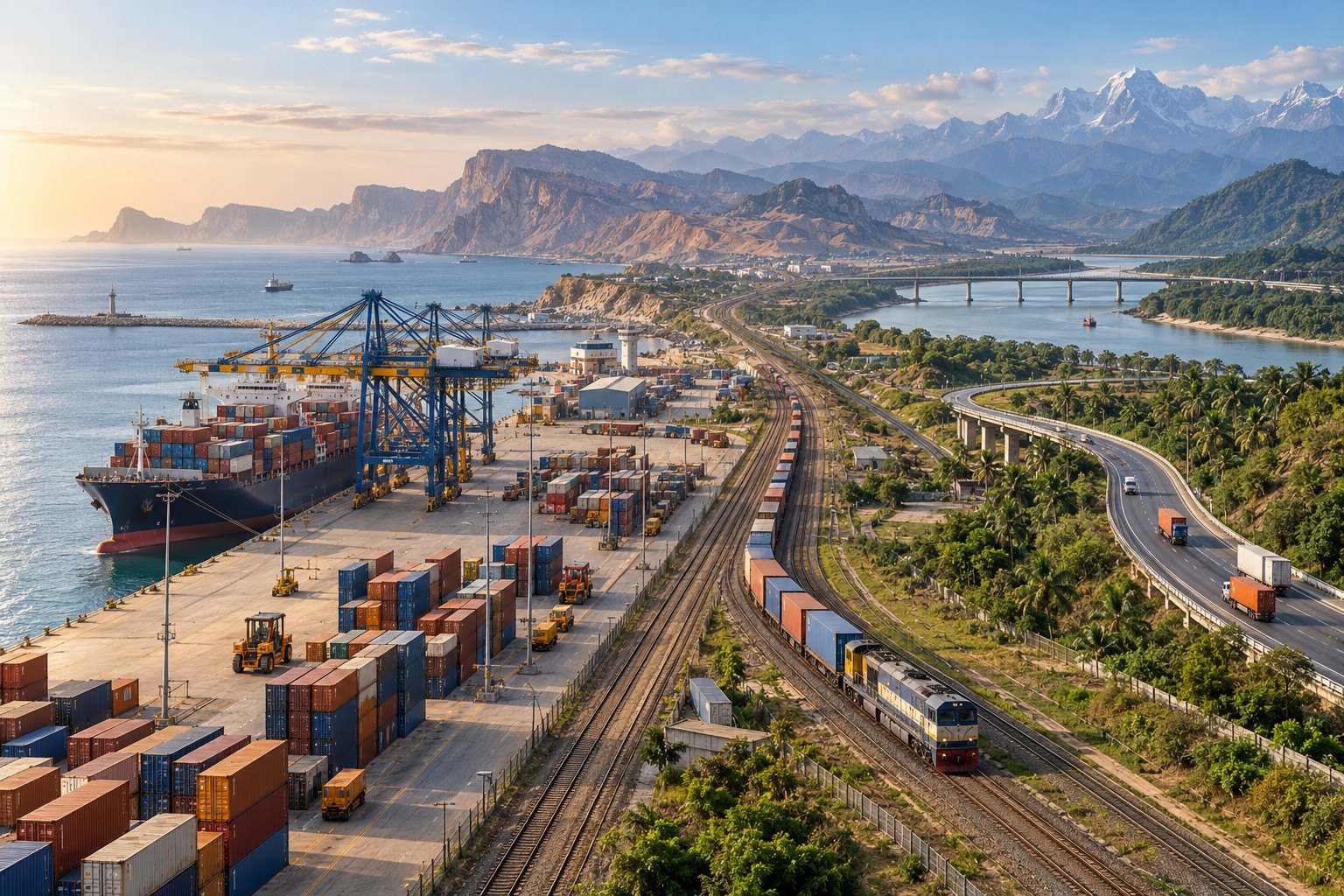
India's connectivity corridors are routes India builds or backs abroad to reach markets past geographic chokepoints: Chabahar Port in Iran and the International North-South Transport Corridor to the west, and the Kaladan project and the Trilateral Highway through Myanmar to the east. The US conditional sanctions waiver for Chabahar ended on 26 April 2026.
Syllabus: Prelims · Geography; GS3 · Infrastructure; GS2 · India & its Neighbourhood
Why this matters for UPSC
GS2 international relations (India and its neighbourhood) and GS3 infrastructure. Prelims can ask the INSTC route, where Sittwe and Chabahar lie and who founded the Ashgabat Agreement; Mains, how sanctions and conflict stall India's connectivity projects.
In short
India's connectivity corridors are routes India finances or operates abroad, west through Iran and east through Myanmar, to reach markets that geography or hostile neighbours block.
The corridors give India reach past chokepoints; sanction-proof contracts, steady finance and finished last-mile roads will decide whether signed routes carry real cargo.
Why it matters
A trader in Aizawl or Agartala today moves goods to Kolkata by the long road through the Siliguri Corridor, the narrow strip through which all its road and rail links to the mainland run. A sea-and-river route through Myanmar would let the same cargo reach a ship far faster and more cheaply. In the west, an exporter in Mumbai selling to Russia or Central Asia could ship to Iran and go on by road, ship and rail, faster than the long sea route. When sanctions or conflict close that route, freight goes back to longer sea routes, costs rise, and India's influence in Afghanistan and Central Asia shrinks.
Prelims pointers
- INSTC route (Ports Ministry, 2023): Mumbai to Chabahar by sea, road to Bandar-e-Anzali, ship across the Caspian Sea to Astrakhan, then Russian railways.
- Ashgabat Agreement: founding members Oman, Iran, Turkmenistan and Uzbekistan; Turkmenistan is the depository State; India's Cabinet approved accession in March 2016.
- Kaladan components: an IWT terminal at Sittwe, the Kaladan waterway to Paletwa (Kaletwa), a trans-shipment terminal there and a highway to the Mizoram border.
- 2008 Kaladan agreement: signed in New Delhi on 2 April 2008; MEA is India's nodal agency; on completion the facility passes to Myanmar to run.
- India-Myanmar border: over 1,643 km, touching Arunachal Pradesh, Nagaland, Manipur and Mizoram; Myanmar is the only ASEAN country adjoining India.
- Sittwe-Sabroom option: cargo at Sittwe can cross 60 nautical miles to Teknaf, Bangladesh, then 300 km by road to Sabroom, Tripura.
- Chabahar Port: a 16 m deep draft for large vessels; it lies near the Asia-Europe and Asia-Asia trade routes.
Practise a UPSC-style question
With reference to the Kaladan Multi-Modal Transit Transport Project, consider the following statements:
1. It links Sittwe Port in Myanmar with the State of Manipur in India.
2. Under the 2008 framework agreement, the Government of India bears the cost of constructing the project.
Which of the statements given above is/are correct?
- (a) 1 only
- (b) 2 only
- (c) Both 1 and 2
- (d) Neither 1 nor 2
Show the answer
Answer: (b) 2 only
Answer: (b) 2 only. The project ends in Mizoram, not Manipur, and India pays for its construction.
Statement 1: incorrect. The 2008 India-Myanmar framework agreement links Sittwe Port with the State of Mizoram, through Paletwa and Zorinpui.
Statement 2: correct. Article 14 of the 2008 framework agreement says the Government of India bears the construction cost; the Cabinet runs it as grant assistance.
Eliminate: Judge statement 1 first: the road ends at Zorinpui in Mizoram, so statement 1 is incorrect. Out: (a), (c).
Eliminate: Judge statement 2: India funds the project as grant assistance, so statement 2 is correct. Out: (d).
Trap: Swapped attribution. Manipur also borders Myanmar, so a neighbouring North-Eastern State is put in place of Mizoram.
Remember: Kaladan: Sittwe to Paletwa by river, Paletwa to Zorinpui (Mizoram) by road; India pays.
In the news
More Explainers
- State Legislative Councils: Articles 168-172 and the graduates' and teachers' seats Polity
- Whales and dolphins in Indian waters: legal protection, IUCN status and strandings Environment
- The Aligarh Movement, AMU and the Article 30 minority test Polity
- Environmental clearance by States: SEIAA, SEAC and the EIA Notification, 2006 Environment
- Software vulnerabilities: CVE, CVSS, coordinated disclosure and CERT-In's role Sci-Tech
- Drug trafficking law in India: NDPS Act, PIT-NDPS, NCB and NCORD National
- Choosing the UN Secretary-General: Article 97, UNSC veto and straw polls World & IR
- UN Convention against Torture, and why India has not ratified it Polity
- NavIC: why India's navigation constellation cannot give a standalone position Sci-Tech
- International Energy Agency: membership, 90-day oil stocks and India's status World & IR
- PM Surya Ghar: Muft Bijli Yojana and the rooftop solar subsidy Economy
- HFSS foods: FSSAI's draft limits and front-of-pack warning labels National