
India–Netherlands Strategic Partnership and the Chola copper plates
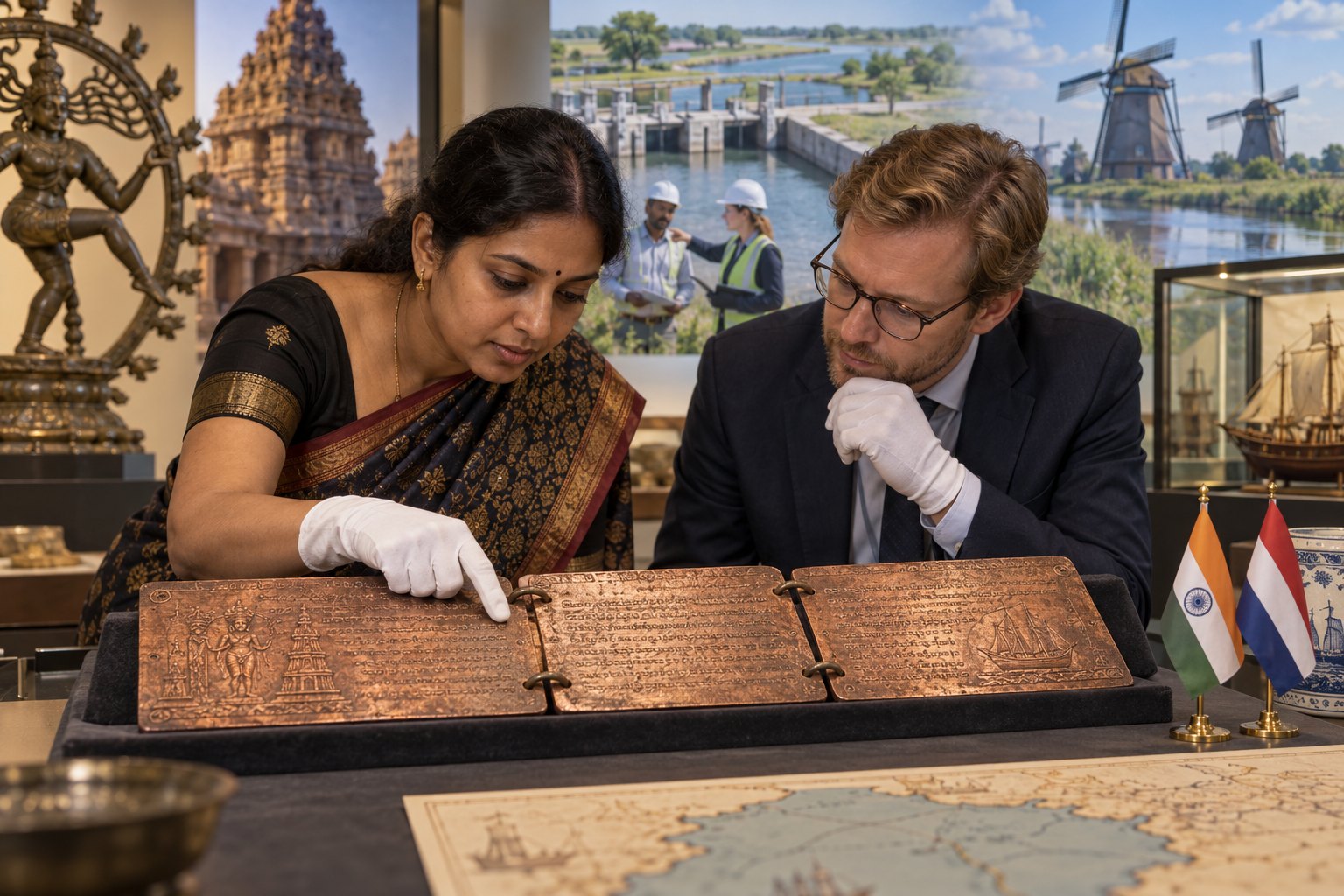
India and the Netherlands, diplomatic partners since 1947, cooperate on water management, semiconductors, green hydrogen, agriculture and maritime technology, and the government counts the Netherlands as India's fourth-largest investor. In May 2026 the two raised ties to a Strategic Partnership for 2026–2030, and the Netherlands returned the 11th-century Chola copper plates recording the Anaimangalam grant.
Syllabus: GS1 · Art & Culture; Prelims · Current Affairs & IR; GS2 · Groupings & Agreements
In short
The India–Netherlands Strategic Partnership (2026–2030), agreed in May 2026, pairs, in India's framing, Dutch frontier technology with Indian scale; it came with the Chola copper plates' return.
India should turn this partnership into chip, water and hydrogen capacity at home, while weighing Kalpasar's ecology and keeping talent mobility two-way.
Why it matters
An Indian student or engineer bound for the Netherlands should find visas, internships and research places easier to get under the new mobility and higher-education pacts. Farmers in water-short Saurashtra stand to gain if Dutch engineering helps the Kalpasar Project store river water that now drains into the sea. India's chip plans lean on Dutch lithography machines, which is why Tata Electronics' cooperation with ASML for the Dholera fab, in line with the India Semiconductor Mission, matters. The plates' return also counts: a key record of the Cholas' ties with Southeast Asia is back in India, showing that cultural restitution can be won through diplomacy.
Prelims pointers
- Anaimangalam (Leiden) copper plates: they chiefly concern Rajendra Chola I keeping a vow of his father, Rajaraja Chola.
- Gulf of Khambhat: lies between the Saurashtra peninsula and mainland Gujarat; the Sabarmati, Mahi and Narmada drain into it; it has India's highest tidal range.
- Dutch in India: the Dutch East India Company's first factory was at Masulipatnam (1605); Travancore defeated the Dutch at Colachel (1741).
- Green hydrogen: made by electrolysis of water using renewable electricity; the National Green Hydrogen Mission (2023) is run by the Ministry of New and Renewable Energy.
- The Netherlands was a founding member of the European Economic Community (1957) and NATO (1949); The Hague hosts the International Court of Justice.
- Suriname: the first group of Indians reached its shores in 1873.
- India Semiconductor Mission: launched in 2021 under the Ministry of Electronics and Information Technology to back chip fabs, packaging units and display fabs.
Practise a UPSC-style question
With reference to the Chola copper plates returned by the Netherlands to India, consider the following statements:
1. The inscriptions on these plates are written in the Tamil and Pali languages.
2. They record the grant of Anaimangalam village to a Buddhist vihara at Nagapattinam.
3. The vihara they endow was built by a ruler of the Srivijaya kingdom.
Which of the statements given above is/are correct?
- (a) 1 and 2 only
- (b) 2 and 3 only
- (c) 1 and 3 only
- (d) 1, 2 and 3
Show the answer
Answer: (b) 2 and 3 only
1 is incorrect: the plates are inscribed in Tamil and Sanskrit, not Pali. 2 is correct: they record the grant of Anaimangalam village to a Buddhist vihara at Nagapattinam in Tamil Nadu. 3 is correct: the Chudamani Vihara was built by a ruler of Srivijaya, a maritime kingdom in present-day Indonesia.
More Explainers
- State Legislative Councils: Articles 168-172 and the graduates' and teachers' seats Polity
- Whales and dolphins in Indian waters: legal protection, IUCN status and strandings Environment
- The Aligarh Movement, AMU and the Article 30 minority test Polity
- Environmental clearance by States: SEIAA, SEAC and the EIA Notification, 2006 Environment
- Software vulnerabilities: CVE, CVSS, coordinated disclosure and CERT-In's role Sci-Tech
- Drug trafficking law in India: NDPS Act, PIT-NDPS, NCB and NCORD National
- Choosing the UN Secretary-General: Article 97, UNSC veto and straw polls World & IR
- UN Convention against Torture, and why India has not ratified it Polity
- NavIC: why India's navigation constellation cannot give a standalone position Sci-Tech
- International Energy Agency: membership, 90-day oil stocks and India's status World & IR
- PM Surya Ghar: Muft Bijli Yojana and the rooftop solar subsidy Economy
- HFSS foods: FSSAI's draft limits and front-of-pack warning labels National