
Indian Cyber Crime Coordination Centre (I4C) and the cybercrime-response chain
Why in news: I4C's National Cybercrime Threat Analytics Unit flagged, on 19 October 2026, deepfake Facebook and Instagram ads of the Prime Minister, Finance Minister and chief ministers.
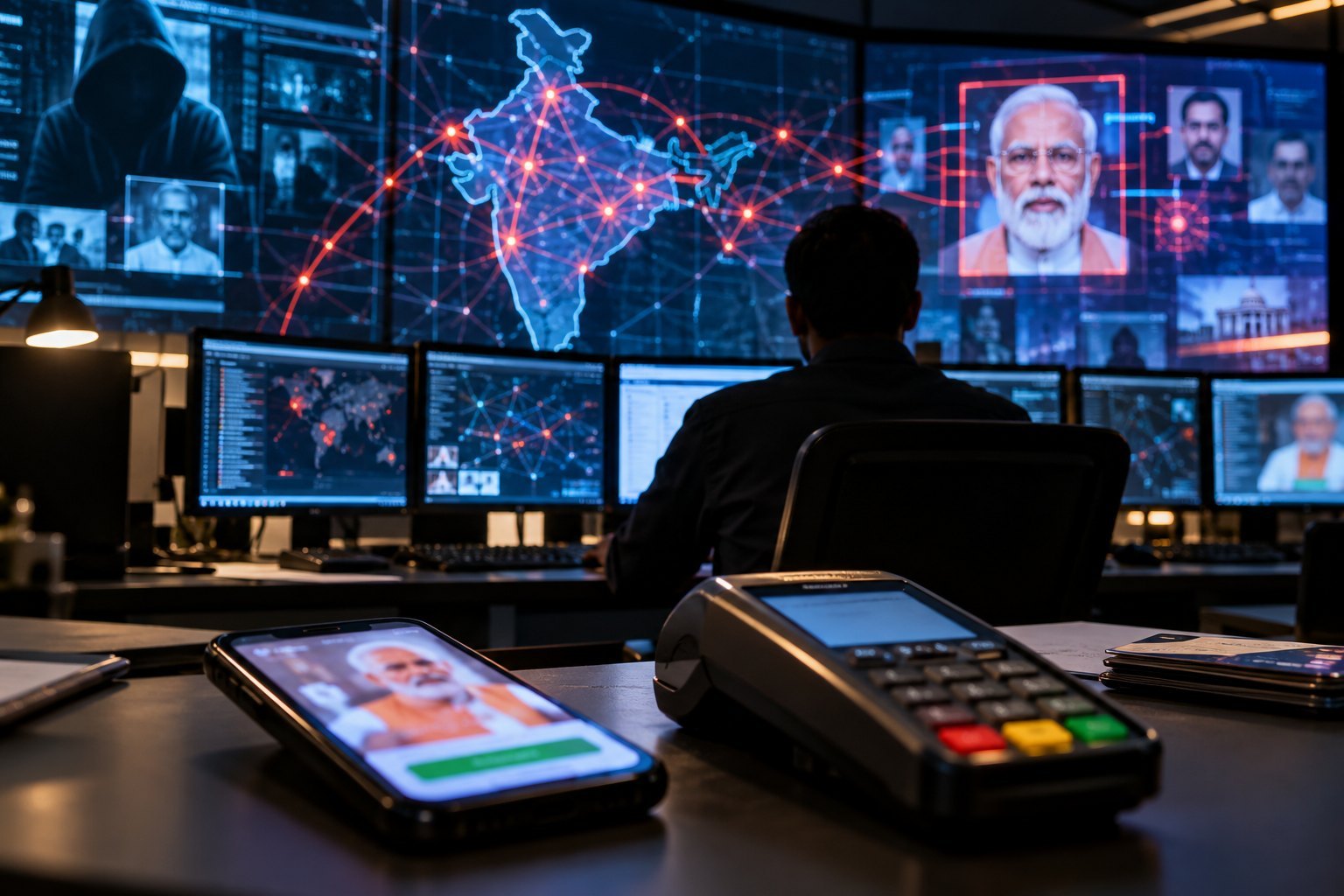
The Home Ministry's Indian Cyber Crime Coordination Centre (I4C) coordinates India's response to cybercrime: complaints through the National Cyber Crime Reporting Portal and helpline 1930, fund freezes through CFCFRMS, and takedown notices through the Sahyog portal. On 19 October 2026, it warned that deepfake ads impersonating the Prime Minister and chief ministers promote fake welfare schemes.
Syllabus: GS2 · Federalism & Local Government; GS2 · Governance & e-Governance; GS3 · Cyber Security & Money Laundering
Why this matters for UPSC
GS3 internal security asks about cybercrime and the bodies fighting it; Prelims can test I4C's ministry, the CFCFRMS, the Sahyog portal and section 79 of the IT Act, 2000; GS2 Mains, Centre-State coordination when police is a State subject.
In short
The Indian Cyber Crime Coordination Centre (I4C) is the Home Ministry's nodal body linking State police, banks, telecom firms and platforms against cybercrime, while policing stays with the States.
I4C has knit State efforts into one chain; its test now is speed, money restored to victims and platforms answerable for deepfakes.
Why it matters
Picture a pensioner who sees a video of the Prime Minister announcing cash help, rings the number and pays a 'registration fee', then another. A quick call to 1930 can get the bank to hold the money before it is passed through mule accounts; a late call gives the fraudsters time to move it on. The same system lets police in one State see that a fraudster has also struck in five others, and lets a fake video be pulled off a platform within hours. The larger issue is federal: online fraud crosses State borders in seconds, police powers stop at them, so a national coordinator becomes the bridge.
Prelims pointers
- Seventh Schedule: 'Police' and 'Public Order' are State subjects, so States/UTs prevent, detect, investigate and prosecute cybercrime; the Centre supplements through advisories and funds.
- Section 69A, IT Act, 2000: the government's blocking orders to intermediaries; removal notices for unlawful acts come under section 79, which the Sahyog portal carries.
- BNS, 2023 on deepfake fraud: section 319 cheating by personation, 336 forgery including false electronic records, 353 public-mischief statements, 111 organised crime.
- IT Act, 2000 offences: section 66C identity theft, 66D impersonation, 66E privacy violation, 67 and 67A obscene or sexually explicit material.
- Significant social media intermediary: 50 lakh or more registered users in India; must publish compliance reports, appoint local officers and use automated tools against unlawful content.
- IT Rules, 2021: made under section 87 of the IT Act, 2000; MeitY administers the due-diligence part; users appeal platform decisions to Grievance Appellate Committees.
- Reserve Bank Innovation Hub: a wholly owned subsidiary of the Reserve Bank of India; its MuleHunter.ai, used across banks, detects mule accounts.
Practise a UPSC-style question
With reference to the Indian Cyber Crime Coordination Centre (I4C), consider the following statements:
1. The scheme to set it up was approved in 2018 with seven components, including the National Cyber Crime Reporting Portal.
2. It has functioned as an Attached Office of the Ministry of Electronics and Information Technology since July 2024.
3. The National Cyber Crime Threat Analytics Unit is one of its components.
Which of the statements given above is/are correct?
- (a) 1 and 2 only
- (b) 2 and 3 only
- (c) 1 and 3 only
- (d) 1, 2 and 3
Show the answer
Answer: (c) 1 and 3 only
Answer: (c) 1 and 3 only. I4C belongs to the Ministry of Home Affairs, not MeitY, so statement 2 fails.
Statement 1: correct. The MHA approved the I4C scheme in October 2018 at Rs 415.86 crore, with seven components, the reporting portal among them.
Statement 2: incorrect. Since 1 July 2024 I4C has been an Attached Office of the Ministry of Home Affairs, not of MeitY.
Statement 3: correct. The National Cyber Crime Threat Analytics Unit is the first of I4C's seven components; it issued the deepfake-ad warning.
Eliminate: Judge statement 2 first: I4C is under the Home Ministry, so statement 2 is incorrect. Out: (a), (b), (d).
Trap: Swapped attribution. A cyber body sounds like a MeitY unit, but I4C is the Home Ministry's.
Remember: I4C: MHA scheme of 2018, Attached Office of the MHA since 1 July 2024, seven components.
More Explainers
- State Legislative Councils: Articles 168-172 and the graduates' and teachers' seats Polity
- Whales and dolphins in Indian waters: legal protection, IUCN status and strandings Environment
- The Aligarh Movement, AMU and the Article 30 minority test Polity
- Environmental clearance by States: SEIAA, SEAC and the EIA Notification, 2006 Environment
- Software vulnerabilities: CVE, CVSS, coordinated disclosure and CERT-In's role Sci-Tech
- Drug trafficking law in India: NDPS Act, PIT-NDPS, NCB and NCORD National
- Choosing the UN Secretary-General: Article 97, UNSC veto and straw polls World & IR
- UN Convention against Torture, and why India has not ratified it Polity
- NavIC: why India's navigation constellation cannot give a standalone position Sci-Tech
- International Energy Agency: membership, 90-day oil stocks and India's status World & IR
- PM Surya Ghar: Muft Bijli Yojana and the rooftop solar subsidy Economy
- HFSS foods: FSSAI's draft limits and front-of-pack warning labels National