
India Semiconductor Mission and the Dholera semiconductor cluster
Why in news: A 200-bed hospital, an International Baccalaureate school and investor housing are being built around Dholera's semiconductor cluster, the government said on 28 September 2026.
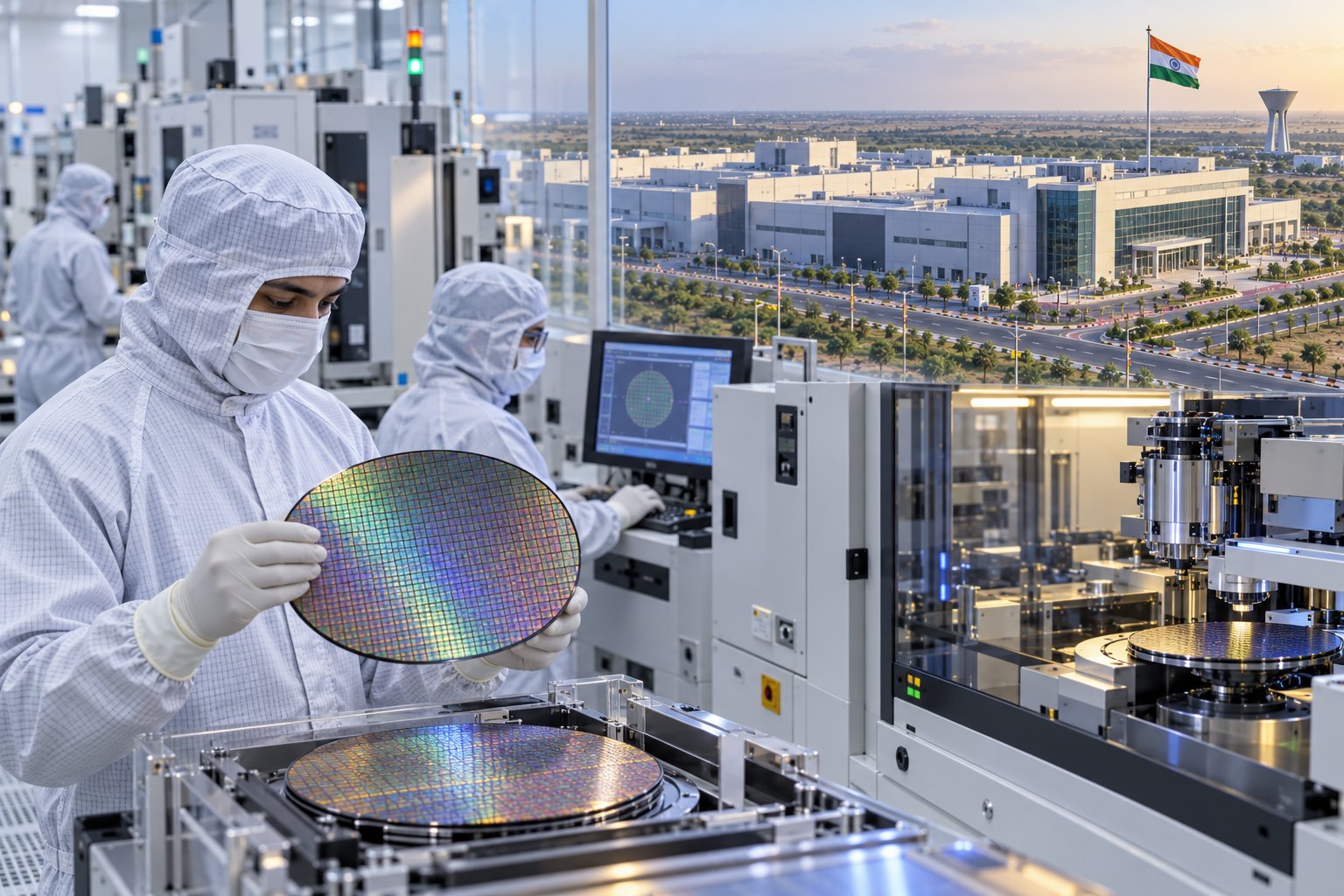
The India Semiconductor Mission (ISM), part of the Digital India Corporation under the Ministry of Electronics and Information Technology, runs the Semicon India programme's incentives for fabs, chip packaging and design. Twelve projects were approved under Semicon India 1.0, six in Gujarat, the government says. A PIB explainer of September 2026 describes the township rising around Dholera's semiconductor cluster.
Syllabus: GS3 · Liberalisation & Industry; GS3 · Infrastructure; GS3 · Indian Achievements in S&T
In short
The India Semiconductor Mission, an independent business division of the Digital India Corporation under MeitY, runs the ₹76,000 crore Semicon India programme; Dholera shows the township a fab needs.
Semicon India's subsidies will leave a lasting industry only if Dholera-style clusters pair fabs with power, water, talent and homes, phased to factory milestones.
Why it matters
An engineer recruited to a chip plant at Dholera needs a hospital, a school for the children and a home nearby; without them, skilled staff stay away and a costly fab runs below capacity. That is why Gujarat is building the township alongside the factories. For the country, chips sit inside phones, cars, power grids, satellites and weapons, and their production is concentrated in a few economies, so a shortage abroad can stop Indian assembly lines. The larger issue is whether India can build whole clusters, with power, water, skills and housing, rather than single plants; that decides whether public subsidy leaves behind a lasting industry.
Prelims pointers
- India Semiconductor Mission (ISM): set up within the Digital India Corporation, MeitY, with administrative and financial autonomy; nodal agency for Semicon India.
- Semicon India schemes: semiconductor fabs; display fabs; compound semiconductors, silicon photonics, sensors and ATMP/OSAT; and the Design Linked Incentive (DLI) Scheme.
- Fab (front end) etches circuits onto silicon wafers; ATMP/OSAT (back end) assembles, tests, marks and packages the finished chips.
- Compound semiconductors are made of two or more elements: gallium nitride, silicon carbide, gallium arsenide. Silicon and germanium are elemental semiconductors.
- Wide-band-gap materials such as silicon carbide and gallium nitride withstand higher voltages and temperatures than silicon; used in electric-vehicle inverters and fast chargers.
- Doping: a pentavalent impurity such as phosphorus in silicon gives an n-type semiconductor; a trivalent one such as boron or gallium gives a p-type semiconductor.
- Dholera SIR: governed under the Gujarat Special Investment Region Act, 2009; developed with the Centre through the National Industrial Corridor Development and Implementation Trust.
- DLI Scheme: implemented through C-DAC, an R&D organisation of MeitY; covers integrated circuits, chipsets, systems-on-chip and IP cores.
Practise a UPSC-style question
With reference to the India Semiconductor Mission (ISM), consider the following statements:
1. It functions as an independent business division within the Digital India Corporation.
2. It functions under the administrative control of the Ministry of Heavy Industries.
Which of the statements given above is/are correct?
- (a) 1 only
- (b) 2 only
- (c) Both 1 and 2
- (d) Neither 1 nor 2
Show the answer
Answer: (a) 1 only
1 is correct: the Union Cabinet set up ISM in 2021 as an independent business division, with administrative and financial autonomy, inside the Digital India Corporation. 2 is incorrect: ISM and the Digital India Corporation come under the Ministry of Electronics and Information Technology, not the Ministry of Heavy Industries.
More Explainers
- State Legislative Councils: Articles 168-172 and the graduates' and teachers' seats Polity
- Whales and dolphins in Indian waters: legal protection, IUCN status and strandings Environment
- The Aligarh Movement, AMU and the Article 30 minority test Polity
- Environmental clearance by States: SEIAA, SEAC and the EIA Notification, 2006 Environment
- Software vulnerabilities: CVE, CVSS, coordinated disclosure and CERT-In's role Sci-Tech
- Drug trafficking law in India: NDPS Act, PIT-NDPS, NCB and NCORD National
- Choosing the UN Secretary-General: Article 97, UNSC veto and straw polls World & IR
- UN Convention against Torture, and why India has not ratified it Polity
- NavIC: why India's navigation constellation cannot give a standalone position Sci-Tech
- International Energy Agency: membership, 90-day oil stocks and India's status World & IR
- PM Surya Ghar: Muft Bijli Yojana and the rooftop solar subsidy Economy
- HFSS foods: FSSAI's draft limits and front-of-pack warning labels National