
IMEC: the India-Middle East-Europe Economic Corridor
Why in news: The United States strongly supports IMEC, its President said on 22 September 2026, citing attacks on commercial shipping in the region.
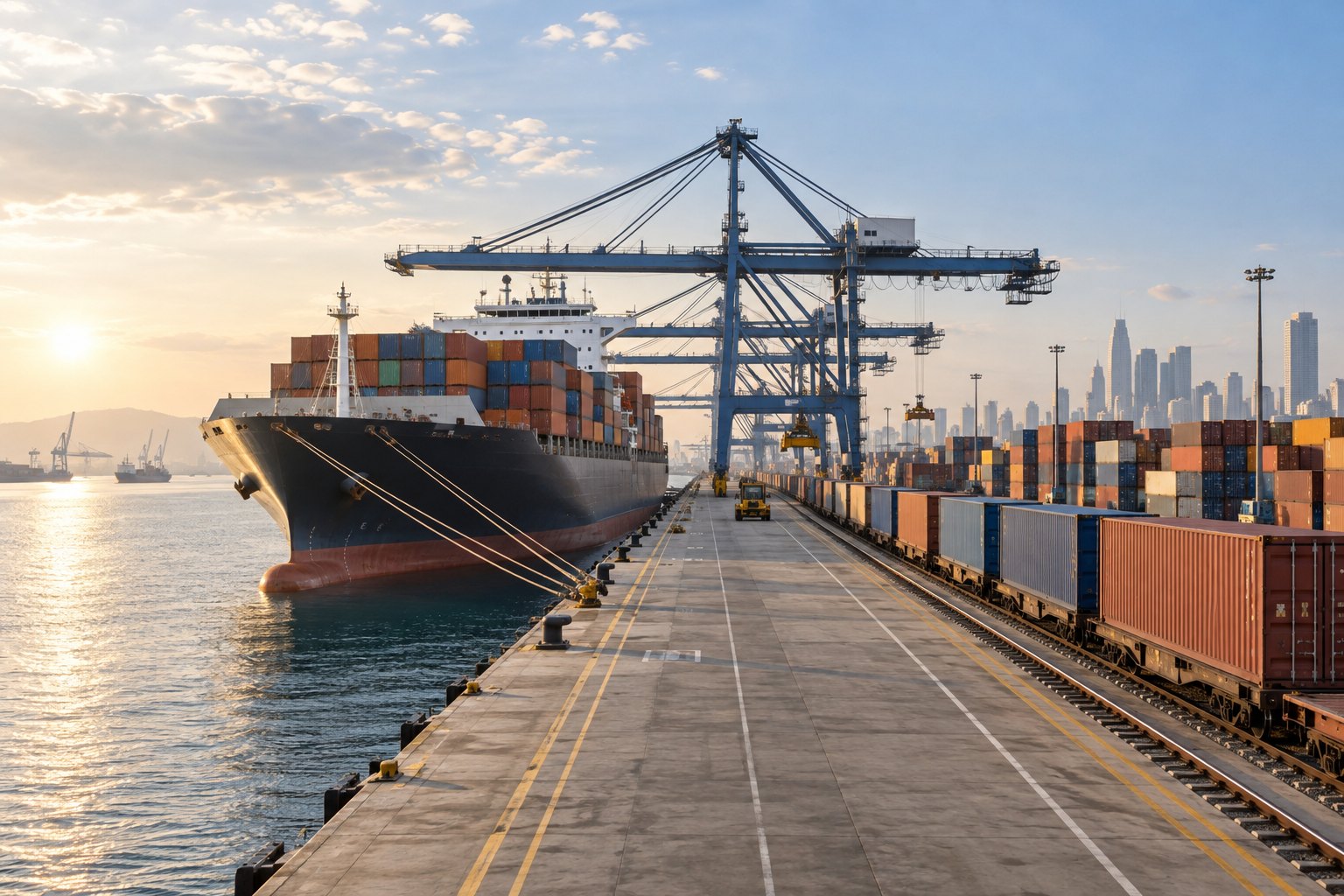
The India-Middle East-Europe Economic Corridor (IMEC) is a planned ship-and-rail trade route, with electricity and data cables and a clean-hydrogen pipe, set out in a non-binding 2023 MoU signed by India, Saudi Arabia, the UAE, the EU, France, Germany, Italy and the US. On 22 September 2026 the US President said his administration strongly supports it, citing attacks on shipping.
Syllabus: Prelims · Geography; GS3 · Infrastructure; GS2 · Groupings & Agreements
In short
The India-Middle East-Europe Economic Corridor (IMEC) is a planned ship-and-rail route linking India to Europe through the Arabian Gulf, resting on a non-binding 2023 MoU.
IMEC suits India as a second route, not a substitute; turning a non-binding MoU into rails needs money, timetables and peace.
Why it matters
Take an Indian firm sending machine parts to Italy. Its cargo now goes by sea through the Bab el-Mandeb, the Red Sea and the Suez Canal; when ships there are attacked, they divert around Africa and freight costs and delivery times rise. IMEC would add a second path: by sea to the Gulf, by rail to the Mediterranean coast, and by sea again to Europe. Cables for power and data and a hydrogen pipe along the railway would make it an energy and digital link as well as a trade route. But the MoU binds no one and commits no money, and the route crosses a region hit by conflict, so its delivery depends on peace, finance and the consent of countries that never signed.
Prelims pointers
- IMEC signatories (8): India, Saudi Arabia, UAE, EU, France, Germany, Italy, US. Not signatories: Jordan and Israel (on the route); Mauritius and the World Bank (at the launch).
- INSTC: founded by India, Iran and Russia under a 2000 agreement; a multimodal route from Mumbai by sea to Iran, across Iran to the Caspian Sea, then to Russia.
- Chabahar: Iranian port on the Gulf of Oman, outside the Strait of Hormuz; India has invested in its Shahid Beheshti terminal, which can feed the INSTC.
- Bandar Abbas: Iran's main port, on the Strait of Hormuz; a sea gateway of the INSTC.
- Strait of Hormuz joins the Persian (Arabian) Gulf to the Gulf of Oman, between Iran and Oman; the Bab el-Mandeb joins the Red Sea to the Gulf of Aden.
- Suez Canal (Egypt) links the Red Sea with the Mediterranean Sea; a rail leg across Arabia to the Mediterranean would bypass it and the Bab el-Mandeb.
- PGII: the Partnership for Global Infrastructure and Investment, launched by the G7 in 2022 to fund infrastructure in developing countries.
Practise a UPSC-style question
With reference to the India-Middle East-Europe Economic Corridor (IMEC), consider the following statements:
1. Under its 2023 Memorandum of Understanding, the corridor's railway is planned to run through Iran to reach Europe.
2. The European Union signed the 2023 Memorandum of Understanding on IMEC, along with France, Germany and Italy.
3. The 2023 Memorandum of Understanding on IMEC creates binding obligations for its participants under international law.
Which of the statements given above is/are correct?
- (a) 1 only
- (b) 2 only
- (c) 3 only
- (d) 1, 2 and 3
Show the answer
Answer: (b) 2 only
1 is incorrect: the IMEC railway is to link the UAE, Saudi Arabia, Jordan and Israel; the corridor that runs through Iran is the INSTC. 2 is correct: the eight participants are Saudi Arabia, the European Union, India, the UAE, France, Germany, Italy and the United States. 3 is incorrect: the MoU sets out political commitments and states that it creates no rights or obligations under international law.
More Explainers
- State Legislative Councils: Articles 168-172 and the graduates' and teachers' seats Polity
- Whales and dolphins in Indian waters: legal protection, IUCN status and strandings Environment
- The Aligarh Movement, AMU and the Article 30 minority test Polity
- Environmental clearance by States: SEIAA, SEAC and the EIA Notification, 2006 Environment
- Software vulnerabilities: CVE, CVSS, coordinated disclosure and CERT-In's role Sci-Tech
- Drug trafficking law in India: NDPS Act, PIT-NDPS, NCB and NCORD National
- Choosing the UN Secretary-General: Article 97, UNSC veto and straw polls World & IR
- UN Convention against Torture, and why India has not ratified it Polity
- NavIC: why India's navigation constellation cannot give a standalone position Sci-Tech
- International Energy Agency: membership, 90-day oil stocks and India's status World & IR
- PM Surya Ghar: Muft Bijli Yojana and the rooftop solar subsidy Economy
- HFSS foods: FSSAI's draft limits and front-of-pack warning labels National