
Human spaceflight analog missions and crew training on Earth
Why in news: On 26 November 2026, ISRO's HSFC issued an Expression of Interest inviting Indian industry to build Mission ANTARIKSH.
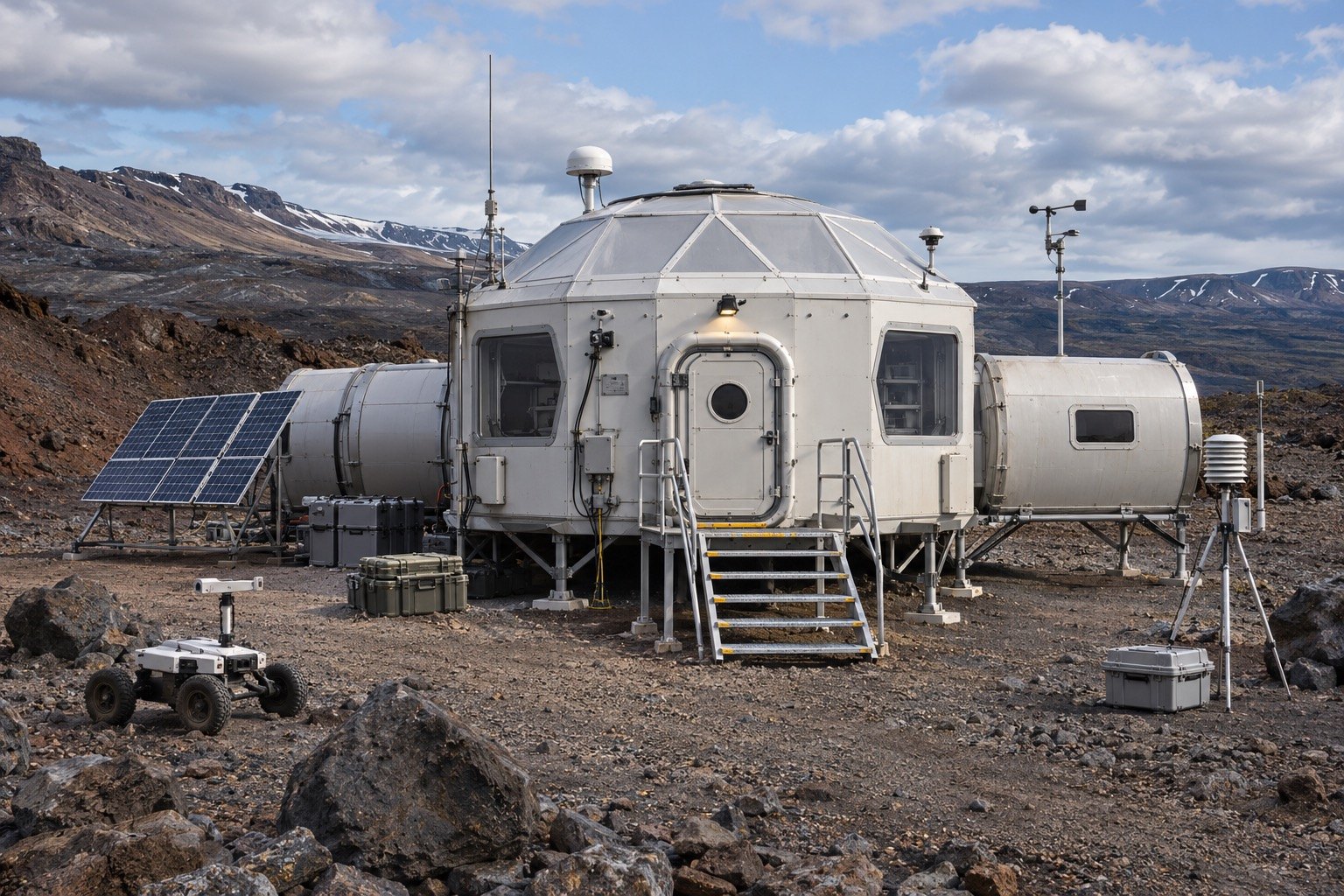
An analog mission is a ground-based mission held where conditions mimic parts of spaceflight, so crew health, performance and procedures can be studied before real flights. ISRO's Human Space Flight Centre (HSFC) runs them for Gaganyaan and the Bharatiya Antariksh Station (BAS). On 26 November 2026 it invited industry to build Mission ANTARIKSH, an Earth-based analog simulation facility.
Syllabus: Prelims · Current Affairs & IR; GS3 · Indian Achievements in S&T; GS3 · IT, Space, Biotech & IPR
Why this matters for UPSC
GS3 science and technology: India's human spaceflight programme and how its crews train on Earth. Prelims can ask what analog missions and neutral buoyancy are; Mains, the BAS roadmap.
In short
An analog mission rehearses parts of human spaceflight on Earth to study crew health, performance and procedures. ISRO's Human Space Flight Centre runs India's, now through Mission ANTARIKSH.
Ground simulators cannot replace orbit, but a well-run analog programme can make India's first station crews safer and its industry ready for human spaceflight.
Why it matters
A Gaganyatri who has already handled a docking or a cabin emergency in a ground module meets fewer surprises in orbit. Analog missions give ISRO data on how Indian crews' bodies and minds respond, and that data shapes the life support, work schedules and medical rules of later flights. A space station asks people to live and work for long spells in a small, sealed space, so isolation, teamwork and stress have to be tested on the ground first. Building the facility through industry also lets Indian firms learn to make and run systems that carry people, a skill the station and a lunar landing will both need.
Prelims pointers
- HSFC's work as ISRO's lead centre for human spaceflight covers crew training, bioastronautics, life support systems, human factors engineering, and human rating and certification.
- Tso Kar Valley in Ladakh was picked for HOPE because its saline permafrost, cold extremes, low air pressure and high UV flux resemble early Mars.
- Human-in-the-loop simulation tests how people operate a system; hardware-in-the-loop simulation tests how real equipment behaves against a simulated environment, with or without people.
- Neutral buoyancy imitates weightlessness but does not remove it: gravity still acts on the body and water adds drag that orbit lacks.
- Gaganyaan, approved in December 2018, aims to fly a crew of three to a 400 km Low Earth Orbit for three days and land them in Indian sea waters.
- Analog missions stay on the ground and study crews; precursor missions under Gaganyaan fly to space to demonstrate and validate technologies for the BAS.
Practise a UPSC-style question
With reference to human spaceflight analog missions, consider the following statements:
1. An analog mission is a ground-based mission in a setting that simulates certain aspects of a human space mission.
2. ISRO's HOPE analog habitat was set up in the Tso Kar Valley of Sikkim.
3. Tso Kar was chosen because its saline permafrost, low air pressure and high UV flux resemble early Mars.
Which of the statements given above is/are correct?
- (a) 1 and 2 only
- (b) 2 and 3 only
- (c) 1 and 3 only
- (d) 1, 2 and 3
Show the answer
Answer: (c) 1 and 3 only
Answer: (c) 1 and 3 only. Statements 1 and 3 hold; statement 2 puts Tso Kar in the wrong region.
Statement 1: correct. ISRO describes analog missions as ground missions in settings that mimic parts of a human space mission, used to study crew health and performance risks.
Statement 2: incorrect. HOPE, the Himalayan Outpost for Planetary Exploration, stood in the Tso Kar Valley of Ladakh in August 2025.
Statement 3: correct. ISRO chose Tso Kar for its early-Mars parallels: saline permafrost, cold extremes, low air pressure and high UV flux.
Eliminate: statement 2 is wrong, since Tso Kar lies in Ladakh. Out: (a), (b), (d).
Trap: Swapped attribution. A real Himalayan analog site is pinned on another Himalayan region, Sikkim, that a student may half-remember.
Remember: HOPE analog mission: Tso Kar Valley, Ladakh, chosen for its likeness to early Mars.
More Explainers
- Didarganj Yakshi and Mauryan art: pillars, capitals, yakshas and the polish National
- E-Waste (Management) Rules, 2022: registration, EPR targets and certificates Environment
- Kyasanur Forest Disease: the tick-borne monkey fever of the Western Ghats Sci-Tech
- Cash transfers and subsidies: what they cost State finances Economy
- India's Tibet policy: Panchsheel, the 1959 asylum and succession World & IR
- Moral rights of authors under Section 57 of the Copyright Act, 1957 Polity
- The Post Office Act, 2023: India's new postal law Polity
- Antiquities and Art Treasures Act, 1972: how India guards and retrieves antiquities National
- AI training vs inference, and what the IndiaAI Mission funds Sci-Tech
- Chandrayaan-5/LUPEX: the ISRO-JAXA lunar polar mission Sci-Tech
- Kalinga's maritime heritage: Boita Bandana and Bali Jatra National
- Eighth Schedule: India's 22 Scheduled Languages Polity