
E-Waste (Management) Rules, 2022: registration, EPR targets and certificates
Why in news: Kerala's Chief Minister declared Wayanad India's first e-waste-free model district on 27 November 2026 after a 102.8-tonne collection drive.
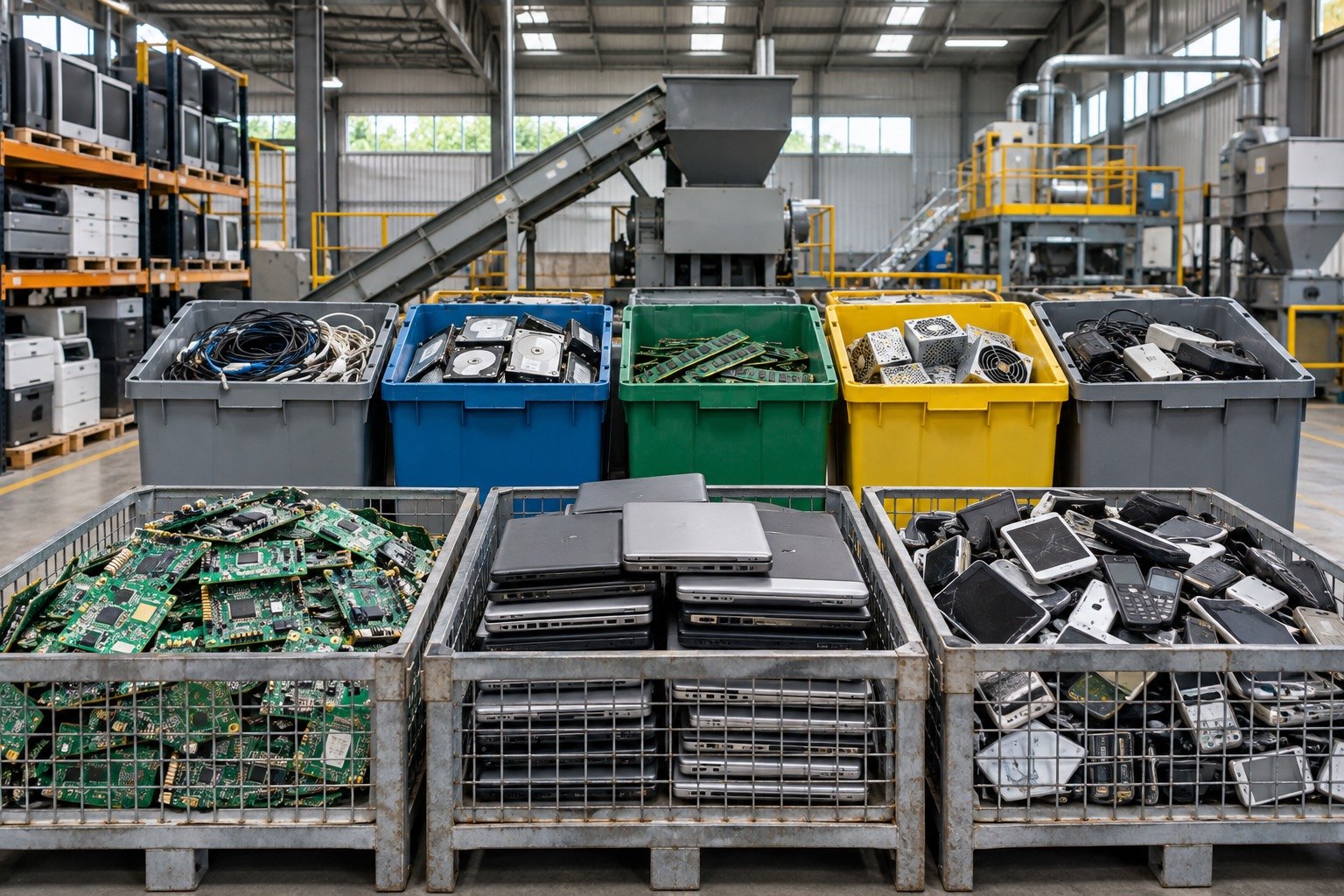
The E-Waste (Management) Rules, 2022 took effect on 1 April 2023, replacing the 2016 Rules. Producers of listed electrical and electronic equipment must register on a Central Pollution Control Board portal and meet yearly recycling targets by buying certificates from registered recyclers. Kerala's Chief Minister declared Wayanad India's first e-waste-free model district on 27 November 2026.
Syllabus: Prelims · Environment & Ecology; GS3 · Environment & Conservation
Why this matters for UPSC
GS3 environment: pollution control law and extended producer responsibility for e-waste. Prelims can ask who registers, what is excluded and how targets work; Mains, the duties of producers and local bodies.
In short
The E-Waste (Management) Rules, 2022 apply extended producer responsibility to electronics: a producer must see that a rising share of what it sells is recycled by registered recyclers.
The Rules make recycling a cost of selling electronics; their worth now rests on honest certificates, active local bodies and a target for solar waste.
Why it matters
A family that hands an old phone to a collection drive relies on a chain the Rules build. The local body gathers it, a registered recycler processes it and earns a certificate, and the phone's maker pays for that certificate to meet its target. A maker that skips the chain pays compensation and still owes the recycling, so the cost of disposal moves from towns to the firms that sell the goods. Recyclers gain steady buyers, and dismantling workers can be recognised, trained and protected by State labour departments. The larger issue is resource recovery: copper, gold and rare earth elements locked in discarded devices are lost when e-waste is not recycled, and toxic substances such as mercury can reach people instead.
Prelims pointers
- Waste batteries are governed by the Battery Waste Management Rules, 2022 and packaging plastics by the Plastic Waste Management Rules, 2016, not by the E-Waste Rules.
- Radioactive wastes stay under the Atomic Energy Act, 1962, and micro enterprises defined by the MSMED Act, 2006 fall outside the E-Waste Rules.
- Under the E-Waste Rules, discarded solar photovoltaic modules, panels and cells are e-waste, but the recycling targets do not apply to them.
- Refurbished equipment must meet the Compulsory Registration Scheme of the Ministry of Electronics and Information Technology and Bureau of Indian Standards norms.
- In each State, the industry department earmarks space for dismantling and recycling units, and the labour department registers and trains their workers.
- The Global E-waste Monitor is published by ITU and UNITAR; its 2024 edition counted 62 million tonnes of e-waste generated worldwide in 2022.
Practise a UPSC-style question
With reference to the E-Waste (Management) Rules, 2022, consider the following statements:
1. The Rules were framed under the Environment (Protection) Act, 1986.
2. The Rules cover waste batteries and packaging plastics along with electrical and electronic equipment.
3. Radioactive wastes are kept outside the Rules and remain under the Atomic Energy Act, 1962.
Which of the statements given above is/are correct?
- (a) 1 and 2 only
- (b) 2 and 3 only
- (c) 1 and 3 only
- (d) 1, 2 and 3
Show the answer
Answer: (c) 1 and 3 only
Answer: (c) 1 and 3 only. The Rules rest on the 1986 Act and leave radioactive waste to atomic energy law.
Statement 1: correct. The Environment Ministry made the Rules using its powers under the Environment (Protection) Act, 1986.
Statement 2: incorrect. Waste batteries fall under the Battery Waste Management Rules, 2022 and packaging plastics under the Plastic Waste Management Rules, 2016.
Statement 3: correct. Radioactive wastes are excluded and governed by the Atomic Energy Act, 1962 and its rules.
Eliminate: Statement 2 is the surest; batteries have their own 2022 Rules. Out: (a), (b), (d).
Trap: Swapped attribution. Batteries and plastics are wastes a student links to e-waste, but separate rules govern each.
Remember: E-waste, batteries and packaging plastics each have their own rules under the 1986 Act.
More Explainers
- Human spaceflight analog missions and crew training on Earth Sci-Tech
- Didarganj Yakshi and Mauryan art: pillars, capitals, yakshas and the polish National
- Kyasanur Forest Disease: the tick-borne monkey fever of the Western Ghats Sci-Tech
- Cash transfers and subsidies: what they cost State finances Economy
- India's Tibet policy: Panchsheel, the 1959 asylum and succession World & IR
- Moral rights of authors under Section 57 of the Copyright Act, 1957 Polity
- The Post Office Act, 2023: India's new postal law Polity
- Antiquities and Art Treasures Act, 1972: how India guards and retrieves antiquities National
- AI training vs inference, and what the IndiaAI Mission funds Sci-Tech
- Chandrayaan-5/LUPEX: the ISRO-JAXA lunar polar mission Sci-Tech
- Kalinga's maritime heritage: Boita Bandana and Bali Jatra National
- Eighth Schedule: India's 22 Scheduled Languages Polity