
Didarganj Yakshi and Mauryan art: pillars, capitals, yakshas and the polish
Why in news: A long read of 28 November 2026 profiled the Bihar Museum, the Yakshi's home, which a German travel guide ranked ninth worldwide.
The Didarganj Yakshi is a life-size sandstone woman holding a chauri, found in 1917 on the Ganga bank at Didarganj in Patna. Its polished finish is shared with Ashoka's pillar capitals, the other face of Mauryan art. The figure is in the news as the Bihar Museum, where it now stands, wins international recognition.
Syllabus: GS1 · Art & Culture; Prelims · History & Culture
Why this matters for UPSC
GS1 Indian culture: Mauryan art, Ashokan pillars and Yaksha images. Prelims asks pillar sites and the Sarnath capital's parts; Mains, royal versus popular art in Mauryan India.
In short
Mauryan art of the third century BCE joined Ashoka's inscribed stone pillars with large polished images of Yakshas, deities of popular worship, such as the Didarganj Yakshi.
The Didarganj Yakshi shows that Mauryan art was not only imperial: popular cults commanded the same polish and skill as Ashoka's pillars.
Why it matters
A student who reads one statue closely learns how a whole age worked. The Yakshi shows that religion in Mauryan India was not one creed handed down by a king. People worshipped Yakshas and mother-goddesses, and the new faiths took those deities into their own monuments instead of erasing them. The pillars show the other side, a ruler using stone and inscriptions to carry his message across his empire. Together they explain why early Indian sacred art mixes royal symbols with popular deities. The same skill on both kinds of work also tells a reader that fine craft was not kept for the palace alone. And because one of these royal capitals became the National Emblem, Mauryan art still shapes how the Indian state presents itself.
Prelims pointers
- Sites of surviving Mauryan pillar capitals: Rampurva, Lauriya-Nandangarh and Basarah-Bakhira (all Bihar); Sarnath and Sankisa (both Uttar Pradesh).
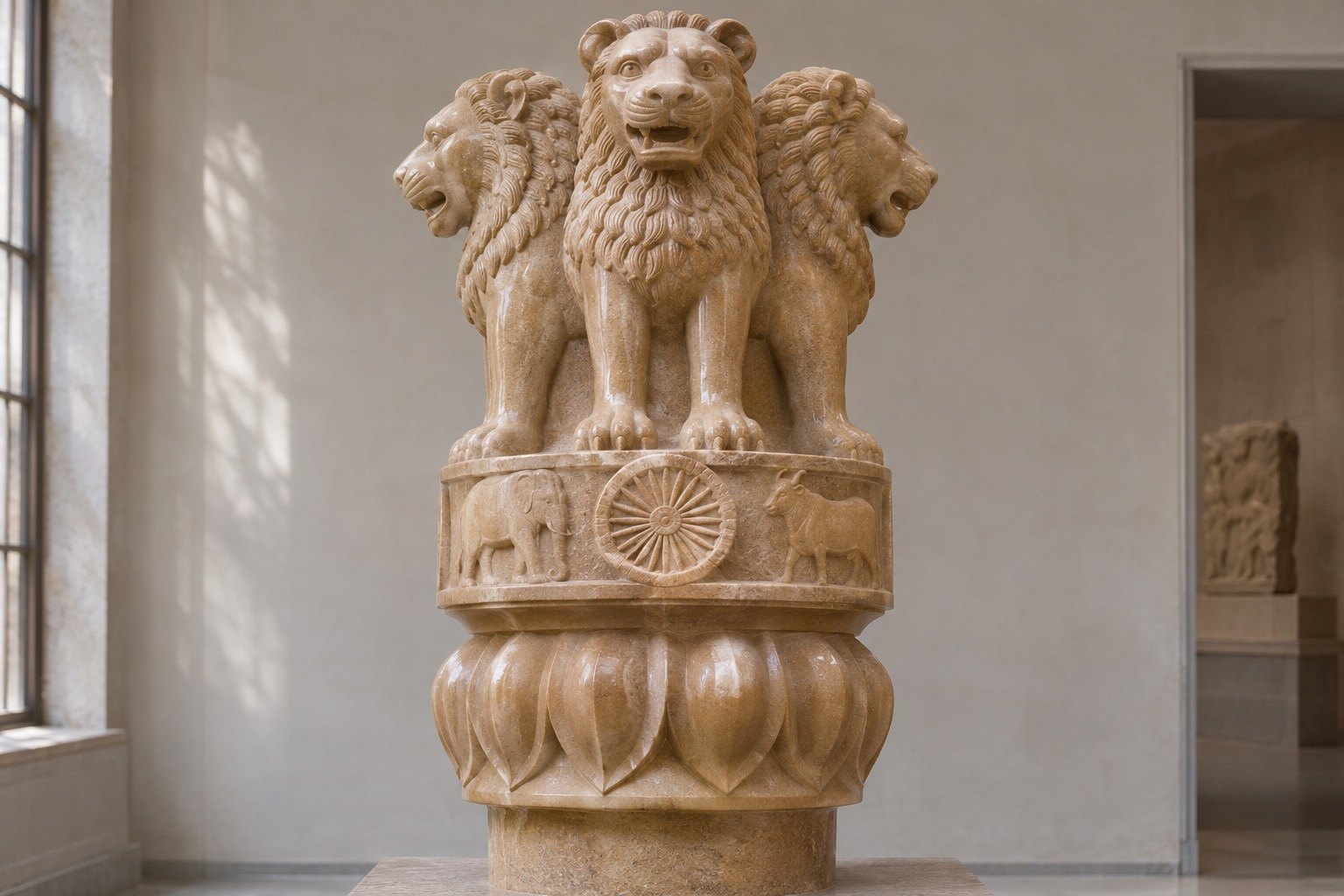
- The Sarnath capital had five parts: shaft, lotus bell base, drum with four animals moving clockwise, four addorsed lions and a crowning wheel.
- Its abacus shows wheels with 24 spokes, and between each pair of wheels a lion, an elephant, a horse or a bull.
- The capital marks the Dhammachakrapravartana and is now housed in Sarnath's archaeological museum, near Varanasi.
- The Sarnath lions show naturalistic carving: strong facial muscles, sharp mane lines following period conventions, and stretched foot muscles bearing their weight.
- Other Mauryan works: a rock-cut elephant with an Ashokan rock edict at Dhauli, Odisha, and a rock-cut cave in the Barabar hills near Gaya, Bihar.
- Large Mauryan Yaksha and Yakshini statues come from Patna, Vidisha and Mathura; most stand upright and have full, rounded faces.
- Sarnath was inscribed on the UNESCO World Heritage List in July 2026 as the Ancient Buddhist Site of Sarnath, per the Ministry of Culture.
Practise a UPSC-style question
With reference to the Sarnath Lion Capital, consider the following statements:
1. Its four lions are seated with their backs together on a square abacus.
2. Its abacus carries wheels of twenty-four spokes, and between them a lion, an elephant, a horse and a bull.
3. It was raised by Ashoka to commemorate the Buddha's first sermon at Sarnath.
Which of the statements given above is/are correct?
- (a) 1 and 2 only
- (b) 2 and 3 only
- (c) 1 and 3 only
- (d) 1, 2 and 3
Show the answer
Answer: (b) 2 and 3 only
Answer: (b) 2 and 3 only. The abacus is circular, not square; the frieze and the purpose are right.
Statement 1: incorrect. NCERT places the four lions, backs together, on an abacus that is circular and rests on an inverted lotus.
Statement 2: correct. The abacus shows a chakra of twenty-four spokes in four directions, and between each pair of wheels a lion, an elephant, a horse or a bull.
Statement 3: correct. Ashoka built the capital to mark the Dhammachakrapravartana, the Buddha's first sermon, at Sarnath.
Eliminate: Statement 1 is wrong because the abacus is circular. Out: (a), (c), (d).
Trap: Near-miss figure. Other Mauryan capitals stand on square or circular abaci, so 'square' sounds plausible for Sarnath too, though its abacus is circular.
Remember: Sarnath capital: four addorsed lions, circular abacus, 24-spoked wheels, four animals.
More Explainers
- Human spaceflight analog missions and crew training on Earth Sci-Tech
- E-Waste (Management) Rules, 2022: registration, EPR targets and certificates Environment
- Kyasanur Forest Disease: the tick-borne monkey fever of the Western Ghats Sci-Tech
- Cash transfers and subsidies: what they cost State finances Economy
- India's Tibet policy: Panchsheel, the 1959 asylum and succession World & IR
- Moral rights of authors under Section 57 of the Copyright Act, 1957 Polity
- The Post Office Act, 2023: India's new postal law Polity
- Antiquities and Art Treasures Act, 1972: how India guards and retrieves antiquities National
- AI training vs inference, and what the IndiaAI Mission funds Sci-Tech
- Chandrayaan-5/LUPEX: the ISRO-JAXA lunar polar mission Sci-Tech
- Kalinga's maritime heritage: Boita Bandana and Bali Jatra National
- Eighth Schedule: India's 22 Scheduled Languages Polity